I've had occasion recently to read through some of this blog's six-plus years of archives. Turns out I used to write about literature! Quite frequently! Ha! It's difficult to imagine having actually written some of those posts—when did I have the time, the energy? When was I thinking about that stuff? Where did it all go? In any case, reading some of those older posts, reading recent blog- and other online sources, engaging in some enjoyable off-blog literary conversations, and, oh yeah, reading a bunch of good fiction, have all helped reinvigorate me just a little bit, to remind me of some of what I might have forgotten. I'm hopeful to get things moving here. Well, hopeful might be too strong a word. We'll see.
To reflect some of this, I've refreshed and jumbled the literary links in my blogroll. Blogs newly added include Danny Byrne's — see his excellent review of the first volume of Karl Ove Knausgaard's marvelous novel/memoir, My Struggle — Daniel Davis Wood's Infinite Patience — his two most recent posts (one, two) are fascinating meditations on the omniscient narrator (which he calls "the knower") in Edward P. Jones remarkable novel from 2003, The Known World — and Ethan's new blog, Marooned Off Vesta, which seeks to "develop [his] own personal poetics of science fiction and of poetry", and which takes as one of its key influences, among other books and authors, the perhaps seemingly unlikely figure of Gabriel Josipovici, in particular his book What Ever Happened to Modernism? (reminder: my review is here). Samuel R. Delany and Joanna Russ are more obvious inspirations, of course, but topics of other posts have included T.S. Eliot and Hart Crane and Denise Levertov. Good stuff. (Also added to the blogroll is David Winters' Why Not Burn Books, which however seems mostly to link to his typically excellent reviews that appear elsewhere - a handy service nonetheless.)
Since I'm providing some literary links, I would be remiss if I didn't mention long-time fellow traveler Stephen Mitchelmore's This Space, still my most essential literary blog. Like me, Stephen's posting has been very light on quantity this year, but unlike me, he's taken the time to write several excellent longer form reviews and essays. His recent essay on one of my favorite books, V.S. Naipaul's The Enigma of Arrival, is a particular highlight, as are reviews of new novels from Josipovici (Infinity: The Story of a Moment) and Enrique Vila-Matas (Dublinesque), as well as his own review of Knausgaard's My Struggle, which, as is so often the case, led directly to my purchase of that book.
And I have been reading a fair amount of fiction lately. If I had to name the authors that have received the most attention (or at least the most attention to which I took enough notice to acquire and/or read a book) in my literary cohort (as defined by people whose blogs I read and twitter feeds I follow), I'd name, in loosely descending order, László Krasznahorkai, Karl Ove Knausgaard, Lars Iyer, Clarice Lispector, Helen DeWitt, Gerald Murnane, Christine Schutt, Enrique Vila-Matas, and Gabriel Josipovici. All with new books, or books newly translated into English.
I've read books by all of these writers this year, except for Krasznahorkai, whose Satantango I have so far been unable to get anywhere with. DeWitt's very funny Lightning Rods I mentioned early in the year; Iyer's even funnier Dogma, ditto. Knausgaard's My Struggle is a great book - I eagerly await the English translation of volume II! - and I'd like to have something interesting to say about it, but there've been several good reviews of it (including especially the two linked above), so I feel no particular need to add another, at least for now. Lispector's first novel, Near to the Wild Heart was one of four newly translated Lispector novels published by New Directions this year, and was also my introduction to the Brazilian writer. It left me with little I could say about it, other than wanting to express a recognition that she was the real deal and that I will be reading more by her (also, in truth, I wasn't writing anything at the time I read it, so the result is that there is, several months on, little now left to report). But some stunning, often baffling writing in that novel. I enjoyed Vila-Matas' Dublinesque, but, again, would refer you to Stephen's review or David Winters'. Gerald Murnane's Barley Patch seemed promising, and I liked quite a bit of what he was doing with it, but ultimately it didn't thrill me, sorry to report. I found myself bored with it, at times (though admittedly sometimes this boredom interested me).
The semi-dullness I experienced at the hands of Barley Patch, followed by a clutch of non-fiction (world-systems analysis and feminism), had me grasping for crime fiction to clear the air a bit. So I read the first two of Patricia Highsmith's Ripley books (The Talented Mr. Ripley and Ripley Under Ground), and the three novels comprising Denise Mina's Garnethill trilogy (Garnethill, Exile, Resolution). I'll have nothing whatsoever to say about these books, except that I found them interesting and entertaining and, especially with the Mina trilogy, sigh, gripping (I know, I know). But they did help clear some space.
Since then, I've been on something of a roll - reading great fiction, reading well, thinking about it, talking about it off-blog - yet struggling to find time or energy to write about it. An enthusiastic, passing mention, in the first Marooned Off Vesta post of Marge Piercy's 1976 feminist science fiction classic, Woman on the Edge of Time, encouraged me to read it immediately. I'd already had a friend's copy lying around gathering dust, and had by coincidence been eye-ing it as a possible next read. And I loved it. My initial sense was that it was formally conventional, that it was the ideas and the situation I was responding to, but as I read further, and discussed it, I began to question this sense. It encouraged me to really think, again, about what we take for granted in fiction.
A review by Dan Green of Diane Williams' new collection of stories ends with a comparison of Williams' work with Gary Lutz's. Next thing I knew, I'd ordered and read Lutz's brilliant and bizarre and fascinating early story collection, Stories in the Worst Way. And in Lutz I've found a new favorite writer (and may have fallen in love a little bit) (see also this fantastic and hilarious interview with Lutz at the Paris Review; on whether the stories in his new collection, Divorcer, are more "accessible": "Even in the lengthier of these new stories, despite their elliptical and fragmentary nature, there is something at least approximating an ongoingness of a sort, if not exactly a plot."). Thinking about Lutz's strange stories while also contemplating certain effects in science fiction was a useful and, for me, helpful exercise of recontextualizaton. Around this time I was reminded, via a twitter exchange, of Christine Schutt, who has a new novel out, Prosperous Friends. I'd previously read and liked her novel Florida, when it had been part of the scandalous class of 2004 National Book Award fiction nominees (that is, they were all books written by women). I was also aware of her name from the Dalkey Archive backlist. Prosperous Friends starts out as if it's going to be merely another entry, if a fantastically written entry, in the tired "dissolution of a marriage" novel genre, but it turned out to be much better and more interesting than that. Incidentally, Lutz, Schutt, and Williams were all edited by Gordon Lish - who now emerges as a rather more interesting figure to me than he had been previously (given his association in my mind with Raymond Carver, who I've never read, nor intend to).
Mixed in here was Josipovici's Infinity - an excellent novel, which I am also not prepared to write about at all, yet. I'd again refer you to Stephen's review (and I'd recommend, too, David Winters' review, at PN Review Online, though it's unfortunately subscription required).
Since then, over the last few weeks, I've been alternating some science fiction from Clifford D. Simak (two novels - Time is the Simplest Thing and Why Call Them Back From Heaven? - which, despite some clunkiness and other issues, have, like the science fiction mentioned above, helped me think about fictional problems in ways I haven't quite before) with multiple novels each from Gilbert Sorrentino (Steelwork and Red the Fiend) and John Hawkes (The Passion Artist), two giants of American post-war so-called post-modernism who I'd read quite a bit of before starting this blog but had not much returned to in subsequent years (long review of Sorrentino's Mulligan Stew notwithstanding). Included here are re-reads of Sorrentino's Aberration of Starlight and Hawkes' The Lime Twig. Early returns are that the fiction of Sorrentino and Hawkes holds up, unlike that of other early favorites, such as Martin Amis.
I've covered a lot of ground here, mentioned a lot of writers. But what about those writers not published at the major houses, or even the already better-known independents? Neither FSG nor New Directions or Dalkey Archive? Not Grove, nor even Melville House? Do we as readers take chances on absolute or relative nobodies? I don’t really have an answer for that. My guess is, on balance, no. But, the thing is, I've left out one writer, in the meandering list above - Edmond Caldwell. Caldwell's Human Wishes/Enemy Combatant is published by Say It With Stones, which primarily publishes poetry. They have it on their website; it retails for $15. It’s a decent-looking trade paperback, with entertaining back-cover copy in the place of blurb, plot summary, and author bio, in keeping with the spirit of the book. Yet I admit that I only know about the book, or took notice of it, because Edmond Caldwell has himself been a member of my blogging/tweeting circle (you may remember him from his blogs Contra James Wood and The Chagall Position). In connection with that, we’d blogrolled each other and linked to each other’s posts on occasion, and have exchanged some friendly e-mail. He was nice enough to send me a copy of the novel. I was already curious about it, but frankly, had little real idea what to expect. I’d gathered it included some material on the critic James Wood and, I admit, this made me a wee bit wary. I’d liked most of what he’d written about Wood’s domestication of various writers and their work, but still, I didn’t feel quite the animus towards Wood and at times wondered at the energy expended in the effort. And, to be honest, whenever Edmond posted a link to one of his stories appearing online, I had difficulty getting very far into them. While I had no trouble attributing this difficulty primarily to my own apparent inability to focus at all on fiction published online, this did little to mitigate my wariness. I admit to having fretted a little about how I'd read a novel by someone I'm friendly with (what I'd say, if asked). And when I received the book and read the apparently bland opening sentence (“They had just returned to the United States.”), I was even less sure … Yet, something nagged at me, a feeling that I’d want to read this novel, despite all of these trivial misgivings.
I needn’t have worried. This is a damn good novel. Better than that: it's fucking brilliant. I should here say that it was Dan Green's review of it that reminded me of the novel, which had slipped my mind and gotten filed away amid the post-move chaos over the summer. But, while Dan's review is positive, I feel he does some violence to the book (Steven Augustine objects on similar grounds as mine in his comments there, and he articulates these objections well). But at least it's a review! There are so few of them, and it very much deserves to be read and reviewed and discussed. I hope to have quite a bit more to say about Human Wishes/Enemy Combatant soon myself, but for now, let it suffice to say that it's frequently very funny, formally interesting, as well as being an excellent example of, horrors, politically viable fiction. I daresay it's an important book. Which I only mean in the best possible sense of: you should read it.
To finish up, were I to name my favorite new books of this year, I'd go with Human Wishes/Enemy Combatant; My Struggle; Dogma; Lightning Rods; and Infinity: The Story of a Moment.
Showing posts with label Gabriel Josipovici. Show all posts
Showing posts with label Gabriel Josipovici. Show all posts
Tuesday, December 04, 2012

Wednesday, May 09, 2012
A World That Has Always Existed
Poetry works on a different level to the novel, and goes much further. The novel accepts the everyday; it narrates it. - Henri Lefebvre, Introduction to ModernityAs part of my ongoing effort to clear out my personal library, I'm currently reading V. S. Naipaul's novel A Bend in the River. Thus far it's been an uneasy read (I've interrupted it twice to read other perfectly fine if inessential books of fiction). Where once I would have simply read the novel without complication, enjoyed the smoothness of his prose, now I'm suspicious, I feel on guard. He's a prickly character, of course, a controversial public figure, often given to making reactionary remarks. And since his books are about places in the world that I've never been to and know relatively little about, I'm wary of the world he narrates. To a large extent, I'm in a position to take his word for it, which is a big part of my unease. His novels (and travel writing, I'd imagine) seem to play a certain role in critically representing parts of the world for a Western audience, telling parts of that audience what it wants to hear about the scary other. At least that's the sense I get from reading some limited criticism about his work. I'm very wary of having Africa narrated to me in this way, and it makes me think about who such books are for.
A Bend in the River is just the third of Naipaul's books for me, after A House for Mr. Biswas and The Enigma of Arrival. The latter is one of my favorite novels, and it strikes me as nothing like the other two. In that book, the narrator is relating, with much uncertainty, those events and thoughts which ultimately resulted him becoming a writer and the person he is. It is altogether wonderful. It is writing, though it's unclear how much of a novel it really is. A House for Mr. Biswas was a kind of sprawling family drama, but perhaps since the story seems closer to Naipaul, it's not so much of a problem (though, admittedly, when I read it I was reading with somewhat different eyes; perhaps a re-read would reveal then-unnoticed issues). Salim, the narrator of A Bend in the River, is there for all sorts of observations about Africa, Africans, modernity, history, politics and political independence, education, and so on. Were the book more fanciful, I wouldn't feel as though I were having some aspect of the real world narrated to me, but it reads like a report, though a smooth one. I feel considerable less wary when Salim simply talks about himself and his own problems; the writing is more interesting in such passages, too. Already halfway through the novel, were I able to discern a plot or point, other than to represent an Africa for the reader, perhaps then I'd feel less overall unease.
Naipaul is Conrad's heir as the annalist of the destinies of empires in the moral sense: what they do to human beings. His authority as a narrator is grounded in his memory of what others have forgotten, the history of the vanquished. - The Swedish Academy, on announcing V.S. Naipaul the winner of the 2001 Nobel Prize in LiteratureSalim's account isn't, on the surface, obviously biased one way or another. It's not as though, at least so far, the novel reads as a statement against African independence, though indeed there are complications to be considered. The Swedish Academy is not wrong to note that Naipaul is attentive, here anyway, to what colonial empires "do to human beings", or to "what others have forgotten, the history of the vanquished". That's here, and not without sympathy. It is interesting, however, that the Academy highlights "[h]is authority as a narrator" in light of this attention. As if writing should necessarily be authoritative. Again, as if a report.
I'm reminded, as I often am, of Gabriel Josipovici and his arguments about modernism. In the chapter, "It Took Talent To Lead Art That Far Astray" in his book What Ever Happened to Modernism? (my review), he discusses contemporary writers who "are concerned with telling a story and telling it in such a way as to make readers feel that they are not reading about a world that has been freshly made but about one that has always existed." One of the passages he provides happens to be from Naipaul's somewhat earlier novel, Guerrillas (1976; A Bend in the River was published in 1979). Now, to be fair, I don't think quoting individual paragraphs out of context, as Josipovici does in that chapter, is a terribly illuminating maneuver (and in the event, it proved to be part of an unfortunate distraction, for many readers, from the book's basic argument), and I will have more to say about that in another post, but the point he's trying to make is an important one, and relevant to my point here. Naipaul's Africa, in A Bend in the River, is narrated as though it has always existed, which encourages us to let it all too easily stand in for the real Africa. This is further exacerbated by the fact that Salim narrates looking back on events, from a seemingly distant, settled future. Yes, Salim observes and reports changes that have happened, but the world he narrates is there, ready, waiting for consumption.
Sunday, October 16, 2011
Follow-up to What Ever Happened to Modernism?, part 1: Shakespeare, Federici, & the devaluation of women
My focus may be shifting somewhat here, but I'm by no means done with literature or blogging about literary matters. Indeed, before moving on, I have some unfinished business to attend to regarding What Ever Happened to Modernism? As long as my essay about that book was, still I had to leave certain topics more or less unaddressed, or less fully explored than I had originally intended. (Isn't it remarkable what we think of as long anymore? As if the essay is anywhere near as long as a full-length essay we'd have read easily prior to the advent of blogs. Fact is, I'm just an amazingly slow writer, so the thing felt interminable. But I digress, even more pointlessly than usual.)
First, having re-read the post a few times, I now wish I had indeed written more about the historical "responses of artists to [the] situation" described by Silvia Federici (for those keeping score at home, I'm referring to the second block quote from Federici in that post, the one that ends with the reference to Rabelais), especially the stuff on Shakespeare I'd ambitiously hoped to include. The title to Federici's Caliban and the Witch, after all, is an explicit reference to The Tempest, a play which is also invoked by Peter Linebaugh and Marcus Rediker in their excellent book, The Many-Headed Hydra, in the opening chapter about the wreck of the Sea-Venture in 1609. They write:
Federici invokes Shakespeare again, in passing, in an extended exploration of the degradation of women that accompanied the transformation of the working class over the course of the 15th to 17th centuries, as part of a process through which women became defined as "non-workers", where any work they did out of the home was now called "housekeeping", and as such devalued, and "[m]arriage was now seen as a woman's true career":
First, having re-read the post a few times, I now wish I had indeed written more about the historical "responses of artists to [the] situation" described by Silvia Federici (for those keeping score at home, I'm referring to the second block quote from Federici in that post, the one that ends with the reference to Rabelais), especially the stuff on Shakespeare I'd ambitiously hoped to include. The title to Federici's Caliban and the Witch, after all, is an explicit reference to The Tempest, a play which is also invoked by Peter Linebaugh and Marcus Rediker in their excellent book, The Many-Headed Hydra, in the opening chapter about the wreck of the Sea-Venture in 1609. They write:
The wreck of the Sea-Venture and the dramas of rebellion that played out among the shipwrecked suggest the major themes of early Atlantic history. These events do not make for a story of English maritime greatness and glory, nor for a tale of the heroic struggle for religious freedom, though sailors and religious radicals both had essential roles. This is, rather, a story about the origins of capitalism and colonization, about world trade and the building of empires. It is also, necessarily, a story about the uprooting and movement of peoples, the making and the transatlantic deployment of "hands". It is a story about exploitation and resistance to exploitation, about how the "sappe of bodies" would be spent. It is a sotry about cooperation among different kinds of people for contrasting purposes of profit and survival. And it is a story about alternative ways of living, and about the official use of violence and terror to deter or destroy them, to overcome popular attachments to "liberty and the fullness of sensuality".No doubt I would have skillfully summarized this material and artfully incorporated it into the essay. Anyway, my point here is not to damn Shakespeare by aligning him with the powerful, but to merely remind us that he was a real person with real interests, living in a specific time and place. In any event, while The Tempest may have "promoted the rising interest of England's ruling class", and indeed Shakespeare's own interests as an investor, the figure of Caliban has long served as a symbol for Latin American rebellion and resistance to colonization. Meanwhile, the figure of Caliban's mother, Sycorax, "the witch", has remained invisible, both in the play and to the revolutionary imagination, Federici says. In Caliban and the Witch, then, Federici places her "at the center-stage, as the embodiment of a world of female subjects that capitalism had to destroy: the heretic, the healer, the disobedient wife, the woman who dared to live alone, the obeha woman who poisoned the master's food and inspired the slaves to revolt."
We are by no means the first to find heroic significance in the story of the Sea-Venture. One of the first—and certainly the most influential—was William Shakespeare, who drew upon firsthand accounts of the wreck in 1610-11 as he wrote his play The Tempest. Shakespeare had long studied the accounts of explorers, traders, and colonizers who were aggressively linking the continents of Europe, Africa, and the Americas through world trade. Moreover, he knew such men personally, and even depended on them for his livelihood. Like many of his patrons and benefactors, such as the Earl of Southampton, Shakespeare himself invested in the Virginia Company, the spearhead of English colonization. His play both described and promoted the rising interest of England's ruling class in the settlement and exploitation of the New World.
Federici invokes Shakespeare again, in passing, in an extended exploration of the degradation of women that accompanied the transformation of the working class over the course of the 15th to 17th centuries, as part of a process through which women became defined as "non-workers", where any work they did out of the home was now called "housekeeping", and as such devalued, and "[m]arriage was now seen as a woman's true career":
This was for women a historic defeat. With their expulsion from the crafts and the devaluation of reproductive labor poverty became feminized, and to enforce men's "primary appropriation" of women's labor, a new patriarchal order was constructed, reducing women to a double dependence: on employers and on men. The fact that unequal power relations between women and men existed even prior to the advent of capitalism, as did a discriminating sexual division of labor, does not detract from this assessment. For in pre-capitalist Europe women's subordination to men had been tempered by the fact that they had access to the commons and other communal assets, while in the new capitalist regime women themselves became the commons, as their work was defined as a natural resource, laying outside the sphere of market relations.Perhaps you can begin to see why I decided not to include this material. Just too much background to cover in order to get to what is really a supplementary point in the course of a review. (There's nothing stopping me here though!) Federici goes on to discuss changes in the family, which
began to separate from the public sphere and acquire its modern connotations as the main centre for the reproduction of the work-force.With these shifts in society, "the insubordination of women and the methods by which they could be 'tamed' were among the main themes in the literature and social policy of the 'transition'." With respect to social relations, "throughout the 16th and 17th centuries, women lost ground in every area of social life" including "a steady erosion of women's rights". Women were attacked and vilified in the popular and intellectual literature of the period:
The counterpart of the market, the instrument for the privatization of social relations and, above all, for the propagation of capitalist discipline and patriarchal rule, the family emerges in the period of primitive accumulation also as the most important institution for the appropriation and concealment of women's labor.
Women were accused of being unreasonable, vain, wild, wasteful. Especially blamed was the female tongue, seen as an instrument of insubordination. But the main female villain was the disobedient wife, who, together with the "scold," the "witch," and the "whore" was the favorite target of dramatists, popular writers, and moralists. In this sense, Shakespeare's The Taming of the Shrew (1593) was the manifesto of the age. The punishment of female insubordination to patriarchal authority was called for and celebrated in countless misogynist plays and tracts. English literature of the Elizabethan and Jacobean period feasted on such themes. Typical of this genre is John Ford's 'Tis a Pity She's a Whore (1633) which ends with the didactic assassination, execution and murder of three of the four female characters. Other classic works concerned with the disciplining of women are John Swetman's (1633) which ends with the didactic assassination, execution and murder of three of the Arraignment of Lewed, Idle, Forward, Inconstant Women (1615); and The Parliament of Women (1646), a satire primarily addressed against middle class women, which portrays them as busy making laws in order to gain supremacy over their husbands. Meanwhile, new laws and new forms of torture were introduced to control women's behavior in and out of the home, confirming that the literary denigration of women expressed a precise political project aiming to strip them of any autonomy and social power. In the Europe of the Age of Reason, the women accused of being scolds were muzzled like dogs and paraded in the streets; prostitutes were whipped, or caged and subjected to fake drownings, while capital punishment was established for women convicted of adultery.No doubt most of this literary output was dreck; it's Shakespeare we remember. It's interesting, though, that it's his play that is dubbed by Federici a "manifesto for the age". Certainly the title seems capable of naming the age and what happened in it. But my admittedly hazy memory of the play has it as rather more playful and ironic about the "taming" attempted and (in the play) provisionally achieved. Perhaps this is one measure of Shakespeare's comparative "responsibility" as an artist? I'm reminded of a passage from Josipovici's chapter on Shakespeare in On Trust. He writes:
Where Marlowe had embraced the new powers given him by the Elizabethan state by placing on that stage men whose power over both their fellows and the audience depended on their rhetoric, men with whom we feel Marlowe the playwright identifies, Shakespeare, more realistic, more responsible, made his plays out of the recognition of the ambiguous nature of play. Marlowe, like Verdi, exults in the ability of the protagonist, through his voice, his speech, his song, to transcend reality, to give body to our desires, and we love him for it and pay to be thus transported. Shakespeare, like Mozart, never forgets the limits of that power as well as its dangerous ambiguity.I was reminded of this passage, it's true, but I also had it readily to hand, since I've had it sitting in a draft post for, literally, more than three years, where I'd also stashed this sentence from “What was Chaucer really up to?”, a review by Josipovici of several Chaucer-related books, which is collected in The Mirror of Criticism:
The responsible artist is the one who is aware of the inevitable failure of all language, its narrow ideological base, and who uses his art to bring this out in the open.The responsible artist. More responsible. I had had some notion, three years ago, of meditating on this idea, exploring its implications in the context of what we mean by the aesthetic, and by political or didactic art. (Perhaps Joanna Russ can help me here. But more on her later.) I didn't get far with it at all. Since that time, I've written a fair amount about the need to situate an artist within his or her political time and place, including the review of What Ever Happened to Modernism? itself ("Literature is not Innocent", I also blogged). But the question of what it means for the artist to be responsible, which may not resemble calls for what the artist should do, has eluded me. Perhaps, though I remain uncomfortable claiming that artists should be expected to do any given thing, it feels accurate to say that a responsible artist manages to avoid merely transmitting (or endorsing) the dominant ideologies of his or her situation, though it seems unavoidable that those will be reflected in the work, in some way. This ambivalence, however slight, perhaps, allows the work to become available to readers or viewers from outside that situation. Shakespeare's Caliban is able to find his audience. Which is probably a good place to end this post. Further examination of the responsibility of the artist will have to wait for another post. As will further follow-ups to the Josipovici review (which follow-ups should actually be more clearly literary in nature than this one ended up being).
Sunday, July 03, 2011
Notes on What Ever Happened to Modernism?
It’s a classic case of "be careful what you wish for". Along with a select few others, I have been writing about the work of Gabriel Josipovici for years, all the while lamenting that he wasn’t more widely read. I imagine that most of us expected more of the same as we anticipated the release of his latest book of criticism, What Ever Happened to Modernism?—the book itself would be up to his typically high standards, but it would sink relatively quickly into oblivion, largely unread or under-reviewed. These expectations were turned upside down when prior to the book’s release a pseudo-interview appeared in the Guardian highlighting some passing remarks Josipovici makes late in the book about such high-profile English writers as Martin Amis, Ian McEwan, and Julian Barnes. The result was a ridiculous controversy, which threatened to overwhelm the book’s arguments. As a result, for good and bad, it turned out that the book was much more widely read and reviewed than most of us anticipated. Reviews continue to trickle in, ranging from the ridiculous (Eliot Weinberger’s clueless review in the New York Review of Books, ably handled by both Stephen Mitchelmore at This Space and the blogger at Grand Hotel Abyss; please also see Stephen’s own unique review of the book, from last October, which in part responded to the early burst of incomprehension) to the excellent (Max Cairnduff’s review at his blog Pechorin’s Journal; incidentally, I think it's no coincidence that the better reviews have appeared at blogs rather than the mainstream journals). Here is mine.
I think the book is just as necessary as Josipovici’s earlier books On Trust, The Book of God, and the collection The Singer on the Shore. In the course of this essay, there are two aspects of the book I would like to devote special attention to. First is the central role played by "the disenchantment of the world". Second is what I think is a perhaps understandable, though real, miscalculation in the last few chapters of the book, chapters which have been given an overwhelming amount of attention by most reviewers, attention which has not served the book well, though, as noted above, it has perhaps attracted new readers (good and bad). Effectively, reviewers have all too often ignored or misunderstood the former, while taking undue offense at the latter.
The bulk of the book is devoted to an exploration of what modernism, for Josipovici, is. His definition, of course, is not the only definition of modernism available to us, which is but one reason for the confusion surrounding the book (for some salient remarks on this point, in this case with respect to James Joyce, see Stephen Mitchelmore's most recent post). For Josipovici it has to do with art's awareness of and response to the condition of being modern, which in part means that the world has become "disenchanted", among other things throwing sensitive artists into a crisis of authority. Allow me to quote from Mark Thwaite's concise description of the problem:
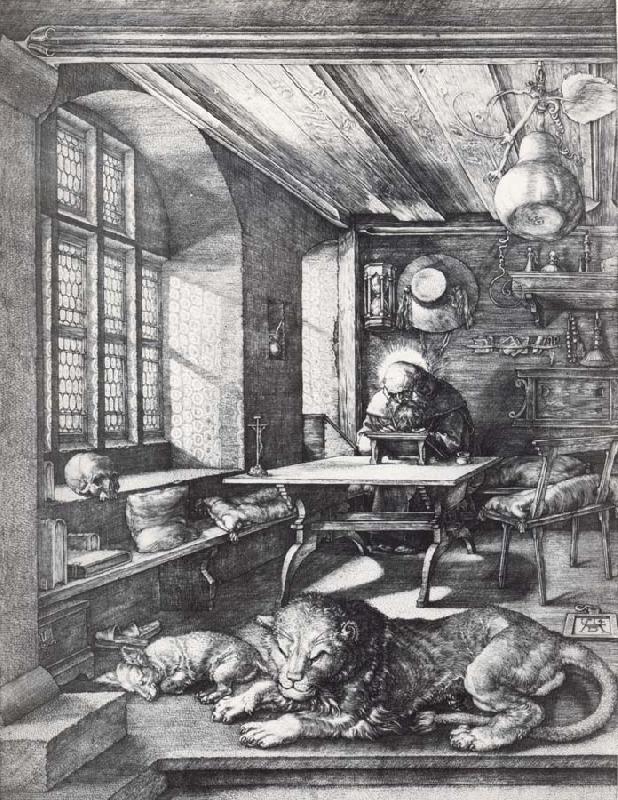
He begins by discussing two Albrecht Dürer engravings from 1514: St. Jerome in his Study and Melancholia. The former, Josipovici writes, depicts the saint as calm, at ease, "bathed in warm sunshine", "at one with himself and with his God as he works". The latter engraving is, by contrast, full of chaos, furious energy, depicting "art in competition with God", Melancolia as "a terrestrial craftsman cut off from all tradition and therefore incapable of productive work". She is inactive "because all work has grown meaningless to her": "St. Jerome shows us what has got lost; Melancolia I what we are left with.” In the following century, this new situation, combined with new possibilities presented by the printing press, is seen as the occasion for comedy for Rabelais and Cerventes. Both writers, in acknowledging the absurdity of writing in isolation for an unknown audience—where in the past storytellers told their tales directly to an audience—undercut the authority of their own narratives, reminding the reader how things really are—remember, after all, this is just a story. Don Quixote
To be blunt, I don't think enough attention has been paid to what Josipovici says about the disenchantment of the world; it is, as Max Cairnduff writes, “absolutely critical to everything that follows”. Reviewers have missed the centrality of this, while also missing the related observation by Josipovici that this disenchantment is generally assumed to be "a Good Thing", "since it led us from an era of superstition to our modern era of common sense and scientific understanding". Which is to say that for Josipovici, as Stephen Mitchelmore emphasizes, it is "not necessarily A Good Thing". This is no small point, yet it is treated as if it were. It is in fact the main point. But how are we to approach this question, from where we sit? It is, admittedly, not easy. I submit that most readers are unlikely to be receptive to this message, and understandably so, since the very structure of our lives seems to argue against it. It is, however, a message I think we need to hear. I'm not going to spend a lot of time on the problem of authority (this is covered to my satisfaction by both Cairnduff and Mitchelmore in the posts I've linked above). I'm instead going to complicate the matter of the disenchantment of the world, but in a way that I hope will help to clarify some of what is at stake.
In The Book of God (1988), his marvelous study of The Bible, Josipovici wrote the following:
But what if we try to look at this period from the standpoint of ordinary people? What if we think of the disenchantment of the world as a very real thing, with events affecting real people, and not simply as an increasing sense "people" had that things were changing? Because the period we're talking about just happens to correspond exactly with the long transition from feudalism to capitalism. It is the period of Karl Polanyi’s “Great Transformation”. The late feudal period was, again from the perspective of ordinary people, marked by elites banding together, by the bourgeoisie and aristocracy putting aside their longstanding differences to defeat the various diverse anti-feudal movements that had characterized the preceding few centuries, which had taken the form of peasant revolts, popular heresy and millenarian movements, not to mention everyday forms of passive resistance, and so on. So, rather than the traditional conception of a smooth or inevitable "transition" from feudalism to capitalism, it is, I think, more accurate to view capitalism as the counter-revolution (just as the United States Constitution is an outgrowth of a counter-revolution, undermining the more popular democratic tendencies of the American Revolution itself). In this light, common people were caught in between the replacement of one form of traditional authority, which they actively (as well as passively) resisted for centuries, and the newer authority imposed by the emergent capitalist social relations and mode of production, which they also actively resisted.
In this context, then, what is the disenchantment of the world? I see it as two related things, always keeping in mind these shifting modes of authority faced by ordinary people. First is the loss of the commons, and all that entails, including access to means of subsistence, control over reproduction, and community life, including festivals, holidays, gossip, mutual care, and resistance. Second, following from the first and no less important, is the disciplining of labor, which provided the backdrop for the philosophical/scientific attack on the body, as in Descartes, and theories of the state, as in Hobbes, which form twin, if occasionally opposed, pillars of our modern scientific and intellectual heritage. Related to both of these is the privatization of religion, or what could be called the "Christianization of the masses"; we know about the inwardness of mainline Protestantism itself (again, Josipovici dwells on this important point in his discussion of Kierkegaard, a writer he also discusses at length in On Trust), but the Catholic confession dates from this period as well—private religious practice being imposed, just as the more communal religious practices are actively being driven out. The Protestant Reformation was in many respects a massive land grab, another significant moment in the general enclosure of the commons. And this is the period of the witch-hunts, which, far from being the irrational attacks from the undifferentiated, ignorant mob of our popular imagination, were instead more or less systematic secular campaigns against common practices and beliefs, primarily those practices and beliefs of women in the areas of reproduction; a campaign, not incidentally, fully supported by some of the biggest names in our scientific legacy.
As Silvia Federici puts it, in her indispensable book, Caliban and the Witch (note: in the next few paragraphs, all quotes are from Federici, unless otherwise specified, but I am informed here by Marx, Polanyi, Peter Linebaugh and Marcus Rediker, Maria Mies, Fernand Braudel, and Giovanni Arrighi, among others):
But we were talking about artists. Despite what some proponents of political art would have us believe, it is not the artist's job to report on political events. Nevertheless, their work is instructive. Dürer’s The Fall of Man (1510), which depicts Adam and Eve being ejected from Eden, can be read as "[evoking] the expulsion of the peasants from their common lands". His Monument to the Vanquished Peasants (1526), following the Peasant War of 1525, could "suggest that the peasants were betrayed or that they themselves should be treated as traitors" and "has been interpreted either as a satire of the rebel peasants or as homage to their moral strength". Dürer was a follower of Luther, and his work is said to have "helped to disseminate the teachings of the Reformation". Luther himself condemned the peasant rebellions; Dürer perhaps agreed, but as an artist saw what he saw, and was able to convey some measure of ambivalence. His version of The Four Horsemen of the Apocalypse was but one example of what was at the time a common artistic theme, which with its Biblical imagery reflected the horrible, very real suffering experienced by very real, ordinary people, who, in a situation of enforced scarcity, were constrained from maintaining their own subsistence in the traditional manner. The first half of the 16th century resulted in "the absolute impoverishment of the European working class, a phenomenon so widespread and general that, by 1550 and long after, workers in Europe were referred to as simply 'the poor'." Meat disappeared from workers’ diets—"a historic setback . . . compared to the abundance of meat that had typified the late Middle Ages." Here is Federici expanding on this point, bringing Rabelais back into our story:
Few people know this history; fewer still look at it from the standpoint of the ordinary people affected by its forward march, though some are sensitive to the difficult problems that history has wrought. We are most of us ordinary people ourselves, who identify all too completely with the winners. So it's probably the case that most anyone reading the book likely does see the disenchantment of the world as a good thing, if they think of it at all. Josipovici quotes the following from a footnote in T.J. Clark's Farewell to an Idea: Episodes from a History of Modernism:
Instead, responses have most often focused on the final two chapters of the book, in which Josipovici turns his attention back to the question raised by the title. What, indeed, ever happened to modernism? Unfortunately, these chapters, while enjoyable reads (large stretches of them are just as fascinating as the rest of the book), are not nearly as successful as the book up to that point, or indeed the rest of his criticism outside of this book. In part this is simply because he mentions several big English literary authors by name (McEwan, Amis, Barnes, etc) without making it clear why they in particular are found wanting. In this way, I think, it has been easy for admirers of those writers to read these passage as attacks. Which is exactly what happened, especially with the very first reactions. For myself, this was the first time in all of his work that I felt he wasn't speaking to me. These two chapters are written, fairly explicitly, to an English audience, with references to "these shores" and the English literary world in particular. At one point, while extolling the virtues of Clark's book, he notes that Clark, by "Writing about episodes in a history",
Related to this is a curious feature common to many of the reviews I've seen, positive and negative. These readers have noticed that Josipovici favors certain writers over others. They've even noticed to some extent what seems to differentiate those writers. Yet, having read the book, they can still do little more than wonder "why can't you like both" kinds of writers? As if two distinct species of writer were being posited. Some have expressed this point with considerable irritation, annoyed that they are being told what to like. They are being told no such thing. It is apparently easy to miss that Josipovici admits that he has enjoyed many of the novels by the authors in question. But he also says that, when he first read such writers, he wondered why they didn't touch him the way other writers did. They were enjoyable, diverting narratives, but he never felt compelled to return to them. It could be said that this disparity has animated his critical career. Anyway, it is not being suggested that readers cannot like whatever they want, just as it is not being asserted that Martin Amis and Ian McEwan are terrible writers. What is, however, being suggested is, first, what characterizes the condition of being modern, and, second, what an appropriate response to that condition might be. In this context, I wonder if it could be argued that Philip Roth is responding appropriately as an American writing after the Second World War. And if not, it seems to me that his response would still need to be situated in that American context (I happen to think this is a potentially fruitful line of inquiry, considering the American tradition of so-called post-modernism, but then I am an American). Of course, as Josipovici readily admits later in the book, these kinds of assessments are necessarily affected by our own personal situation (it is in this context that he admits that the Marxist perspective on Modernism perhaps has a point).
One of the factors leading to the writing of this book was Josipovici's dismay at the adulation showered on Irène Némirovsky's posthumous novel, Suite Française. Written in 1942, and set in the war, the novel would have been old-fashioned at the time, and in its mode is little more than "run-of-the-mill middlebrow narrative", yet was treated as a modern classic when discovered and finally published in 2004. So, in Chapter 14 ("It Took Talent to Lead Art Astray"), Josipovici discusses Némirovsky's novel, comparing it to a novel of similar vintage, also about the war, by Claude Simon. Némirovsky, he says, "is simply unaware of the inappropriateness of what she is doing, and one has to say that by her writing she makes 'a written renunciation to all claim to be an author'." In this case, it is useful to see the excerpts from the two novels, to see what Josipovici is claiming about the approaches taken by the two writers, to see what he means by an "appropriate" response. But, again, his problem is less with Némirovsky, who could only do what she felt was right, but in the out-sized praise her work received:
Towards the end of the book, Josipovici writes that "There cannot, then, be a definitive 'story' of Modernism. We cannot step outside it, much as we would like to, and pronounce with authority on it. We can only try to persuade people to see it from our point of view." His book is just such an attempt at persuasion, though he has been accused of elitism, of smugness (!!), of nostalgia, of snobbery. Rather, I think, he is peculiarly positioned to be able to perceive things many of us cannot, in part because of the details of his biography. In the final paragraph of the book, he allows that his particular affinities "may be largely because of who and what I am". He closes the book like this:
Related posts:
"Smoothness of Surface"
"A world about to be lost"
"The very notion of wholeness"
Notes on "The Bible Open and Closed"
"Modernism against Modernity"
Notes in advance of reading What Ever Happened to Modernism?
Follow-up to this post
Review of In a Hotel Garden
Review in The Quarterly Conversation of Goldberg: Variations (and follow-up)
Review of Everything Passes
I think the book is just as necessary as Josipovici’s earlier books On Trust, The Book of God, and the collection The Singer on the Shore. In the course of this essay, there are two aspects of the book I would like to devote special attention to. First is the central role played by "the disenchantment of the world". Second is what I think is a perhaps understandable, though real, miscalculation in the last few chapters of the book, chapters which have been given an overwhelming amount of attention by most reviewers, attention which has not served the book well, though, as noted above, it has perhaps attracted new readers (good and bad). Effectively, reviewers have all too often ignored or misunderstood the former, while taking undue offense at the latter.
The bulk of the book is devoted to an exploration of what modernism, for Josipovici, is. His definition, of course, is not the only definition of modernism available to us, which is but one reason for the confusion surrounding the book (for some salient remarks on this point, in this case with respect to James Joyce, see Stephen Mitchelmore's most recent post). For Josipovici it has to do with art's awareness of and response to the condition of being modern, which in part means that the world has become "disenchanted", among other things throwing sensitive artists into a crisis of authority. Allow me to quote from Mark Thwaite's concise description of the problem:
In a world that moved from being viewed by the vast majority through a sacramental lens, to one where earthly powers had ever more secular explanations, the problem of authority became a problem for art and artists. Why and in what way did the artist have authority to speak? And how could that question inform the art that the artist produced, so that their work did not exhibit the bad faith of pretending that question away. [...] Do artists seek to re-enchant the world (and who/what gives them authority to do so) or to respond to its disenchantment?How, under such circumstances, can the artist create? For whom does he or she create? Here, then, is Josipovici:
Here the desire, even the need, to create comes to be seen not as a gift but as a curse. For while the desire to create seems to be the most natural thing in the world, something we are all born with, what is it in a world without sure relation to either tradition or authority but a meaningless self-indulgence? When the social trappings of art fall away, when patronage disappears and the artist is forced to compete in the market-place for the sale of his goods, can there be any justification for art other than the desire for money and fame? […] in today's world there is no place for natural, spontaneous creation; everything we do seems false, laboured, second-hand; it feels like padding, pretence, a lie perpetrated by those who like to think of themselves as artists, in collusion with a market which knows that enough people need to feel they are in touch with some higher truth to make the art business profitable.The book opens with a series of quotations from four writers faced with this dilemma, selected by Josipovici from among many possible options to "stand for a century of pain, anxiety and despair", to "stand for what has been called the Crisis of Modernism": Mallarmé ("...each day discouragement overwhelms me..."; "...I am disgusted with my self; ... and cry when I feel myself to be empty and cannot put pen to the implacably white paper"), Hugo von Hofmannsthal ("I have quite lost the faculty to think or speak on any subject in a coherent fashion"; "...the language in which it might perhaps have been given to me not only to write, but also to think, is [...] a language of which I do not know even one word, [...] in which I may once, in my grave, have to account for myself before an unknown judge."), Kafka ("I can't write. I haven't written a single line that I can accept. . ."), and Beckett ("I speak of an art. . .weary of puny exploits, weary of pretending to be able, of being able, of doing a little better the same old thing, of going a little further along a dreary road." "The expression that there is nothing to express, nothing with which to express, nothing from which to express, no power to express, no desire to express, together with the obligation to express.") These quotations all come from the years 1850 to 1950, which is to say the years that are commonly seen as the Modernist period. Josipovici is aware that this makes it all too easy to reinforce the conception of Modernism as a style or period, or both, either way "as something safely behind us", rather than, as he argues, "a coming into awareness by art of its precarious status and responsibilities, and therefore as something that will, from now on, always be with us". This "precariousness" is seen as a condition of being modern; Modernism becomes, then, "a response by artists to the 'disenchantment of the world'". Josipovici then spends several chapters exploring this disenchantment, using the work of several artists and writers as illustrations of the problem and of the array of artistic responses to the problem.
He begins by discussing two Albrecht Dürer engravings from 1514: St. Jerome in his Study and Melancholia. The former, Josipovici writes, depicts the saint as calm, at ease, "bathed in warm sunshine", "at one with himself and with his God as he works". The latter engraving is, by contrast, full of chaos, furious energy, depicting "art in competition with God", Melancolia as "a terrestrial craftsman cut off from all tradition and therefore incapable of productive work". She is inactive "because all work has grown meaningless to her": "St. Jerome shows us what has got lost; Melancolia I what we are left with.” In the following century, this new situation, combined with new possibilities presented by the printing press, is seen as the occasion for comedy for Rabelais and Cerventes. Both writers, in acknowledging the absurdity of writing in isolation for an unknown audience—where in the past storytellers told their tales directly to an audience—undercut the authority of their own narratives, reminding the reader how things really are—remember, after all, this is just a story. Don Quixote

dramatises the way we as readers collude in this game because we want, for the duration of our reading, to be part of a realised world, a world full of meaning and adventure, an enchanted world. It is no coincidence that the novel emerges at the very moment the world is growing disenchanted.Somewhat later we have another important example in Laurence Sterne’s Tristram Shandy (not discussed in the book, though Josipovici has written about it elsewhere), in which the narrator hilariously never quite gets around to getting moving on telling the story of his life. Several key pages are spent on the poetry of Wordsworth (many reviews have indeed taken note of the unique presence of this poet in a book on Modernism) and the philosophical works of Kierkegaard, in particular in connection with problems of authority, anxiety, and inward-looking religious practice.
To be blunt, I don't think enough attention has been paid to what Josipovici says about the disenchantment of the world; it is, as Max Cairnduff writes, “absolutely critical to everything that follows”. Reviewers have missed the centrality of this, while also missing the related observation by Josipovici that this disenchantment is generally assumed to be "a Good Thing", "since it led us from an era of superstition to our modern era of common sense and scientific understanding". Which is to say that for Josipovici, as Stephen Mitchelmore emphasizes, it is "not necessarily A Good Thing". This is no small point, yet it is treated as if it were. It is in fact the main point. But how are we to approach this question, from where we sit? It is, admittedly, not easy. I submit that most readers are unlikely to be receptive to this message, and understandably so, since the very structure of our lives seems to argue against it. It is, however, a message I think we need to hear. I'm not going to spend a lot of time on the problem of authority (this is covered to my satisfaction by both Cairnduff and Mitchelmore in the posts I've linked above). I'm instead going to complicate the matter of the disenchantment of the world, but in a way that I hope will help to clarify some of what is at stake.
In The Book of God (1988), his marvelous study of The Bible, Josipovici wrote the following:
. . . once Luther stood up and asserted the need to speak the truth as he saw it and not pay lip-service to tradition, things could never be quite the same again. We tend to see Luther's break with the medieval church, like Spinoza's with Jewish tradition, as the triumph of light and integrity over the forces of obscurantism and hypocrisy; but this is to see it from their own point of view. It is important, however, to grasp what gets lost as well as what is won in such revolutions. . .Our point of view, or what feminists call standpoint, can be an obstacle; further, we can learn a lot by considering matters from alternative standpoints, especially those that are underrepresented in official histories. We view these events, respectively, from Luther’s and Spinoza’s perspectives—we see them as signposts, if you will, on the way to our current secular world, a world, in its modernity anyway, that most of us see as desirable and inevitable, if perhaps besieged. We identify with the smug self-congratulation of the Age of Reason and the Enlightenment—the very labels tell us how to think about them!—and all too rarely do we consider what was lost, or if we do, we are rarely likely to consider that what was lost is worth worrying about or mourning. Josipovici, along with other critics and writers, has looked past this point of view, to consider the perspectives of artists. And indeed artists can and do offer us glimpses into changes that took place, worlds that were lost. But they do it from their own standpoint, which is a standpoint often at some remove from the events. For when we look at this period from the standpoint of artists, we are necessarily also looking at it also (but not completely) from the standpoint of the elite, or an elite, for in this period artists were either themselves elites, or at least patronized by elites, whether aristocratic, clerical, or bourgeois. So when we think of the declining of traditional authority, we are thinking of not only the Catholic Church, but also the feudal lords. In their place, eventually, are the various Protestant churches, and the bourgeoisie. This was a long process, covering almost the entire period under discussion, in one way or another.
But what if we try to look at this period from the standpoint of ordinary people? What if we think of the disenchantment of the world as a very real thing, with events affecting real people, and not simply as an increasing sense "people" had that things were changing? Because the period we're talking about just happens to correspond exactly with the long transition from feudalism to capitalism. It is the period of Karl Polanyi’s “Great Transformation”. The late feudal period was, again from the perspective of ordinary people, marked by elites banding together, by the bourgeoisie and aristocracy putting aside their longstanding differences to defeat the various diverse anti-feudal movements that had characterized the preceding few centuries, which had taken the form of peasant revolts, popular heresy and millenarian movements, not to mention everyday forms of passive resistance, and so on. So, rather than the traditional conception of a smooth or inevitable "transition" from feudalism to capitalism, it is, I think, more accurate to view capitalism as the counter-revolution (just as the United States Constitution is an outgrowth of a counter-revolution, undermining the more popular democratic tendencies of the American Revolution itself). In this light, common people were caught in between the replacement of one form of traditional authority, which they actively (as well as passively) resisted for centuries, and the newer authority imposed by the emergent capitalist social relations and mode of production, which they also actively resisted.
In this context, then, what is the disenchantment of the world? I see it as two related things, always keeping in mind these shifting modes of authority faced by ordinary people. First is the loss of the commons, and all that entails, including access to means of subsistence, control over reproduction, and community life, including festivals, holidays, gossip, mutual care, and resistance. Second, following from the first and no less important, is the disciplining of labor, which provided the backdrop for the philosophical/scientific attack on the body, as in Descartes, and theories of the state, as in Hobbes, which form twin, if occasionally opposed, pillars of our modern scientific and intellectual heritage. Related to both of these is the privatization of religion, or what could be called the "Christianization of the masses"; we know about the inwardness of mainline Protestantism itself (again, Josipovici dwells on this important point in his discussion of Kierkegaard, a writer he also discusses at length in On Trust), but the Catholic confession dates from this period as well—private religious practice being imposed, just as the more communal religious practices are actively being driven out. The Protestant Reformation was in many respects a massive land grab, another significant moment in the general enclosure of the commons. And this is the period of the witch-hunts, which, far from being the irrational attacks from the undifferentiated, ignorant mob of our popular imagination, were instead more or less systematic secular campaigns against common practices and beliefs, primarily those practices and beliefs of women in the areas of reproduction; a campaign, not incidentally, fully supported by some of the biggest names in our scientific legacy.
As Silvia Federici puts it, in her indispensable book, Caliban and the Witch (note: in the next few paragraphs, all quotes are from Federici, unless otherwise specified, but I am informed here by Marx, Polanyi, Peter Linebaugh and Marcus Rediker, Maria Mies, Fernand Braudel, and Giovanni Arrighi, among others):
What died was the concept of the body as a receptacle of magical powers that had prevailed in the medieval world. In reality, it was destroyed. For in the background of the new philosophy we find a vast initiative by the state, whereby what the philosophers classified as "irrational" was branded as crime.[...] "Knowledge" can only become "power" if it can enforce its prescriptions. This means that the mechanical body, the body-machine, could not have become a model of social behavior without the destruction by the state of a vast range of pre-capitalist beliefs, practices, and social subjects whose existence contradicted the regularization of corporeal behavior promised by Mechanical Philosophy. [...] This is how we must read the attack against witchcraft and against that magical view of the world which, despite the efforts of the Church, had continued to prevail on a popular level through the Middle Ages. [...] Eradicating these practices was a necessary condition for the capitalist rationalization of work, since magic appeared as an illicit form of power and an instrument to obtain what one wanted without work, that is, a refusal of work in action.[...] Magic, moreover, rested upon a qualitative conception of space and time that precluded a regularization of the labor process. [...] From [the ruling class's] viewpoint it hardly mattered whether the powers that people claimed to have, or aspired to have, were real or not, for the very existence of magical beliefs was a source of social insubordination. [Note: the above has been collapsed into one paragraph, with elisions bracketed off, in order to save space; emphasis is in the original]This is the disenchantment of the world, and it is, in my opinion, undeniably a tragedy, a regrettable loss, one very much worth mourning. This is not at all popular view in the mainstream, but neither is it popular among leftists or Marxists, who seem just as wedded to the telos of progress as any liberal or capitalist, and who are generally more than happy to consign to the dustbin of history the "rural idiocies" of those ignorant masses dispossessed in this period of "so-called primitive accumulation". Indeed, one of the better reviews of What Ever Happened to Modernism? was by Tim Black at Spiked. Black’s review is from a largely Marxist perspective, and though he calls the book "important" (and actually offers an interesting defense of realism), he also calls it "irritating" and "reactionary". For another recent example of this general attitude, in his book First As Tragedy, Then As Farce, Slavoj Žižek wrote "if there is one good thing about capitalism, it is that, precisely, mother earth now no longer exists" and "we should remain resolutely modern and reject the all too glib generalization whereby critique of capitalism morphs into the critique of 'instrumental reason' or 'modern technological civilization'. " No one who seriously considers the history of capitalism from the perspective of not only what actually happened to those people who were expropriated in the past, but also what is happening to those who are being expropriated today, still, in the same ways, but in different places, can so easily dismiss such "morphed" critiques.
But we were talking about artists. Despite what some proponents of political art would have us believe, it is not the artist's job to report on political events. Nevertheless, their work is instructive. Dürer’s The Fall of Man (1510), which depicts Adam and Eve being ejected from Eden, can be read as "[evoking] the expulsion of the peasants from their common lands". His Monument to the Vanquished Peasants (1526), following the Peasant War of 1525, could "suggest that the peasants were betrayed or that they themselves should be treated as traitors" and "has been interpreted either as a satire of the rebel peasants or as homage to their moral strength". Dürer was a follower of Luther, and his work is said to have "helped to disseminate the teachings of the Reformation". Luther himself condemned the peasant rebellions; Dürer perhaps agreed, but as an artist saw what he saw, and was able to convey some measure of ambivalence. His version of The Four Horsemen of the Apocalypse was but one example of what was at the time a common artistic theme, which with its Biblical imagery reflected the horrible, very real suffering experienced by very real, ordinary people, who, in a situation of enforced scarcity, were constrained from maintaining their own subsistence in the traditional manner. The first half of the 16th century resulted in "the absolute impoverishment of the European working class, a phenomenon so widespread and general that, by 1550 and long after, workers in Europe were referred to as simply 'the poor'." Meat disappeared from workers’ diets—"a historic setback . . . compared to the abundance of meat that had typified the late Middle Ages." Here is Federici expanding on this point, bringing Rabelais back into our story:
Not only did meat disappear, but food shortages became common, aggravated in times of harvest failure, when the scanty grain reserves sent the price of grain sky-high, condemning city dwellers to starvation. This is what occurred in the famine years of the 1540s and 1550s, and again in the decades of the 1580s and 1590s, which were some of the worst in the history of the European proletariat, coinciding with widespread unrest and a record number of witch-trials. But malnutrition was rampant also in normal times, so that food acquired a high symbolic value as a marker of rank. The desire for it among the poor reached epic proportions, inspiring dreams of Pantagruelian orgies, like those described by Rabelais in his Gargantua and Pantagruel (1552), and causing nightmarish obsessions, such as the conviction (spread among north-eastern Italian farmers) that witches roamed the countryside at night to feed upon the cattle.Allow me to leave here my detour into this working class history. I'd planned on delving more into the responses of artists to this situation, with a special emphasis on Shakespeare (including a digression into Josipovici's use of the work of the medieval historian Peter Brown in his elucidation of Richard II in On Trust; for this, let me instead refer the reader to my piece, "A world about to be lost"), but I believe I've said enough. My point, I think, is sufficiently made.
Few people know this history; fewer still look at it from the standpoint of the ordinary people affected by its forward march, though some are sensitive to the difficult problems that history has wrought. We are most of us ordinary people ourselves, who identify all too completely with the winners. So it's probably the case that most anyone reading the book likely does see the disenchantment of the world as a good thing, if they think of it at all. Josipovici quotes the following from a footnote in T.J. Clark's Farewell to an Idea: Episodes from a History of Modernism:
I realize that I shall be taken here and elsewhere to be idealizing pre-modern society, and inventing a previous watertight world of myth and ritual, agreed-on hierarchies, implicit understandings, embodied places, and so on. There is no easy way out of this dilemma. Of course pre-Modern societies (and certainly the ones existing in Europe immediately before the spread of mercantile capitalism and the seventeenth-century crisis) were conflicted and ideologically incomplete. I am on the side of historians who have fought against the picture of a pre-modern Europe characterised by absolute cultural uniformity, immovable religious consensus, the unthinkability of alternative views of the world, etc. Nonetheless, if we do not make a distinction between societies built, however inefficiently, upon instanced and incorporated belief, with distinctions and places said to be inherited from time immemorial, and societies driven by a new kind of economic imperative, in which place and belief are subject to constant revision by the very forces that give society form, then I reckon we forfeit the chance of thinking critically about the past two hundred years. To call such comparative thinking 'nostalgia' (or in the present techno-ecstatic conjuncture, 'Luddism') is just the latest form of philistinism about history in general.As such, the book is fighting an uphill battle, and not just against philistinism. To the extent that reviewers have addressed the matter at all, nostalgia is indeed usually the charge (regardless of explicit attempts to anticipate and forestall such a charge).
Instead, responses have most often focused on the final two chapters of the book, in which Josipovici turns his attention back to the question raised by the title. What, indeed, ever happened to modernism? Unfortunately, these chapters, while enjoyable reads (large stretches of them are just as fascinating as the rest of the book), are not nearly as successful as the book up to that point, or indeed the rest of his criticism outside of this book. In part this is simply because he mentions several big English literary authors by name (McEwan, Amis, Barnes, etc) without making it clear why they in particular are found wanting. In this way, I think, it has been easy for admirers of those writers to read these passage as attacks. Which is exactly what happened, especially with the very first reactions. For myself, this was the first time in all of his work that I felt he wasn't speaking to me. These two chapters are written, fairly explicitly, to an English audience, with references to "these shores" and the English literary world in particular. At one point, while extolling the virtues of Clark's book, he notes that Clark, by "Writing about episodes in a history",
is free to explore a whole web of stories rather than trace any linear sequence, and thus restore a sense of history being made—by artists, by events—rather than simply lived out, that the blind alleys down which artists have gone at certain periods of their lives are as important as their achieved successes, and that different responses are called for in pre-First World War France, in post-Revolutionary Russia and in America after the Second World War.I like this a lot, and I especially like the bit about blind alleys (I'm always thinking artists' minor or lesser works are too easily dismissed in this culture because we are impatient to move on to the next book or album or mp3 file). But I'm thrown, just a little, but the clause about the need for different responses. Not because it strikes me as wrong (it does not), but because in the previous chapter, one of the examples he uses of a writer who we read "to pass the time, to reassure ourselves that the world has meaning, and then . . . leave . . . and move on to the next book", is the American Philip Roth. He subsequently spends more time (though still not much) on Roth than he does on any other contemporary writer, because Roth has a reputation for being playful and "experimental", and Josipovici senses that his readers will have mistaken his book as an extended argument for experimental art—"Is that not what Modernism is about?" No, it is not: "If that is your reaction you have not really been taking in what I have been saying." It's clear enough to me, a longtime reader, that Josipovici has not equated Modernism with experimental art, but it's not difficult to imagine it not being clear to readers unfamiliar with his argument from his other work, given the general sense of Modernism as indeed being about experiment and innovation (on the other hand, does anyone really think of Kafka as an experimental writer?). Frankly, his remarks about the big shot contemporary writers are not terribly persuasive (even though I agree with most of them).
Related to this is a curious feature common to many of the reviews I've seen, positive and negative. These readers have noticed that Josipovici favors certain writers over others. They've even noticed to some extent what seems to differentiate those writers. Yet, having read the book, they can still do little more than wonder "why can't you like both" kinds of writers? As if two distinct species of writer were being posited. Some have expressed this point with considerable irritation, annoyed that they are being told what to like. They are being told no such thing. It is apparently easy to miss that Josipovici admits that he has enjoyed many of the novels by the authors in question. But he also says that, when he first read such writers, he wondered why they didn't touch him the way other writers did. They were enjoyable, diverting narratives, but he never felt compelled to return to them. It could be said that this disparity has animated his critical career. Anyway, it is not being suggested that readers cannot like whatever they want, just as it is not being asserted that Martin Amis and Ian McEwan are terrible writers. What is, however, being suggested is, first, what characterizes the condition of being modern, and, second, what an appropriate response to that condition might be. In this context, I wonder if it could be argued that Philip Roth is responding appropriately as an American writing after the Second World War. And if not, it seems to me that his response would still need to be situated in that American context (I happen to think this is a potentially fruitful line of inquiry, considering the American tradition of so-called post-modernism, but then I am an American). Of course, as Josipovici readily admits later in the book, these kinds of assessments are necessarily affected by our own personal situation (it is in this context that he admits that the Marxist perspective on Modernism perhaps has a point).
One of the factors leading to the writing of this book was Josipovici's dismay at the adulation showered on Irène Némirovsky's posthumous novel, Suite Française. Written in 1942, and set in the war, the novel would have been old-fashioned at the time, and in its mode is little more than "run-of-the-mill middlebrow narrative", yet was treated as a modern classic when discovered and finally published in 2004. So, in Chapter 14 ("It Took Talent to Lead Art Astray"), Josipovici discusses Némirovsky's novel, comparing it to a novel of similar vintage, also about the war, by Claude Simon. Némirovsky, he says, "is simply unaware of the inappropriateness of what she is doing, and one has to say that by her writing she makes 'a written renunciation to all claim to be an author'." In this case, it is useful to see the excerpts from the two novels, to see what Josipovici is claiming about the approaches taken by the two writers, to see what he means by an "appropriate" response. But, again, his problem is less with Némirovsky, who could only do what she felt was right, but in the out-sized praise her work received:
[T]he question is not why she should have written as she did, but what has happened to our culture that serious and intelligent and well-read reviewers, not to speak of prize-winnings novelists and distinguished biographers, many of whom have studied the poems of Eliot or the novels of Virginia Woolf at university, should so betray their calling as to go into ecstasies over books like Némirovsky's while, in their lifetimes and now after their deaths, ignoring the work of novelists like Claude Simon, Georges Perec, Thomas Bernhard and Gert Hofmann.This, then, is a fuller expression of the question asked by the title. But in the very next paragraph he admits that "To answer this would require a sociologist, perhaps, and another book." He is not really in a position to answer the question. It could be said that the book itself intends to raise the question rather than to answer it. Well, one can almost hear it being said (indeed, Weinberger says it with much annoyance), if he's not going to answer the question, what is the point? The point, I think, is that some questions need to be sensitively and intelligently posed before they can be answered. That is, since the disenchantment of the world is a general cultural problem, the question raised by the title cannot be answered via literary criticism alone, or through art history.
Towards the end of the book, Josipovici writes that "There cannot, then, be a definitive 'story' of Modernism. We cannot step outside it, much as we would like to, and pronounce with authority on it. We can only try to persuade people to see it from our point of view." His book is just such an attempt at persuasion, though he has been accused of elitism, of smugness (!!), of nostalgia, of snobbery. Rather, I think, he is peculiarly positioned to be able to perceive things many of us cannot, in part because of the details of his biography. In the final paragraph of the book, he allows that his particular affinities "may be largely because of who and what I am". He closes the book like this:
The late R.B. Kitaj compared Cézanne's rootedness in his native Provence to what he called the 'diasporist' ... imagination of the uprooted Picasso, and he suggested that at some deep level Modernism and the diasporist imagination go together. This may be true if we have a flexible enough notion of disapora to accept that an apparently rooted Frenchman like Bonnard or Englishwoman like Virginia Woolf could also have created a 'diasporic' art—and then one would want to look at Bonnard's relocation to the South of France in the latter part of his life as a kind of exile in which he went with his problematic wife, and at Virginia Woolf's sense of herself as a woman excluded from a male-dominated society. To that extent the Marxist critique of Modernism I mentioned at the start may have a point: Modernism may not be a consequence of the crisis of the bourgeoisie but it may be the product of a general European rootlessness in the wake of the French and Industrial revolutions. All will then depend on whether we see such rootlessness as pathological or as giving those who are imbued with it a certain vantage point, allowing them to see things which might otherwise have remained hidden. In other words, are we to see our own history, that which makes us what we are, as something which blinkers us or which sharpens our vision. This is, in itself, of course, a very Modernist question.For all that Josipovici is advancing a particular perspective, he leaves it up to us to see for ourselves. Can it not be said that each of us is potentially our own diaspora? We have been fragmented, dispersed, alienated. We constitute a working class massive, but identify all too much with the very power that destroyed the history described above and seems unable to avoid destroying everything it touches, on the way alienating us from not only our own labor, but our very existences, though some of us, not only artists, are afforded glimpses of other possibilities and are receptive to art that suggests such possibilities, and otherwise questions and breathes. This is why all of this matters, and why Modernism continues to speak to us, through the din of received histories and imperial narratives, fictional or otherwise, and why we need critics like Gabriel Josipovici.
Related posts:
"Smoothness of Surface"
"A world about to be lost"
"The very notion of wholeness"
Notes on "The Bible Open and Closed"
"Modernism against Modernity"
Notes in advance of reading What Ever Happened to Modernism?
Follow-up to this post
Review of In a Hotel Garden
Review in The Quarterly Conversation of Goldberg: Variations (and follow-up)
Review of Everything Passes
Monday, February 28, 2011
Scattered thoughts on children and learning; or: "children are born to philosophize"
Children and how they learn is a subject much on my mind of late. Play being of the utmost importance. (Piaget looms in the background, inevitably.)
We've received a book by Vivian Gussin Paley called A Child's Work: The Importance of Fantasy Play. I've only just begun it, but it's got me thinking. The ways in which children use fantasy in order to explore certain issues, in order to become who they are, reminds me of what Chris Knight and his colleagues have said and written about the human revolution. Very loosely, how in a sense the ability to make believe is what makes us human. Language being the ability to use symbols that are not in fact what they refer to. The ability to hold ideas in our minds, which are in a sense, fantasies.
It is in this context, among others, that I've often felt, though I remain an atheist, that the so-called rational drive to ridicule or eradicate religious belief is remarkably misguided.
Which reminds me of something Sarah Blaffer Hrdy wrote towards the end of her book Mothers and Others: The Evolutionary Origins of Mutual Understanding, about epigenetics, in which she wondered, speculated, at the possibility that those of our genes that have evolved enabling us to understand each other, and cooperate, both being necessary components of our becoming human, might at some point stop being "expressed", given the drastically changed and changing environment in which they have to operate on us, or to emerge. Which makes me double-back and think of our closed-off spaces, the unavailability of room for children to roam; and the current testing mania, teaching to the test, No Child Left Behind. How misguided, short-sighted, unsupportable it all is.
And the emphasis on play further reminds me of Gabriel Josipovici's work, and I think that literature is not a trivial matter, though we treat it like it is, though at the same time we nonetheless take it too seriously, too solemnly, when we take it at all, and that the best of it so often seems to embody a sense of play. The plays within plays of Shakespeare. The playfulness of Beckett and of Kafka (both all too often seen as dour). Kafka's work, and Borges', not unlike fables in their own way, in a sense, not unlike tales told by children, without the self-importance of literariness. . .
And just the other day, Skholiast noted the passing of two philosophers, J.T. Fraser and Matthew Lipman, only the former of which I'd ever heard, which means nothing. Both seem interesting, but Lipman is most pertinent here. "Frustrated by the apparent incapacity of college students to engage in critical thinking", he, among other things, wrote a series of novels aimed at pre-teens, intended, I gather, to explore philosophical topics. I love how Skholiast ends his post: "as a teacher of school-children I can confirm what probably ought to be obvious to anyone who thinks about it: children are born to philosophize, and what's more, ask far more ambitious questions than most grad students."
And I think, not for the first time, with some despair, that all of the elements are available, are accessible, for us to be better, but we seem bound and determined not to attend to what we know. We really don't know what we're doing, do we?
We've received a book by Vivian Gussin Paley called A Child's Work: The Importance of Fantasy Play. I've only just begun it, but it's got me thinking. The ways in which children use fantasy in order to explore certain issues, in order to become who they are, reminds me of what Chris Knight and his colleagues have said and written about the human revolution. Very loosely, how in a sense the ability to make believe is what makes us human. Language being the ability to use symbols that are not in fact what they refer to. The ability to hold ideas in our minds, which are in a sense, fantasies.
It is in this context, among others, that I've often felt, though I remain an atheist, that the so-called rational drive to ridicule or eradicate religious belief is remarkably misguided.
Which reminds me of something Sarah Blaffer Hrdy wrote towards the end of her book Mothers and Others: The Evolutionary Origins of Mutual Understanding, about epigenetics, in which she wondered, speculated, at the possibility that those of our genes that have evolved enabling us to understand each other, and cooperate, both being necessary components of our becoming human, might at some point stop being "expressed", given the drastically changed and changing environment in which they have to operate on us, or to emerge. Which makes me double-back and think of our closed-off spaces, the unavailability of room for children to roam; and the current testing mania, teaching to the test, No Child Left Behind. How misguided, short-sighted, unsupportable it all is.
And the emphasis on play further reminds me of Gabriel Josipovici's work, and I think that literature is not a trivial matter, though we treat it like it is, though at the same time we nonetheless take it too seriously, too solemnly, when we take it at all, and that the best of it so often seems to embody a sense of play. The plays within plays of Shakespeare. The playfulness of Beckett and of Kafka (both all too often seen as dour). Kafka's work, and Borges', not unlike fables in their own way, in a sense, not unlike tales told by children, without the self-importance of literariness. . .
And just the other day, Skholiast noted the passing of two philosophers, J.T. Fraser and Matthew Lipman, only the former of which I'd ever heard, which means nothing. Both seem interesting, but Lipman is most pertinent here. "Frustrated by the apparent incapacity of college students to engage in critical thinking", he, among other things, wrote a series of novels aimed at pre-teens, intended, I gather, to explore philosophical topics. I love how Skholiast ends his post: "as a teacher of school-children I can confirm what probably ought to be obvious to anyone who thinks about it: children are born to philosophize, and what's more, ask far more ambitious questions than most grad students."
And I think, not for the first time, with some despair, that all of the elements are available, are accessible, for us to be better, but we seem bound and determined not to attend to what we know. We really don't know what we're doing, do we?
Saturday, September 11, 2010
The Book to Come: A note prior to reading What Ever Happened to Modernism?
I keep thinking I'm going to find the time to finish up the set of blog posts I have hanging fire, but it doesn't seem to happen. One of these days. In the meantime, I ordered three new Gabriel Josipovici books, including What Ever Happened to Modernism?, which arrived today and has lately been the cause of much uncomprehending stir in the British press. As if he hadn't been making much the same sort of argument for 35 years. As it happens, the lecture Josipovici gave some three-plus years ago that led to this book was a momentous occasion in my life, and I wasn't even there. But the better blogs covered it, and the ensuing conversation led me back to his earlier books, On Trust and The Book of God. Much of my thinking since then, reflected in the content of this blog, has been guided, if you will, by the gentle spirit of those books. Indeed, the posts I have in mind to finish are very much in the vein of arguments I've been pursuing in that time. What does it mean to live in this time, now? What is our relationship to art? What is the meaning of art? What does it have to do with living now?
It's possible that I take the argument further afield than Josipovici takes it, if only because I'm more likely to write explicitly about politics. In his recent piece in the New Statesman, he attempted to explain some of the impetus behind the book, and specifically addressed the silly controversy surrounding his passing remarks on various high profile contemporary British writers (e.g., Martin Amis, Ian McEwan, Julian Barnes). In it, he asks, again, what it is that happened to literary modernism in England, and in English-language writers more generally. Here, he is more focused on England itself, especially given the scuttlebutt about his assessments of Amis, McEwan, Barnes, etc. He recalls a different situation in the 1950s, when he first arrived in England, and wonders at how that culture has since become small and mean. In an earlier post, I excerpted some lines from that aforementioned lecture. In part he said there
The United States, untouched by the war, in a position of immense political and, especially, economic power and prestige, actively taking on many of the responsibilities of the former British Empire—and also home to a spate of writers who either explicitly conceived of themselves, or were so identified by enthusiastic critics, as continuing in the spirit of modernism, writers who were collectively called "post-modernists" (cf. Barth, Gaddis, Pynchon, Gass, Hawkes, Elkin, Sorrentino, etc.). Of course, for them, as for so many, modernism was a period of literary history (hence post), in which certain literary techniques were introduced; that is, the modernists were innovators. And so the American post-modernists continued on innovating, apparently untroubled by doubt as to the legitimacy of the project itself. Now, the term post-modernism has been much abused, but I think it was inevitable that it morphed into the cultural tendency dominating our sense of the word today. It's a situation in which anything goes, in which there is no reason not to do any particular thing, let alone write a novel and try to get it published. A situation very different to that faced, on the one hand by the historical European modernists up to World War II or so, and on the other, by European writers at the close of the war.
It's possible that I take the argument further afield than Josipovici takes it, if only because I'm more likely to write explicitly about politics. In his recent piece in the New Statesman, he attempted to explain some of the impetus behind the book, and specifically addressed the silly controversy surrounding his passing remarks on various high profile contemporary British writers (e.g., Martin Amis, Ian McEwan, Julian Barnes). In it, he asks, again, what it is that happened to literary modernism in England, and in English-language writers more generally. Here, he is more focused on England itself, especially given the scuttlebutt about his assessments of Amis, McEwan, Barnes, etc. He recalls a different situation in the 1950s, when he first arrived in England, and wonders at how that culture has since become small and mean. In an earlier post, I excerpted some lines from that aforementioned lecture. In part he said there
. . . that England was just about the only European country not to be overrun by Nazi forces during the Second World War, which was a blessing for it but has left it strangely innocent and resistant to Europe, and thrown it into the arms, culturally as well as politically, of the even more innocent United States. This has turned a robust, pragmatic tradition, always suspicious of the things of the mind, into a philistine one.I was reminded in a comment to that post that, while England was not overrun by Nazis, it was nevertheless "bombed to smithereens" during the war. I did not need the reminder, but it's still important to keep in mind. I wonder if the uncertainty following the war helped create a kind of cultural bubble, allowing for a final flowering of the modernist impulse, before that turning towards the "more innocent United States".
The United States, untouched by the war, in a position of immense political and, especially, economic power and prestige, actively taking on many of the responsibilities of the former British Empire—and also home to a spate of writers who either explicitly conceived of themselves, or were so identified by enthusiastic critics, as continuing in the spirit of modernism, writers who were collectively called "post-modernists" (cf. Barth, Gaddis, Pynchon, Gass, Hawkes, Elkin, Sorrentino, etc.). Of course, for them, as for so many, modernism was a period of literary history (hence post), in which certain literary techniques were introduced; that is, the modernists were innovators. And so the American post-modernists continued on innovating, apparently untroubled by doubt as to the legitimacy of the project itself. Now, the term post-modernism has been much abused, but I think it was inevitable that it morphed into the cultural tendency dominating our sense of the word today. It's a situation in which anything goes, in which there is no reason not to do any particular thing, let alone write a novel and try to get it published. A situation very different to that faced, on the one hand by the historical European modernists up to World War II or so, and on the other, by European writers at the close of the war.
Saturday, April 10, 2010
Notes on The Letters of Samuel Beckett, 1929-1940
I've finished reading the first volume of Beckett's Letters and now eagerly await the publication of the second (of four planned volumes). Till then there is much Beckett-related material to hold me over, not including his own work, much of which still remains for me to read. So I'm now reading James Knowlson's enormous biography of Beckett, Damned to Fame. I can see now that some of the letters might have meant more to me had I been more familiar with certain details of his life. Even so, reading the Letters was a very pleasurable experience. I have excerpted from several letters in previous posts (here, here, here, and here), so I won't include any samples here. Instead, these are my thoughts on the overall project and the presentation of the current edition.
Beckett's main directive was that any volume of his correspondence must include only those letters having bearing on his work. And the introduction tells us that the sheer number of letters in existence necessitated further selection even beyond Beckett's dictum. I had forgotten this last point and have been somewhat frustrated while reading Damned to Fame, with its numerous references to several letters that do not appear in The Letters but which seem to have direct bearing on Beckett's work. But returning just now to the introductory pages in the Letters, I not only remind myself that it wasn't meant to be a "complete" Letters (with Beckett's rule in mind), I notice again this paragraph:
That said, the editors have done a very fine job with what was evidently an extremely difficult undertaking, and is indeed a major literary event. My only other complaint is with the footnotes that accompany virtually every letter. The edition itself, published by Columbia University Press, is attractive, though quite bulky. It's a very heavy book. The size could have been reduced considerably with fewer notes, many of which are, to this reader, plainly irrelevant, needlessly repetitive, pedantically detailed, or, on rare occasion, comically tone-deaf (as when it appears they've missed a joke). Josipovici addresses this point in his excellent review of the book last May in the TLS:
Beckett's main directive was that any volume of his correspondence must include only those letters having bearing on his work. And the introduction tells us that the sheer number of letters in existence necessitated further selection even beyond Beckett's dictum. I had forgotten this last point and have been somewhat frustrated while reading Damned to Fame, with its numerous references to several letters that do not appear in The Letters but which seem to have direct bearing on Beckett's work. But returning just now to the introductory pages in the Letters, I not only remind myself that it wasn't meant to be a "complete" Letters (with Beckett's rule in mind), I notice again this paragraph:
The editors [Martha Dow Fehsenfeld & Lois More Overbeck] believe, especially because the several biographies of Beckett make liberal use of the letters in quotation or paraphrase, that there remains very little reason to exclude a letter, or part of a letter, because of what Beckett says about himself. To take one example, it is the editors' view that Beckett's frequent, at times almost obsessive, discussion of his health problems—his feet, his heart palpitations, his boils and cysts—is of direct relevance to the work; with this The Estate of Samuel Beckett has disagreed.This is unfortunate and, I think, represents a lost opportunity. Anyone who has read Beckett's fiction should, I would think, be able to see the connection between the author's own health issues and his attention to the problems of the human body, the absurdity of being alive with a body that fails us. In fact, echoing the editors' point about the existing biographies, Knowlson shows just such a clear connection, identifying, for example, Beckett's experience in the hospital to have a cyst removed from his neck as the likely source for some of the details in his fiction written soon thereafter (however much one may want to take issue with Knowlson's at times excessive, though eventually tempered, interpretation of fictional details through the lens of the biographical). A related lacuna could be Beckett's experience with psychoanalysis and his fascination with its theory and practice. The Letters do record various references to Beckett's therapist, Wilfred Reprecht Boin. But there is very little, if anything, about the actual therapy itself. Of course, it's entirely possible that Beckett did not write about his experience in letters. Knowlson does, however, make reference to the considerable quantity of notes that Beckett took about his own analysis and about the various theories in general, some of which made their way into Beckett's fiction, as Knowlson also shows. I wonder, then, if potentially valuable letters regarding Beckett's analysis were excluded on the basis that the Estate does not view them as relevant. Given Beckett's own interest, evident in the Letters themselves, in somewhat unpleasant biographical details of Samuel Johnson's later life, one would think that a looser interpretation was in order.
That said, the editors have done a very fine job with what was evidently an extremely difficult undertaking, and is indeed a major literary event. My only other complaint is with the footnotes that accompany virtually every letter. The edition itself, published by Columbia University Press, is attractive, though quite bulky. It's a very heavy book. The size could have been reduced considerably with fewer notes, many of which are, to this reader, plainly irrelevant, needlessly repetitive, pedantically detailed, or, on rare occasion, comically tone-deaf (as when it appears they've missed a joke). Josipovici addresses this point in his excellent review of the book last May in the TLS:
A word in conclusion about this edition. One cannot but be grateful to Martha Dow Fehsenfeld and Lois More Overbeck, and to the associate editors George Craig and Dan Gunn, for persevering with their project in the face of what must at times have seemed like dispiriting opposition from the executors, understandably concerned to protect Beckett’s privacy. But one must question their method. Though they describe their annotations as light, there appear to be as many pages of notes as there are of letters, and since the notes are in small print there must be double the number of words. Why was it necessary to gloss Beckett’s passing mention of Hardy: "Thomas Hardy (1840–1928)"? Are there any other Hardys? Do we need to be told that A. A. Milne was Alan Alexander Milne and Elgar a "British" composer? And is it really necessary, when Beckett reports that he went to an uninteresting concert, to have ten packed lines giving us every item played, complete with the full names of the composers and the precise opus numbers? This is not just neutral: it gets in the way of the letters and makes for an unwieldy volume. The Beckett who lives with such intensity in the letters risks being entombed in the annotations. On the other hand the decision to quote in the notes from the acceptance and rejection letters Beckett received reminds us of the acumen and courage of those, like Charles Prentice at Chatto and T. M. Ragg at Routledge, who took on and encouraged Beckett while others were turning him away. And the notes would be worthwhile just for the sensitive and tactful unpacking, by George Craig, of Beckett’s games with French expressions. I doubt if I would have worked out that "fuck the field" is Beckett’s literal translation of the dead French metaphor for making a quick exit, or that "Dear Reavey, Herewith 2 Prépuscules d’un Gueux" is Beckett’s little joke with the French for "Twilight of the Gods", "Crépuscule des dieux", and thus means: "Herewith two little foreskins [prépuces] of a beggar (with a nod to Wagner)".I was indeed grateful for the translations, in the notes, of Beckett's playful use of several other languages. And there are indeed many notes that add much to the experience. But way too many involve details that any reader of the volume would already know about. We are told not only who Thomas Hardy was (with unnecessary dates), but who Dostoevsky was and Samuel Johnson and so on. There are several letters in which Beckett refers to a painting called Morning by his friend Jack B. Yeats; the notes repeatedly explain the reference, as though readers cannot be expected to remember details from page to page. We are told countless details about the art Beckett viewed during his strange visit to Germany in 1936. Etc. This is a relatively minor complaint, except insofar as the notes do indeed intrude on the letters themselves (I fairly quickly started skipping most of them) and make the book itself heavier (and perhaps more expensive?) than necessary.
Sunday, December 20, 2009
The Condensed Spirit of Literature
At Tales from the Reading Room, litlove has long been one of blogdom's most persistent champions of Gabriel Josipovici. There are too few of us. Recently she had the opportunity to meet the writer and found him to be "like the condensed spirit of literature". I love this expression. And based on my readings of Josipovici's fiction and criticism, and also A Life, his loving biography of his mother, the translator (of Blanchot, as well as Henri Lefebvre, among others) Sacha Rabinovitch, the phrase is apt.
For some of us Josipovici means almost too much to convey. I find I could write about him constantly, and nearly do. Just last month, Stephen Mitchelmore wrote of his first encounter with Josipovici, as far back as 1988, via a letter to the editor of the London Review of Books, an encounter that, for him, ultimately had a profound impact. My own first encounter was as a name seen in passing, across a blog here or there, a name which stuck in my mind well enough to be dimly recognizable when I spied a remaindered copy of the New Directions edition of In a Hotel Garden. I enjoyed the novel, but I wouldn't chalk the experience up as a life-changer. But then came the critical books On Trust and The Book of God, books that hit me at just the right time in my life, when I was both dissatisfied with my reading and also working through certain borderline existential (not to say banal) issues in my personal life. The implications of the arguments in these two books alone continue to strike me as hugely important. The impact on my thinking, anyway, has been enormous, and much that I have written about since then has been deeply informed by his writing. With litlove's phrase in mind, along with Stephen's remembrance of a "profound conjunction", I wanted to take this opportunity to simply offer a little thanks.
For some of us Josipovici means almost too much to convey. I find I could write about him constantly, and nearly do. Just last month, Stephen Mitchelmore wrote of his first encounter with Josipovici, as far back as 1988, via a letter to the editor of the London Review of Books, an encounter that, for him, ultimately had a profound impact. My own first encounter was as a name seen in passing, across a blog here or there, a name which stuck in my mind well enough to be dimly recognizable when I spied a remaindered copy of the New Directions edition of In a Hotel Garden. I enjoyed the novel, but I wouldn't chalk the experience up as a life-changer. But then came the critical books On Trust and The Book of God, books that hit me at just the right time in my life, when I was both dissatisfied with my reading and also working through certain borderline existential (not to say banal) issues in my personal life. The implications of the arguments in these two books alone continue to strike me as hugely important. The impact on my thinking, anyway, has been enormous, and much that I have written about since then has been deeply informed by his writing. With litlove's phrase in mind, along with Stephen's remembrance of a "profound conjunction", I wanted to take this opportunity to simply offer a little thanks.
Saturday, December 19, 2009
On modernization and its discontents
In one of my early posts engaging with Josipovici's On Trust, I opened with this passage, which actually is from his equally excellent study, The Book of God:
I find, in my intermittent attempts to take on Marx, that I am vastly more interested in his analysis of capital than I am his theories of history. The teleological view that history has certain necessary stages strikes me as deeply problematic, though not uniquely so. Marx and his successors were working within a widely shared set of beliefs, a set of beliefs that took such progress as both necessary and good. They have done great work to unpack the complicated workings of capital so that it can be seen to be historically contingent, but I'm less persuaded by the historical project itself.
But why am I talking about Marx here? I'm not sure I have, just yet, a satisfactory answer. I look on the history of modernization with unease and from a historically privileged standpoint. I want to ask questions about the overall justification of that modernization. We hold onto its inevitability and necessity as a matters of faith. We are conditioned to tacitly accept, if we don't always come right out and say it explicitly, Marx's characterization of the "idiocy of rural life". Modernization is seen as necessary in order for freedom to truly exist, in order, indeed, for us to be in a sense truly human.
And yet, I am not automatically given to anti-modernism. I wouldn't know what to do with myself in a rural, unlinked environment. I love big cities, I like basic dentistry, I like refrigerators, ice cubes, regular electricity, running water, rock music and jazz, movies, the telephone, email, etc and so on and on. I have a hard time conceiving of myself living in a different time, so used to the amenities of modern life am I. But with the real possibility of drastic climatic change as a result of global warming, such modern life may not be sustainable for long. And that's not the only reason to question the very lives we lead—that is, questions arise in the area of viability, yes, but also justification, moral and otherwise. Our lives, as we live them, are only possible as a function of massive global inequality and widespread privation, both of which appear to be necessary outputs of the capitalist system. We cannot all be modernized, even without the spectre of global warming. And, of course, now, as ever, there are those resisting attempts at modernization, just as their counterparts resist, as they always have, the wholesale theft necessary to keep the system running. Marx called this process "primitive accumulation"—the capital accumulation that was necessary for a capitalist system to get going in the first place. Capitalists needed to have stolen a whole bunch of shit in order to amass piles big enough to get the ball rolling. It was Rosa Luxembourg, I believe, who observed that this process must be ongoing—capital must continue to look "outside" itself to get what it needs—and feminist critics of Marx, for example Silvia Federici (I've just read her excellent Caliban and the Witch: Women, the Body and Primitive Accumulation, which has much bearing on these matters), have observed further that this process of accumulation amounts to a war against women.
This is not the first time I've touched on these topics, but I hope it will be the beginning of a more extended and fruitful exploration of the problems.
. . . once Luther stood up and asserted the need to speak the truth as he saw it and not pay lip-service to tradition, things could never be quite the same again. We tend to see Luther's break with the medieval church, like Spinoza's with Jewish tradition, as the triumph of light and integrity over the forces of obscurantism and hypocrisy; but this is to see it from their own point of view. It is important, however, to grasp what gets lost as well as what is won in such revolutions. . .I'm interested here in this question of point of view. Because not only is it their own point of view, Luther's and Spinoza's, it is in fact our point of view. We have adopted wholesale this point of view; it would have been difficult for us not to have. Not only do we experience capitalism as natural—it's the air we breathe—but we experience progress as natural, technological progress in particular. We simply expect it to happen, as if it were causeless (though we may chalk it up unthinkingly to "innovation" or "human ingenuity", each only made possible by that natural market).
I find, in my intermittent attempts to take on Marx, that I am vastly more interested in his analysis of capital than I am his theories of history. The teleological view that history has certain necessary stages strikes me as deeply problematic, though not uniquely so. Marx and his successors were working within a widely shared set of beliefs, a set of beliefs that took such progress as both necessary and good. They have done great work to unpack the complicated workings of capital so that it can be seen to be historically contingent, but I'm less persuaded by the historical project itself.
But why am I talking about Marx here? I'm not sure I have, just yet, a satisfactory answer. I look on the history of modernization with unease and from a historically privileged standpoint. I want to ask questions about the overall justification of that modernization. We hold onto its inevitability and necessity as a matters of faith. We are conditioned to tacitly accept, if we don't always come right out and say it explicitly, Marx's characterization of the "idiocy of rural life". Modernization is seen as necessary in order for freedom to truly exist, in order, indeed, for us to be in a sense truly human.
And yet, I am not automatically given to anti-modernism. I wouldn't know what to do with myself in a rural, unlinked environment. I love big cities, I like basic dentistry, I like refrigerators, ice cubes, regular electricity, running water, rock music and jazz, movies, the telephone, email, etc and so on and on. I have a hard time conceiving of myself living in a different time, so used to the amenities of modern life am I. But with the real possibility of drastic climatic change as a result of global warming, such modern life may not be sustainable for long. And that's not the only reason to question the very lives we lead—that is, questions arise in the area of viability, yes, but also justification, moral and otherwise. Our lives, as we live them, are only possible as a function of massive global inequality and widespread privation, both of which appear to be necessary outputs of the capitalist system. We cannot all be modernized, even without the spectre of global warming. And, of course, now, as ever, there are those resisting attempts at modernization, just as their counterparts resist, as they always have, the wholesale theft necessary to keep the system running. Marx called this process "primitive accumulation"—the capital accumulation that was necessary for a capitalist system to get going in the first place. Capitalists needed to have stolen a whole bunch of shit in order to amass piles big enough to get the ball rolling. It was Rosa Luxembourg, I believe, who observed that this process must be ongoing—capital must continue to look "outside" itself to get what it needs—and feminist critics of Marx, for example Silvia Federici (I've just read her excellent Caliban and the Witch: Women, the Body and Primitive Accumulation, which has much bearing on these matters), have observed further that this process of accumulation amounts to a war against women.
This is not the first time I've touched on these topics, but I hope it will be the beginning of a more extended and fruitful exploration of the problems.
Wednesday, December 02, 2009
Modernism against Modernity
This is from an interview with Aleksandar Hemon at Paper Cuts (link via BLCKDGRD), about the new collection of European fiction he has edited for the Dalkey Archive:
Much can be said about the socio-political effects of literature, its lack of innocence. I took a preliminary stab last year myself. But what effect does politics--a political culture--have on literature?
As ever, Gabriel Josipovici is a helpful guide in these matters. Recently Stephen Mitchelmore forwarded to me the abridged text of the much-discussed lecture on Modernism that Josipovici gave two years ago (the text appeared in the Times Literary Supplement, November 30, 2007, under the Beckettian title "Fail Again. Fail Better"). Interestingly, it was the blog discussions of this lecture that first introduced me to Josipovici's criticism (I had already read and reviewed his fine novel In a Hotel Garden) and led me to his important books, On Trust and The Book of God, yet till now I had never actually read the text of the talk. It came to me at a good time, just as I was working through some of these very issues. In the lecture, he talked about "a curious case of knowing and not knowing" that obtains in the English (and certainly American) literary world today, asking "what has happened to our culture such that serious critics and intelligent, well-read reviewers, many of whom studied the poems of Eliot, the stories of Kafka and the plays of Beckett at University, should go into ecstasies over Atonement or Suite Francaise, while ignoring the work of marvellous novelists such as Robert Pinget and Gert Hofmann?" He offers three suggestions:
Q. What was the biggest surprise for you, editing the collection?I've gotten the same sense through my much more limited experience with European writers. No doubt there is much crap that is thankfully not translated into English, or otherwise brought to our attention, while all manner of Dan Browns and John Grishams are translated out. Even so, the difference strikes me as true enough. And it seems to me that it's no accident that it's the Anglo-American literary mainstream that so despises writers who "engage with literary forms", dismissing them or marginalizing them as "experimental" or frivolously avant-garde. Alongside Hemon's point "that there are many stories to be told and many traditions to draw from" is the huge political fact of hegemony and empire. The center doesn't need to listen to the periphery, or see it. England and the United States stand as the most pervasive, the most dominant empires of the last two centuries, even as England, since 1945, operates as a junior partner in the concern. Both cultures are highly technical, pragmatic, analytic. All is utility, power, confidence, containment.
A. It was less of a surprise than a reminder: how unabashedly comfortable many of the writers are to engage with literary forms that would be perceived as experimental or avant-garde here. In turn, I was reminded how deeply conservative contemporary American literature is in terms of form. And that conservative bent is a recent development, I believe. The European form flexibility is not a consequence of some snotty, elitist aesthetic but rather of the fact that there are many stories to be told and many traditions to draw from.
Much can be said about the socio-political effects of literature, its lack of innocence. I took a preliminary stab last year myself. But what effect does politics--a political culture--have on literature?
As ever, Gabriel Josipovici is a helpful guide in these matters. Recently Stephen Mitchelmore forwarded to me the abridged text of the much-discussed lecture on Modernism that Josipovici gave two years ago (the text appeared in the Times Literary Supplement, November 30, 2007, under the Beckettian title "Fail Again. Fail Better"). Interestingly, it was the blog discussions of this lecture that first introduced me to Josipovici's criticism (I had already read and reviewed his fine novel In a Hotel Garden) and led me to his important books, On Trust and The Book of God, yet till now I had never actually read the text of the talk. It came to me at a good time, just as I was working through some of these very issues. In the lecture, he talked about "a curious case of knowing and not knowing" that obtains in the English (and certainly American) literary world today, asking "what has happened to our culture such that serious critics and intelligent, well-read reviewers, many of whom studied the poems of Eliot, the stories of Kafka and the plays of Beckett at University, should go into ecstasies over Atonement or Suite Francaise, while ignoring the work of marvellous novelists such as Robert Pinget and Gert Hofmann?" He offers three suggestions:
The first is that England was just about the only European country not to be overrun by Nazi forces during the Second World War, which was a blessing for it but has left it strangely innocent and resistant to Europe, and thrown it into the arms, culturally as well as politically, of the even more innocent United States. This has turned a robust, pragmatic tradition, always suspicious of the things of the mind, into a philistine one. Though there is something appealing in the resolute determination not to be taken in evinced by Larkin and Amis in the face of Modernism and Modernists [...] it soon begins to pall. Second, and related to this, ours is the first generation in which High Art and fashion have married in a spirit joyously welcomed by both parties. When we are enjoined to buy three books for the price of two and a serious newspaper like the Independent offers its readers the chance to gatecrash a book launch of their choice with the paper's literary editor as a Christmas bonanza, we have truly arrived at the age of uncircumscribed consumerism. Finally, as Kierkegaard well understood, it is hard to keep "the wound of the negative open", and we prefer not to remember that the price of not doing so is that the wound will fester.I could take up a lot of space investigating each part of this paragraph, and there is as always much else in the talk worth quoting and discussing, but for now I'm most interested in the implications of the first point, the different experiences of World War II. I think this can be extended to the experience of modernity itself. It is in this way that literary Modernism is quite different, I think, from the other Modernisms (e.g., architecture, agriculture, etc). Or, rather, that, again, the historical European Modernists are different from the most famous Anglo-American Modernists--the ones most famous as Modernists; I'm thinking Pound, Stein, Hemingway as examples in the latter group, versus Proust, Kafka, Beckett in the former. Triumph versus failure. Josipovici talks here and elsewhere about the "crisis of Modernism". For the European Modernist, modernity is experienced as a calamity, and why not? Two world wars will do that. Such is not the case for England, and especially the United States. Modernity is experienced by Americans especially as our time ("the American Century"), the best time. We are the New World, we are progress, triumphant. When Josipovici refers to American innocence he is obviously not ignorant of America's many wars and other crimes against humanity. What we are innocent of, however, is invasion, of struggle, of suffering, in the grand sense--which is not to say that there are not wide swaths of Americans who struggle and suffer. But that is the periphery within the dominant culture; the overriding themes are success, happiness, positive thinking, moving forward. (Failure is our own damn fault.) We don't experience bombings, we inflict them, at a distance (with good intentions, by golly). And we get things done, we are practical, technical, tell us like it is, dammit. American writers are generally a liberal lot, even when politically conservative, generally untroubled by the problems of writing--that is untroubled by the question of whether to write, unless the question has to do with practical concerns, such as whether it pays, not so much whether the act is warranted--we need to express ourselves, have the right to be published, or so it seems, and books and stories proliferate. It might be argued that it's a good thing to hear so many voices, and I'd agree, if it weren't for the containment of these voices in the same old thing, voices trapped as they try to learn the "right" way to hone the craft which is not a craft.
Subscribe to:
Posts (Atom)