Showing posts with label Modernism. Show all posts

Sunday, July 03, 2011

Notes on What Ever Happened to Modernism?

It’s a classic case of "be careful what you wish for". Along with a select few others, I have been writing about the work of Gabriel Josipovici for years, all the while lamenting that he wasn’t more widely read. I imagine that most of us expected more of the same as we anticipated the release of his latest book of criticism, What Ever Happened to Modernism?—the book itself would be up to his typically high standards, but it would sink relatively quickly into oblivion, largely unread or under-reviewed. These expectations were turned upside down when prior to the book’s release a pseudo-interview appeared in the Guardian highlighting some passing remarks Josipovici makes late in the book about such high-profile English writers as Martin Amis, Ian McEwan, and Julian Barnes. The result was a ridiculous controversy, which threatened to overwhelm the book’s arguments. As a result, for good and bad, it turned out that the book was much more widely read and reviewed than most of us anticipated. Reviews continue to trickle in, ranging from the ridiculous (Eliot Weinberger’s clueless review in the New York Review of Books, ably handled by both Stephen Mitchelmore at This Space and the blogger at Grand Hotel Abyss; please also see Stephen’s own unique review of the book, from last October, which in part responded to the early burst of incomprehension) to the excellent (Max Cairnduff’s review at his blog Pechorin’s Journal; incidentally, I think it's no coincidence that the better reviews have appeared at blogs rather than the mainstream journals). Here is mine.

I think the book is just as necessary as Josipovici’s earlier books On Trust, The Book of God, and the collection The Singer on the Shore. In the course of this essay, there are two aspects of the book I would like to devote special attention to. First is the central role played by "the disenchantment of the world". Second is what I think is a perhaps understandable, though real, miscalculation in the last few chapters of the book, chapters which have been given an overwhelming amount of attention by most reviewers, attention which has not served the book well, though, as noted above, it has perhaps attracted new readers (good and bad). Effectively, reviewers have all too often ignored or misunderstood the former, while taking undue offense at the latter.

The bulk of the book is devoted to an exploration of what modernism, for Josipovici, is. His definition, of course, is not the only definition of modernism available to us, which is but one reason for the confusion surrounding the book (for some salient remarks on this point, in this case with respect to James Joyce, see Stephen Mitchelmore's most recent post). For Josipovici it has to do with art's awareness of and response to the condition of being modern, which in part means that the world has become "disenchanted", among other things throwing sensitive artists into a crisis of authority. Allow me to quote from Mark Thwaite's concise description of the problem:
In a world that moved from being viewed by the vast majority through a sacramental lens, to one where earthly powers had ever more secular explanations, the problem of authority became a problem for art and artists. Why and in what way did the artist have authority to speak? And how could that question inform the art that the artist produced, so that their work did not exhibit the bad faith of pretending that question away. [...] Do artists seek to re-enchant the world (and who/what gives them authority to do so) or to respond to its disenchantment?
How, under such circumstances, can the artist create? For whom does he or she create? Here, then, is Josipovici:
Here the desire, even the need, to create comes to be seen not as a gift but as a curse. For while the desire to create seems to be the most natural thing in the world, something we are all born with, what is it in a world without sure relation to either tradition or authority but a meaningless self-indulgence? When the social trappings of art fall away, when patronage disappears and the artist is forced to compete in the market-place for the sale of his goods, can there be any justification for art other than the desire for money and fame? […] in today's world there is no place for natural, spontaneous creation; everything we do seems false, laboured, second-hand; it feels like padding, pretence, a lie perpetrated by those who like to think of themselves as artists, in collusion with a market which knows that enough people need to feel they are in touch with some higher truth to make the art business profitable.
The book opens with a series of quotations from four writers faced with this dilemma, selected by Josipovici from among many possible options to "stand for a century of pain, anxiety and despair", to "stand for what has been called the Crisis of Modernism": Mallarmé ("...each day discouragement overwhelms me..."; "...I am disgusted with my self; ... and cry when I feel myself to be empty and cannot put pen to the implacably white paper"), Hugo von Hofmannsthal ("I have quite lost the faculty to think or speak on any subject in a coherent fashion"; "...the language in which it might perhaps have been given to me not only to write, but also to think, is [...] a language of which I do not know even one word, [...] in which I may once, in my grave, have to account for myself before an unknown judge."), Kafka ("I can't write. I haven't written a single line that I can accept. . ."), and Beckett ("I speak of an art. . .weary of puny exploits, weary of pretending to be able, of being able, of doing a little better the same old thing, of going a little further along a dreary road." "The expression that there is nothing to express, nothing with which to express, nothing from which to express, no power to express, no desire to express, together with the obligation to express.") These quotations all come from the years 1850 to 1950, which is to say the years that are commonly seen as the Modernist period. Josipovici is aware that this makes it all too easy to reinforce the conception of Modernism as a style or period, or both, either way "as something safely behind us", rather than, as he argues, "a coming into awareness by art of its precarious status and responsibilities, and therefore as something that will, from now on, always be with us". This "precariousness" is seen as a condition of being modern; Modernism becomes, then, "a response by artists to the 'disenchantment of the world'". Josipovici then spends several chapters exploring this disenchantment, using the work of several artists and writers as illustrations of the problem and of the array of artistic responses to the problem.

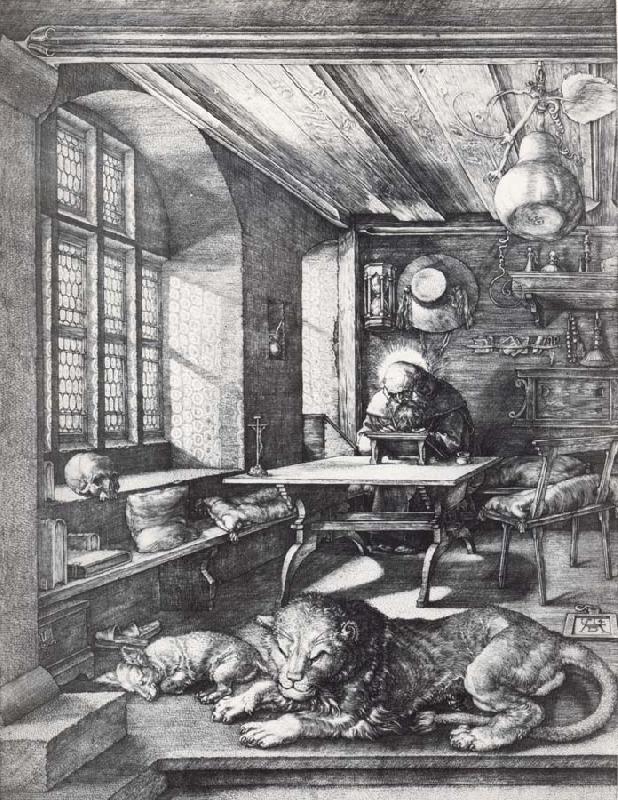
He begins by discussing two Albrecht Dürer engravings from 1514: St. Jerome in his Study and Melancholia. The former, Josipovici writes, depicts the saint as calm, at ease, "bathed in warm sunshine", "at one with himself and with his God as he works". The latter engraving is, by contrast, full of chaos, furious energy, depicting "art in competition with God", Melancolia as "a terrestrial craftsman cut off from all tradition and therefore incapable of productive work". She is inactive "because all work has grown meaningless to her": "St. Jerome shows us what has got lost; Melancolia I what we are left with.” In the following century, this new situation, combined with new possibilities presented by the printing press, is seen as the occasion for comedy for Rabelais and Cerventes. Both writers, in acknowledging the absurdity of writing in isolation for an unknown audience—where in the past storytellers told their tales directly to an audience—undercut the authority of their own narratives, reminding the reader how things really are—remember, after all, this is just a story. Don Quixote
dramatises the way we as readers collude in this game because we want, for the duration of our reading, to be part of a realised world, a world full of meaning and adventure, an enchanted world. It is no coincidence that the novel emerges at the very moment the world is growing disenchanted.
Somewhat later we have another important example in Laurence Sterne’s Tristram Shandy (not discussed in the book, though Josipovici has written about it elsewhere), in which the narrator hilariously never quite gets around to getting moving on telling the story of his life. Several key pages are spent on the poetry of Wordsworth (many reviews have indeed taken note of the unique presence of this poet in a book on Modernism) and the philosophical works of Kierkegaard, in particular in connection with problems of authority, anxiety, and inward-looking religious practice.

To be blunt, I don't think enough attention has been paid to what Josipovici says about the disenchantment of the world; it is, as Max Cairnduff writes, “absolutely critical to everything that follows”. Reviewers have missed the centrality of this, while also missing the related observation by Josipovici that this disenchantment is generally assumed to be "a Good Thing", "since it led us from an era of superstition to our modern era of common sense and scientific understanding". Which is to say that for Josipovici, as Stephen Mitchelmore emphasizes, it is "not necessarily A Good Thing". This is no small point, yet it is treated as if it were. It is in fact the main point. But how are we to approach this question, from where we sit? It is, admittedly, not easy. I submit that most readers are unlikely to be receptive to this message, and understandably so, since the very structure of our lives seems to argue against it. It is, however, a message I think we need to hear. I'm not going to spend a lot of time on the problem of authority (this is covered to my satisfaction by both Cairnduff and Mitchelmore in the posts I've linked above). I'm instead going to complicate the matter of the disenchantment of the world, but in a way that I hope will help to clarify some of what is at stake.

In The Book of God (1988), his marvelous study of The Bible, Josipovici wrote the following:
. . . once Luther stood up and asserted the need to speak the truth as he saw it and not pay lip-service to tradition, things could never be quite the same again. We tend to see Luther's break with the medieval church, like Spinoza's with Jewish tradition, as the triumph of light and integrity over the forces of obscurantism and hypocrisy; but this is to see it from their own point of view. It is important, however, to grasp what gets lost as well as what is won in such revolutions. . .
Our point of view, or what feminists call standpoint, can be an obstacle; further, we can learn a lot by considering matters from alternative standpoints, especially those that are underrepresented in official histories. We view these events, respectively, from Luther’s and Spinoza’s perspectives—we see them as signposts, if you will, on the way to our current secular world, a world, in its modernity anyway, that most of us see as desirable and inevitable, if perhaps besieged. We identify with the smug self-congratulation of the Age of Reason and the Enlightenment—the very labels tell us how to think about them!—and all too rarely do we consider what was lost, or if we do, we are rarely likely to consider that what was lost is worth worrying about or mourning. Josipovici, along with other critics and writers, has looked past this point of view, to consider the perspectives of artists. And indeed artists can and do offer us glimpses into changes that took place, worlds that were lost. But they do it from their own standpoint, which is a standpoint often at some remove from the events. For when we look at this period from the standpoint of artists, we are necessarily also looking at it also (but not completely) from the standpoint of the elite, or an elite, for in this period artists were either themselves elites, or at least patronized by elites, whether aristocratic, clerical, or bourgeois. So when we think of the declining of traditional authority, we are thinking of not only the Catholic Church, but also the feudal lords. In their place, eventually, are the various Protestant churches, and the bourgeoisie. This was a long process, covering almost the entire period under discussion, in one way or another.

But what if we try to look at this period from the standpoint of ordinary people? What if we think of the disenchantment of the world as a very real thing, with events affecting real people, and not simply as an increasing sense "people" had that things were changing? Because the period we're talking about just happens to correspond exactly with the long transition from feudalism to capitalism. It is the period of Karl Polanyi’s “Great Transformation”. The late feudal period was, again from the perspective of ordinary people, marked by elites banding together, by the bourgeoisie and aristocracy putting aside their longstanding differences to defeat the various diverse anti-feudal movements that had characterized the preceding few centuries, which had taken the form of peasant revolts, popular heresy and millenarian movements, not to mention everyday forms of passive resistance, and so on. So, rather than the traditional conception of a smooth or inevitable "transition" from feudalism to capitalism, it is, I think, more accurate to view capitalism as the counter-revolution (just as the United States Constitution is an outgrowth of a counter-revolution, undermining the more popular democratic tendencies of the American Revolution itself). In this light, common people were caught in between the replacement of one form of traditional authority, which they actively (as well as passively) resisted for centuries, and the newer authority imposed by the emergent capitalist social relations and mode of production, which they also actively resisted.

In this context, then, what is the disenchantment of the world? I see it as two related things, always keeping in mind these shifting modes of authority faced by ordinary people. First is the loss of the commons, and all that entails, including access to means of subsistence, control over reproduction, and community life, including festivals, holidays, gossip, mutual care, and resistance. Second, following from the first and no less important, is the disciplining of labor, which provided the backdrop for the philosophical/scientific attack on the body, as in Descartes, and theories of the state, as in Hobbes, which form twin, if occasionally opposed, pillars of our modern scientific and intellectual heritage. Related to both of these is the privatization of religion, or what could be called the "Christianization of the masses"; we know about the inwardness of mainline Protestantism itself (again, Josipovici dwells on this important point in his discussion of Kierkegaard, a writer he also discusses at length in On Trust), but the Catholic confession dates from this period as well—private religious practice being imposed, just as the more communal religious practices are actively being driven out. The Protestant Reformation was in many respects a massive land grab, another significant moment in the general enclosure of the commons. And this is the period of the witch-hunts, which, far from being the irrational attacks from the undifferentiated, ignorant mob of our popular imagination, were instead more or less systematic secular campaigns against common practices and beliefs, primarily those practices and beliefs of women in the areas of reproduction; a campaign, not incidentally, fully supported by some of the biggest names in our scientific legacy.

As Silvia Federici puts it, in her indispensable book, Caliban and the Witch (note: in the next few paragraphs, all quotes are from Federici, unless otherwise specified, but I am informed here by Marx, Polanyi, Peter Linebaugh and Marcus Rediker, Maria Mies, Fernand Braudel, and Giovanni Arrighi, among others):
What died was the concept of the body as a receptacle of magical powers that had prevailed in the medieval world. In reality, it was destroyed. For in the background of the new philosophy we find a vast initiative by the state, whereby what the philosophers classified as "irrational" was branded as crime.[...] "Knowledge" can only become "power" if it can enforce its prescriptions. This means that the mechanical body, the body-machine, could not have become a model of social behavior without the destruction by the state of a vast range of pre-capitalist beliefs, practices, and social subjects whose existence contradicted the regularization of corporeal behavior promised by Mechanical Philosophy. [...] This is how we must read the attack against witchcraft and against that magical view of the world which, despite the efforts of the Church, had continued to prevail on a popular level through the Middle Ages. [...] Eradicating these practices was a necessary condition for the capitalist rationalization of work, since magic appeared as an illicit form of power and an instrument to obtain what one wanted without work, that is, a refusal of work in action.[...] Magic, moreover, rested upon a qualitative conception of space and time that precluded a regularization of the labor process. [...] From [the ruling class's] viewpoint it hardly mattered whether the powers that people claimed to have, or aspired to have, were real or not, for the very existence of magical beliefs was a source of social insubordination. [Note: the above has been collapsed into one paragraph, with elisions bracketed off, in order to save space; emphasis is in the original]
This is the disenchantment of the world, and it is, in my opinion, undeniably a tragedy, a regrettable loss, one very much worth mourning. This is not at all popular view in the mainstream, but neither is it popular among leftists or Marxists, who seem just as wedded to the telos of progress as any liberal or capitalist, and who are generally more than happy to consign to the dustbin of history the "rural idiocies" of those ignorant masses dispossessed in this period of "so-called primitive accumulation". Indeed, one of the better reviews of What Ever Happened to Modernism? was by Tim Black at Spiked. Black’s review is from a largely Marxist perspective, and though he calls the book "important" (and actually offers an interesting defense of realism), he also calls it "irritating" and "reactionary". For another recent example of this general attitude, in his book First As Tragedy, Then As Farce, Slavoj Žižek wrote "if there is one good thing about capitalism, it is that, precisely, mother earth now no longer exists" and "we should remain resolutely modern and reject the all too glib generalization whereby critique of capitalism morphs into the critique of 'instrumental reason' or 'modern technological civilization'. " No one who seriously considers the history of capitalism from the perspective of not only what actually happened to those people who were expropriated in the past, but also what is happening to those who are being expropriated today, still, in the same ways, but in different places, can so easily dismiss such "morphed" critiques.

But we were talking about artists. Despite what some proponents of political art would have us believe, it is not the artist's job to report on political events. Nevertheless, their work is instructive. Dürer’s The Fall of Man (1510), which depicts Adam and Eve being ejected from Eden, can be read as "[evoking] the expulsion of the peasants from their common lands". His Monument to the Vanquished Peasants (1526), following the Peasant War of 1525, could "suggest that the peasants were betrayed or that they themselves should be treated as traitors" and "has been interpreted either as a satire of the rebel peasants or as homage to their moral strength". Dürer was a follower of Luther, and his work is said to have "helped to disseminate the teachings of the Reformation". Luther himself condemned the peasant rebellions; Dürer perhaps agreed, but as an artist saw what he saw, and was able to convey some measure of ambivalence. His version of The Four Horsemen of the Apocalypse was but one example of what was at the time a common artistic theme, which with its Biblical imagery reflected the horrible, very real suffering experienced by very real, ordinary people, who, in a situation of enforced scarcity, were constrained from maintaining their own subsistence in the traditional manner. The first half of the 16th century resulted in "the absolute impoverishment of the European working class, a phenomenon so widespread and general that, by 1550 and long after, workers in Europe were referred to as simply 'the poor'." Meat disappeared from workers’ diets—"a historic setback . . . compared to the abundance of meat that had typified the late Middle Ages." Here is Federici expanding on this point, bringing Rabelais back into our story:
Not only did meat disappear, but food shortages became common, aggravated in times of harvest failure, when the scanty grain reserves sent the price of grain sky-high, condemning city dwellers to starvation. This is what occurred in the famine years of the 1540s and 1550s, and again in the decades of the 1580s and 1590s, which were some of the worst in the history of the European proletariat, coinciding with widespread unrest and a record number of witch-trials. But malnutrition was rampant also in normal times, so that food acquired a high symbolic value as a marker of rank. The desire for it among the poor reached epic proportions, inspiring dreams of Pantagruelian orgies, like those described by Rabelais in his Gargantua and Pantagruel (1552), and causing nightmarish obsessions, such as the conviction (spread among north-eastern Italian farmers) that witches roamed the countryside at night to feed upon the cattle.
Allow me to leave here my detour into this working class history. I'd planned on delving more into the responses of artists to this situation, with a special emphasis on Shakespeare (including a digression into Josipovici's use of the work of the medieval historian Peter Brown in his elucidation of Richard II in On Trust; for this, let me instead refer the reader to my piece, "A world about to be lost"), but I believe I've said enough. My point, I think, is sufficiently made.

Few people know this history; fewer still look at it from the standpoint of the ordinary people affected by its forward march, though some are sensitive to the difficult problems that history has wrought. We are most of us ordinary people ourselves, who identify all too completely with the winners. So it's probably the case that most anyone reading the book likely does see the disenchantment of the world as a good thing, if they think of it at all. Josipovici quotes the following from a footnote in T.J. Clark's Farewell to an Idea: Episodes from a History of Modernism:
I realize that I shall be taken here and elsewhere to be idealizing pre-modern society, and inventing a previous watertight world of myth and ritual, agreed-on hierarchies, implicit understandings, embodied places, and so on. There is no easy way out of this dilemma. Of course pre-Modern societies (and certainly the ones existing in Europe immediately before the spread of mercantile capitalism and the seventeenth-century crisis) were conflicted and ideologically incomplete. I am on the side of historians who have fought against the picture of a pre-modern Europe characterised by absolute cultural uniformity, immovable religious consensus, the unthinkability of alternative views of the world, etc. Nonetheless, if we do not make a distinction between societies built, however inefficiently, upon instanced and incorporated belief, with distinctions and places said to be inherited from time immemorial, and societies driven by a new kind of economic imperative, in which place and belief are subject to constant revision by the very forces that give society form, then I reckon we forfeit the chance of thinking critically about the past two hundred years. To call such comparative thinking 'nostalgia' (or in the present techno-ecstatic conjuncture, 'Luddism') is just the latest form of philistinism about history in general.
As such, the book is fighting an uphill battle, and not just against philistinism. To the extent that reviewers have addressed the matter at all, nostalgia is indeed usually the charge (regardless of explicit attempts to anticipate and forestall such a charge).

Instead, responses have most often focused on the final two chapters of the book, in which Josipovici turns his attention back to the question raised by the title. What, indeed, ever happened to modernism? Unfortunately, these chapters, while enjoyable reads (large stretches of them are just as fascinating as the rest of the book), are not nearly as successful as the book up to that point, or indeed the rest of his criticism outside of this book. In part this is simply because he mentions several big English literary authors by name (McEwan, Amis, Barnes, etc) without making it clear why they in particular are found wanting. In this way, I think, it has been easy for admirers of those writers to read these passage as attacks. Which is exactly what happened, especially with the very first reactions. For myself, this was the first time in all of his work that I felt he wasn't speaking to me. These two chapters are written, fairly explicitly, to an English audience, with references to "these shores" and the English literary world in particular. At one point, while extolling the virtues of Clark's book, he notes that Clark, by "Writing about episodes in a history",
is free to explore a whole web of stories rather than trace any linear sequence, and thus restore a sense of history being made—by artists, by events—rather than simply lived out, that the blind alleys down which artists have gone at certain periods of their lives are as important as their achieved successes, and that different responses are called for in pre-First World War France, in post-Revolutionary Russia and in America after the Second World War.
I like this a lot, and I especially like the bit about blind alleys (I'm always thinking artists' minor or lesser works are too easily dismissed in this culture because we are impatient to move on to the next book or album or mp3 file). But I'm thrown, just a little, but the clause about the need for different responses. Not because it strikes me as wrong (it does not), but because in the previous chapter, one of the examples he uses of a writer who we read "to pass the time, to reassure ourselves that the world has meaning, and then . . . leave . . . and move on to the next book", is the American Philip Roth. He subsequently spends more time (though still not much) on Roth than he does on any other contemporary writer, because Roth has a reputation for being playful and "experimental", and Josipovici senses that his readers will have mistaken his book as an extended argument for experimental art—"Is that not what Modernism is about?" No, it is not: "If that is your reaction you have not really been taking in what I have been saying." It's clear enough to me, a longtime reader, that Josipovici has not equated Modernism with experimental art, but it's not difficult to imagine it not being clear to readers unfamiliar with his argument from his other work, given the general sense of Modernism as indeed being about experiment and innovation (on the other hand, does anyone really think of Kafka as an experimental writer?). Frankly, his remarks about the big shot contemporary writers are not terribly persuasive (even though I agree with most of them).

Related to this is a curious feature common to many of the reviews I've seen, positive and negative. These readers have noticed that Josipovici favors certain writers over others. They've even noticed to some extent what seems to differentiate those writers. Yet, having read the book, they can still do little more than wonder "why can't you like both" kinds of writers? As if two distinct species of writer were being posited. Some have expressed this point with considerable irritation, annoyed that they are being told what to like. They are being told no such thing. It is apparently easy to miss that Josipovici admits that he has enjoyed many of the novels by the authors in question. But he also says that, when he first read such writers, he wondered why they didn't touch him the way other writers did. They were enjoyable, diverting narratives, but he never felt compelled to return to them. It could be said that this disparity has animated his critical career. Anyway, it is not being suggested that readers cannot like whatever they want, just as it is not being asserted that Martin Amis and Ian McEwan are terrible writers. What is, however, being suggested is, first, what characterizes the condition of being modern, and, second, what an appropriate response to that condition might be. In this context, I wonder if it could be argued that Philip Roth is responding appropriately as an American writing after the Second World War. And if not, it seems to me that his response would still need to be situated in that American context (I happen to think this is a potentially fruitful line of inquiry, considering the American tradition of so-called post-modernism, but then I am an American). Of course, as Josipovici readily admits later in the book, these kinds of assessments are necessarily affected by our own personal situation (it is in this context that he admits that the Marxist perspective on Modernism perhaps has a point).

One of the factors leading to the writing of this book was Josipovici's dismay at the adulation showered on Irène Némirovsky's posthumous novel, Suite Française. Written in 1942, and set in the war, the novel would have been old-fashioned at the time, and in its mode is little more than "run-of-the-mill middlebrow narrative", yet was treated as a modern classic when discovered and finally published in 2004. So, in Chapter 14 ("It Took Talent to Lead Art Astray"), Josipovici discusses Némirovsky's novel, comparing it to a novel of similar vintage, also about the war, by Claude Simon. Némirovsky, he says, "is simply unaware of the inappropriateness of what she is doing, and one has to say that by her writing she makes 'a written renunciation to all claim to be an author'." In this case, it is useful to see the excerpts from the two novels, to see what Josipovici is claiming about the approaches taken by the two writers, to see what he means by an "appropriate" response. But, again, his problem is less with Némirovsky, who could only do what she felt was right, but in the out-sized praise her work received:
[T]he question is not why she should have written as she did, but what has happened to our culture that serious and intelligent and well-read reviewers, not to speak of prize-winnings novelists and distinguished biographers, many of whom have studied the poems of Eliot or the novels of Virginia Woolf at university, should so betray their calling as to go into ecstasies over books like Némirovsky's while, in their lifetimes and now after their deaths, ignoring the work of novelists like Claude Simon, Georges Perec, Thomas Bernhard and Gert Hofmann.
This, then, is a fuller expression of the question asked by the title. But in the very next paragraph he admits that "To answer this would require a sociologist, perhaps, and another book." He is not really in a position to answer the question. It could be said that the book itself intends to raise the question rather than to answer it. Well, one can almost hear it being said (indeed, Weinberger says it with much annoyance), if he's not going to answer the question, what is the point? The point, I think, is that some questions need to be sensitively and intelligently posed before they can be answered. That is, since the disenchantment of the world is a general cultural problem, the question raised by the title cannot be answered via literary criticism alone, or through art history.

Towards the end of the book, Josipovici writes that "There cannot, then, be a definitive 'story' of Modernism. We cannot step outside it, much as we would like to, and pronounce with authority on it. We can only try to persuade people to see it from our point of view." His book is just such an attempt at persuasion, though he has been accused of elitism, of smugness (!!), of nostalgia, of snobbery. Rather, I think, he is peculiarly positioned to be able to perceive things many of us cannot, in part because of the details of his biography. In the final paragraph of the book, he allows that his particular affinities "may be largely because of who and what I am". He closes the book like this:
The late R.B. Kitaj compared Cézanne's rootedness in his native Provence to what he called the 'diasporist' ... imagination of the uprooted Picasso, and he suggested that at some deep level Modernism and the diasporist imagination go together. This may be true if we have a flexible enough notion of disapora to accept that an apparently rooted Frenchman like Bonnard or Englishwoman like Virginia Woolf could also have created a 'diasporic' art—and then one would want to look at Bonnard's relocation to the South of France in the latter part of his life as a kind of exile in which he went with his problematic wife, and at Virginia Woolf's sense of herself as a woman excluded from a male-dominated society. To that extent the Marxist critique of Modernism I mentioned at the start may have a point: Modernism may not be a consequence of the crisis of the bourgeoisie but it may be the product of a general European rootlessness in the wake of the French and Industrial revolutions. All will then depend on whether we see such rootlessness as pathological or as giving those who are imbued with it a certain vantage point, allowing them to see things which might otherwise have remained hidden. In other words, are we to see our own history, that which makes us what we are, as something which blinkers us or which sharpens our vision. This is, in itself, of course, a very Modernist question.
For all that Josipovici is advancing a particular perspective, he leaves it up to us to see for ourselves. Can it not be said that each of us is potentially our own diaspora? We have been fragmented, dispersed, alienated. We constitute a working class massive, but identify all too much with the very power that destroyed the history described above and seems unable to avoid destroying everything it touches, on the way alienating us from not only our own labor, but our very existences, though some of us, not only artists, are afforded glimpses of other possibilities and are receptive to art that suggests such possibilities, and otherwise questions and breathes. This is why all of this matters, and why Modernism continues to speak to us, through the din of received histories and imperial narratives, fictional or otherwise, and why we need critics like Gabriel Josipovici.

Related posts:
"Smoothness of Surface"
"A world about to be lost"
"The very notion of wholeness"
Notes on "The Bible Open and Closed"
"Modernism against Modernity"
Notes in advance of reading What Ever Happened to Modernism?
Follow-up to this post

Review of In a Hotel Garden
Review in The Quarterly Conversation of Goldberg: Variations (and follow-up)
Review of Everything Passes

Sunday, September 12, 2010

Notes on Laird Hunt's The Exquisite

So, then, the literary situation facing us today is that of post-modernism—anything is permissible—but also one of conservatism—anything is permissible, but innovation is not valued as it was during the heyday of the major American post-modernists, literary ambition is treated with scorn. Thus the range of options apparently available to the writer. As is the case in Britain, the literary culture, as discerned through its critical commentary, has become small and mean. But there still exists numerous writers who seek to carry on in the spirit of the giants of American post-modernism. What do we do with them?

A few weeks ago, I wrote that I felt Laird Hunt's The Exquisite justified its existence. This isn't to say that I didn't have problems with it, merely that, after a prolonged period in which I was unable to read fiction, I found I could read this novel and did so with some enjoyment. In the comments to that earlier post, Ethan said that he found it "irritatingly precious", but also interesting enough. This isn't far off the mark.

In the novel, we find two related narratives, told in alternating chapters. Henry is our narrator for both. In the first, which takes place in New York City, apparently in the weeks or months after the 9/11 attacks, Henry gets caught up with some interesting if sketchy people—in particular a boss-type who goes by the name Aris Kindt, who's taken his name explicitly from the subject of Rembrandt's The Anatomy Lesson and who has a variety of conflicting stories about his own history—who stage fake murders for people who, it seems, want to experience death to make themselves feel more alive, people who might be sleepwalking somewhat in the wake of 9/11. It seems obvious that Henry is getting set up in some elaborate fashion. In the second, Henry is in a mental hospital of some kind, trying to piece together his past, which may or may not include the activities in the first narrative, which may or may not have actually happened. He speaks to the ghosts of his aunt (who he may have let die) and possibly Kindt as well (who he may have killed, if he ever existed), who may also be, or have been, a patient at the hospital. (If you like, see Matthew Tiffany's enthusiastic review from 2006 at PopMatters for more details about the plot.)

I think we're supposed to be uncertain about the relationship between these two narratives, we're supposed to be uncertain about the relationships between the various characters, we're supposed to feel a kind of tension in that uncertainty. I can't say I did feel any narrative tension. I enjoyed much of what was written—including a lot of Kindt's pseudo-philosophizing, Henry's observations, and so on, and, in fact, I especially appreciated the treatment of 9/11 itself, which is clear enough, but in only passing and somewhat ghostly; you could miss the references to that event if you weren't paying enough attention (for example, normally perceptive Matthew Cheney admitted to not having read the book carefully and he seemed to have missed them). Even the fake murders idea had some promise, and it was treated fairly well (though not without some annoying silliness along the way). And I did feel some frisson reading the pages in which Henry is confronted by a man who seems to know rather a lot about his activities and about Kindt; one feels the onion beginning to be unpeeled and is uncertain about what will be found. This uncertainty was interesting. But my attention flagged considerably whenever we flipped a new chapter and it was time again for the hospital narrative. No doubt in part because it's been done, I was not impressed by either the idea or the execution here, in which one narrative is meant to call into question the reality of the other. I was bored reading these chapters and wanted to get back to the city.

Ok, I'm more or less done with the book itself. Now let me back up a bit and talk about the book's trappings and Hunt's own perspective. The novel has two epigraphs, one from Fernando Pessoa, the other from Maurice Blanchot. As if designed to appeal to me! Here they are, then. From Pessoa's The Book of Disquiet:
I fainted during a bit of my life. I regained consciousness without any memory of what I was, and the memory of who I was suffers for having been interrupted. There is in me a confused notion of an unknown interval, a futile effort on the part of my memory to want to find that other memory. I don't connect myself with myself. If I've lived, I forget having known it.
And from Blanchot's novel Death Sentence:
I entered. I shut the door. I sat down on the bed. The blackest space spread out before me.
So far so good. Then in the acknowledgments, Hunt cites Sebald's The Rings of Saturn as an influence (a man in a mental hospital recalling his journeys?), as well as the role played by both The Anatomy Lesson and Sir Thomas Browne's Hydriotaphia, which he reminds us are discussed in Sebald's novel. Sounds promising. Then Hunt tells us that he wanted to avoid an obvious literary homage to Sebald (with pictures and quiet observation and melancholia and the like), what Pound would have called "dilution":
The approach then was to write a book unlike one Sebald would have written, while taking up and recasting his favorite themes and obsessions. An improbable ghost noir set in New York's East Village, involving portentous nightmares, a mock-murder service, and great quantities of pickled herring seemed to fit the bill.
This sounds a little glib. It might have been more illuminating to hear about the nature of the impulse to write on these themes. But it's an acknowledgment at the back of the novel; I shouldn't read too much into it. Regardless, Hunt cites all the right names, and he is a talented writer. After reading the novel, I came across a post in Largehearted Boy's Book Notes series, in which Hunt showed up to recommend some music and had this to say about his novel (which the blogger describes as a literary thriller that is "truly haunting" and "[s]hocking, intellectual, eerie, and wonderfully written"):
The traditional way of looking at what a novel does might be likened to a fist that opens, more or less slowly, onto to some object – a jewel, a key, a quarter, the proverbial lump of coal – that is thereby gradually revealed. The wave of experimentation that stretched out over the 20th century did considerable damage to this model – offering up one fist after another that opened onto nothing, or not what we expected (a palm full of question marks, the after-echo of its own opening, a little mirror). Some novels never opened at all, and others, written by especially crafty/annoying devils, seemed to be opening onto something, something we almost got a good look at, then abruptly slammed themselves shut. Which is to say that by century’s end, there were a lot of different models for how fiction could be written and why not (I seem to have said to myself) take advantage of them? The Exquisite then is two fists (kapow!) sitting side by side. One seems at first glance to be on its way to opening (maybe onto something dark and glowing and mysterious to do with New York and mock murder) and the other seems at first glance not to be doing much of anything (maybe just getting its nails done at some East Village hand and foot parlor). Look again, however, and the fists seem to have been reversed. Or have they?
And my doubts are confirmed. What had felt to me like the recombination of various literary techniques (with particular attention to certain genre tropes; enthusiastic bloggers routinely drew attention to his expert "use" of noir and ghost story elements, respectively), to little apparent purpose, is here revealed as just that. There's the reference to the traditional novel and to the 20th century "wave of experimentation" (innovation). In this context, the job of the serious, talented writer becomes either how to further experiment or how to recombine the fruits of previous experiments into something fresh and new. Looking back at the epigraphs from Pessoa and Blanchot, we can now see that they merely offer descriptions of a sort of the events that will unfold in the book and the themes explored. They have no bearing on the relationship to the writing itself, which very much seems to operate under the quintessentially American philosophy of "anything goes". After all, why not write a ghost noir in offbeat homage to W.G. Sebald?

Saturday, September 11, 2010

The Book to Come: A note prior to reading What Ever Happened to Modernism?

I keep thinking I'm going to find the time to finish up the set of blog posts I have hanging fire, but it doesn't seem to happen. One of these days. In the meantime, I ordered three new Gabriel Josipovici books, including What Ever Happened to Modernism?, which arrived today and has lately been the cause of much uncomprehending stir in the British press. As if he hadn't been making much the same sort of argument for 35 years. As it happens, the lecture Josipovici gave some three-plus years ago that led to this book was a momentous occasion in my life, and I wasn't even there. But the better blogs covered it, and the ensuing conversation led me back to his earlier books, On Trust and The Book of God. Much of my thinking since then, reflected in the content of this blog, has been guided, if you will, by the gentle spirit of those books. Indeed, the posts I have in mind to finish are very much in the vein of arguments I've been pursuing in that time. What does it mean to live in this time, now? What is our relationship to art? What is the meaning of art? What does it have to do with living now?

It's possible that I take the argument further afield than Josipovici takes it, if only because I'm more likely to write explicitly about politics. In his recent piece in the New Statesman, he attempted to explain some of the impetus behind the book, and specifically addressed the silly controversy surrounding his passing remarks on various high profile contemporary British writers (e.g., Martin Amis, Ian McEwan, Julian Barnes). In it, he asks, again, what it is that happened to literary modernism in England, and in English-language writers more generally. Here, he is more focused on England itself, especially given the scuttlebutt about his assessments of Amis, McEwan, Barnes, etc. He recalls a different situation in the 1950s, when he first arrived in England, and wonders at how that culture has since become small and mean. In an earlier post, I excerpted some lines from that aforementioned lecture. In part he said there
. . . that England was just about the only European country not to be overrun by Nazi forces during the Second World War, which was a blessing for it but has left it strangely innocent and resistant to Europe, and thrown it into the arms, culturally as well as politically, of the even more innocent United States. This has turned a robust, pragmatic tradition, always suspicious of the things of the mind, into a philistine one.
I was reminded in a comment to that post that, while England was not overrun by Nazis, it was nevertheless "bombed to smithereens" during the war. I did not need the reminder, but it's still important to keep in mind. I wonder if the uncertainty following the war helped create a kind of cultural bubble, allowing for a final flowering of the modernist impulse, before that turning towards the "more innocent United States".

The United States, untouched by the war, in a position of immense political and, especially, economic power and prestige, actively taking on many of the responsibilities of the former British Empire—and also home to a spate of writers who either explicitly conceived of themselves, or were so identified by enthusiastic critics, as continuing in the spirit of modernism, writers who were collectively called "post-modernists" (cf. Barth, Gaddis, Pynchon, Gass, Hawkes, Elkin, Sorrentino, etc.). Of course, for them, as for so many, modernism was a period of literary history (hence post), in which certain literary techniques were introduced; that is, the modernists were innovators. And so the American post-modernists continued on innovating, apparently untroubled by doubt as to the legitimacy of the project itself. Now, the term post-modernism has been much abused, but I think it was inevitable that it morphed into the cultural tendency dominating our sense of the word today. It's a situation in which anything goes, in which there is no reason not to do any particular thing, let alone write a novel and try to get it published. A situation very different to that faced, on the one hand by the historical European modernists up to World War II or so, and on the other, by European writers at the close of the war.

Wednesday, December 02, 2009

Modernism against Modernity

This is from an interview with Aleksandar Hemon at Paper Cuts (link via BLCKDGRD), about the new collection of European fiction he has edited for the Dalkey Archive:
Q. What was the biggest surprise for you, editing the collection?

A. It was less of a surprise than a reminder: how unabashedly comfortable many of the writers are to engage with literary forms that would be perceived as experimental or avant-garde here. In turn, I was reminded how deeply conservative contemporary American literature is in terms of form. And that conservative bent is a recent development, I believe. The European form flexibility is not a consequence of some snotty, elitist aesthetic but rather of the fact that there are many stories to be told and many traditions to draw from.
I've gotten the same sense through my much more limited experience with European writers. No doubt there is much crap that is thankfully not translated into English, or otherwise brought to our attention, while all manner of Dan Browns and John Grishams are translated out. Even so, the difference strikes me as true enough. And it seems to me that it's no accident that it's the Anglo-American literary mainstream that so despises writers who "engage with literary forms", dismissing them or marginalizing them as "experimental" or frivolously avant-garde. Alongside Hemon's point "that there are many stories to be told and many traditions to draw from" is the huge political fact of hegemony and empire. The center doesn't need to listen to the periphery, or see it. England and the United States stand as the most pervasive, the most dominant empires of the last two centuries, even as England, since 1945, operates as a junior partner in the concern. Both cultures are highly technical, pragmatic, analytic. All is utility, power, confidence, containment.

Much can be said about the socio-political effects of literature, its lack of innocence. I took a preliminary stab last year myself. But what effect does politics--a political culture--have on literature?

As ever, Gabriel Josipovici is a helpful guide in these matters. Recently Stephen Mitchelmore forwarded to me the abridged text of the much-discussed lecture on Modernism that Josipovici gave two years ago (the text appeared in the Times Literary Supplement, November 30, 2007, under the Beckettian title "Fail Again. Fail Better"). Interestingly, it was the blog discussions of this lecture that first introduced me to Josipovici's criticism (I had already read and reviewed his fine novel In a Hotel Garden) and led me to his important books, On Trust and The Book of God, yet till now I had never actually read the text of the talk. It came to me at a good time, just as I was working through some of these very issues. In the lecture, he talked about "a curious case of knowing and not knowing" that obtains in the English (and certainly American) literary world today, asking "what has happened to our culture such that serious critics and intelligent, well-read reviewers, many of whom studied the poems of Eliot, the stories of Kafka and the plays of Beckett at University, should go into ecstasies over Atonement or Suite Francaise, while ignoring the work of marvellous novelists such as Robert Pinget and Gert Hofmann?" He offers three suggestions:
The first is that England was just about the only European country not to be overrun by Nazi forces during the Second World War, which was a blessing for it but has left it strangely innocent and resistant to Europe, and thrown it into the arms, culturally as well as politically, of the even more innocent United States. This has turned a robust, pragmatic tradition, always suspicious of the things of the mind, into a philistine one. Though there is something appealing in the resolute determination not to be taken in evinced by Larkin and Amis in the face of Modernism and Modernists [...] it soon begins to pall. Second, and related to this, ours is the first generation in which High Art and fashion have married in a spirit joyously welcomed by both parties. When we are enjoined to buy three books for the price of two and a serious newspaper like the Independent offers its readers the chance to gatecrash a book launch of their choice with the paper's literary editor as a Christmas bonanza, we have truly arrived at the age of uncircumscribed consumerism. Finally, as Kierkegaard well understood, it is hard to keep "the wound of the negative open", and we prefer not to remember that the price of not doing so is that the wound will fester.
I could take up a lot of space investigating each part of this paragraph, and there is as always much else in the talk worth quoting and discussing, but for now I'm most interested in the implications of the first point, the different experiences of World War II. I think this can be extended to the experience of modernity itself. It is in this way that literary Modernism is quite different, I think, from the other Modernisms (e.g., architecture, agriculture, etc). Or, rather, that, again, the historical European Modernists are different from the most famous Anglo-American Modernists--the ones most famous as Modernists; I'm thinking Pound, Stein, Hemingway as examples in the latter group, versus Proust, Kafka, Beckett in the former. Triumph versus failure. Josipovici talks here and elsewhere about the "crisis of Modernism". For the European Modernist, modernity is experienced as a calamity, and why not? Two world wars will do that. Such is not the case for England, and especially the United States. Modernity is experienced by Americans especially as our time ("the American Century"), the best time. We are the New World, we are progress, triumphant. When Josipovici refers to American innocence he is obviously not ignorant of America's many wars and other crimes against humanity. What we are innocent of, however, is invasion, of struggle, of suffering, in the grand sense--which is not to say that there are not wide swaths of Americans who struggle and suffer. But that is the periphery within the dominant culture; the overriding themes are success, happiness, positive thinking, moving forward. (Failure is our own damn fault.) We don't experience bombings, we inflict them, at a distance (with good intentions, by golly). And we get things done, we are practical, technical, tell us like it is, dammit. American writers are generally a liberal lot, even when politically conservative, generally untroubled by the problems of writing--that is untroubled by the question of whether to write, unless the question has to do with practical concerns, such as whether it pays, not so much whether the act is warranted--we need to express ourselves, have the right to be published, or so it seems, and books and stories proliferate. It might be argued that it's a good thing to hear so many voices, and I'd agree, if it weren't for the containment of these voices in the same old thing, voices trapped as they try to learn the "right" way to hone the craft which is not a craft.

Wednesday, July 01, 2009

Bored by Hemingway

I tried again last night to read The Sun Also Rises. No particular reason: I was in between books, felt like I wanted some fiction, flipped through a few, reading the first page or so of this, the first paragraph of that, before arbitrarily deciding to give the Hemingway another go. It's not going to happen. I get no pleasure from the prose. I find young Mr. Jacob Barnes, the narrator, exceedingly annoying, and the no-pleasure-in-the-prose factor makes that a major problem. I don't care about Robert Cohn or the rest. I'm not interested in characters who are supposed to be metaphors for the Lost Generation. I don't care about any of it. I made it through the first three chapters, approximately 25 pages, about a tenth of the thing, irritated the whole way, telling myself the while that it'd come into focus, I'll get into it. But, no.

I went through an earlier period scorning Hemingway, without really knowing what I was talking about, outside of hated forced readings of short stories (about fishing, I'm almost certain) in high school. Then I took a stab at this same novel, made it 80 pages in, decided it wasn't for me, but without the scorn. I was younger, read too quickly, and his writing didn't fit in with the more expansive, language-drunk novels I was reading at the time. Since then, I always told myself I'd read it; it would be the Hemingway I'd read, since I really don't want to read his war novels. But, again, no, finally, I'm not going to. I'm not going to read any further. I'm giving up on Hemingway.

Tuesday, June 23, 2009

Another forgotten writer: Evelyn Scott

Forgotten or neglected writers abound. In March, I blogged about Olive Moore, who it seems was so little known she wasn't even forgotten. And not too long ago, at ABC of Reading, I learned of Evelyn Scott. Scott, Thomas McGonigle tells us in another post, was published in The Little Review, alongside a slew of still-famous names: Eliot, Hemingway, Joyce, Stein, Hart Crane, Djuana Barnes, William Carlos Williams, Wallace Stevens. She introduced Faulkner's The Sound and the Fury, and, McGonigle says, "received for her troubles his back-handed compliment, as being pretty good for a woman". I sense a glimmer of recognition at this remark; I must have read previously of Faulkner saying such a thing, though I obviously never looked into it.

Well, I'm interested. Most of Scott's books appear to be out-of-print. I check the library, and it has several, ranging from 1923 to 1941; the library provides no further information online. I somewhat arbitrarily put a hold on the earliest, Escapade (which, it turns out, is itself not out-of-print, available in a University of Virginia Press edition), which I subsequently check out. The volume is old, though clearly not a first edition. It's not covered in any kind of protective sleeve; there are signs of mildew. For all that, the book is in decent condition; it was obviously well made. It was last checked out in 1991. After beginning the book on my commute in yesterday, I'm more than ever curious how such a writer can fall through the cracks, so I look Scott up on Wikipedia: virtually nothing, though I do learn that she was born in 1893 and died in 1963, and links are provided to a bibliography and a short biographical sketch ("Tennessee's Prodigal Daughter: Evelyn Scott" by Caroline Maun), the latter being part of a modest website devoted to celebrating Scott and her work. I skim the bibliography, but I don't find Escapade. I read the opening of the biographical sketch (where I learn that "Evelyn Scott" was a pseudonym for Elsie Dunn), and midway through the first paragraph I read of "Scott's first autobiography, Escapade (1923)", and I go back to the bibliography and sure enough, there it is, listed not under "Novels" but "Autobiography". If I hadn't looked up this information, I'm sure I would have read the entire book without having any inkling it was autobiography.

Anyway, I'm now more than halfway through Escapade, and friends, it's good. It was immediately evident that I was in the presence of a writer. (Says the description at the website: "It explores female subjectivity and breaks new ground in literary modernism." Whatever that means.)

Interestingly, there are other similarities with Olive Moore's Spleen, beyond simply being forgotten. Here, the narrator has escaped the States with her married lover; it's a major scandal back home; she is twenty, pregnant. They are in Brazil. She resents the life she left that looks down on her actions; she is confident, assured, modern. Independent-minded. She writes about the locals, with sympathy, if not always with warmth, and about her opinion on the scandal and her ideas about life and existence ("Death is like the unknown lover to whom the child, in infancy, is already dedicated.")--there are many references to being; remember, the book was published in 1923. And she writes about her pregnancy and about the birth itself and about being a mother. It strikes me that, with Moore's novel, we have perhaps the earliest literary writing about pregnancy (though I strain to come up with any more at all; for one, there's Carole Maso's diary about pregnancy and depression, A Room Full of Roses; no doubt in my ignorance I am missing many). In the great 19th century novels, this kind of thing happened offstage. But here we also have writing about being a mother, about the work, and the weariness:
It was always dark in the bedroom. I lived in the long contemplation of a blank wall, of a pale violet light that fell across me as it penetrated the blinds of the sala window which was opposite my door. The baby lay beside me. He seemed fragile. I was heavy with response to the new indescribable smell he gave out. I had been close to babies before but I did not recognize the odor as anything familiar. I had found something which I had needed for a long time. I knew now what I had needed.

When he drank of my milk, all of me was arrested in the sensation of his soft clinging touch. I was mindless, beautiful. I wanted to be like that forever and ever. I let him drink too much. His head fell back and the white milk trickled warmly from between his parted lips. His mouth was loose and red. He half closed his eyes and I could see the delicate pinkish veins in the thin lids. He looked drunken with himself, and I was drunk also. We were in a relaxation that was almost a debauch.

Once a bat came into the room while we were alone. I was terrified of bats, but I got up and put a mosquito net over the baby. I had a sharp painful pleasure in my fright, in my sense of bondage to my child. I would always belong to him. I would always think of him first. My abandon to him was humiliating and sweet like abandon to a lover. I thought, It is my body I give to him. And I was surprised in recognizing this. I had imagined maternity as something thin and ideal.
And a bit later:
I am exhausted. The housework and the care of a heavy child are too much for me so soon after leaving my bed. My nerves are too vivid, exhausted by responsiveness. I feel as if I were dying already of too much life. I am in terror of my fatigue which is strong and impersonal--stronger than I am. I pray to something or other, beg myself to go on, beg the baby to sleep, to give me a little rest.

When the baby cries in the night I get up in the dim relaxation of despair and talk to him. "Oh, baby, I can't bear it any longer. Please go to sleep. Please go to sleep."
And: "My back aches. And the baby is merciless. Yes, sometimes I am so tired that I long for the irresponsibility of insanity in order to escape."

It's not all about being a mother, but it's all writing. Occasionally Scott's lyrical descriptions lose me in their piled up metaphors, but even these are often marvelously vivid and well-chosen. I'm already prepared to rank this with the great literary memoirs: Thomas Bernhard's relentless Gathering Evidence; Edward Dahlberg's Because I was Flesh; Mary McCarthy's Memories of a Catholic Girlhood (and, no, I still haven't read Nabokov's Speak, Memory). I'm excited to know that there are several other Evelyn Scott books quietly awaiting my attention at the library. Many thanks to Thomas McGonigle.

Friday, June 19, 2009

On Baudelaire and modernity and ambivalence

In the June 8, 2009, issue of The Nation, Joshua Clover has a review (full review is for subscribers only, which I am not) of a new translation by Keith Waldrop of Baudelaire's collection of prose poems, Paris Spleen. In his review, Clover discusses the "contradiction that charges" the collection:
The individual is endlessly threatened by the gravity of the social whorl, by the maw of the masses and the tinsel seductions of the marketplace. And yet he is an individual only insofar as he is part of this new configuration, the very grounds for this new sort of person. He has no being beyond it.
Exploring this further, he writes:
For all his hate, it is the mass of people, each more unfortunate that the last, to whom he keeps returning. In "Solitude," perhaps the book's most paradoxical poem, he seems to renounce any rapprochement with the crowd. "The unfortunate inability to be alone," he bemoans, and "practically all our mishaps come from not staying in our room"--summoning the exhausted wisdom of La Bruyère and Pascal. By the end he has in his sights "all the fools searching for happiness in movement and in a prostitution I would call fraternalistic, if I wanted to speak in my century's uppity tone."

These last two words are an unconventional translation to "belle langue"... The common phrasing has long been "the beautiful language of my century"[...]. Waldrop's willingness to alienate the language, to make it dance again, cannot help but be striking to any reader of Baudelaire. It now suggests something of the poet's contempt for the honeyed talk of the bourgeoisie and its new cadre of captive intellectuals, and Waldrop gets this exactly right.

What slips away in this rendering, however, is the extent to which Baudelaire did wish to speak the beautiful language of his century, to wrest it from the salon and the Académie. Again and again he goes looking for it; the secret he knows is that it is to be found exactly "in movement and in a prostitution." The passage is the stroll of the flâneur, that jaundiced inspector of modernity, walking through the market but imagining himself not quite of it: the private citizen invented by public existence. This is the daily or nightly course for which Paris Spleen's lyrical movements and undulations find form.
It occurs to me that, if Clover appeared more often in The Nation, I might be persuaded to re-subscribe. (Of course, I'd be vastly more likely to re-subscribe if the quality of that rag's political analysis in any way resembled Clover's own, as known by me through his jane dark guise; see, for example, such recent entries on The New York Times and Tiananmen Square, on world-system hegemons, on the economic downturn and race, and so on.) Anyway, Clover's review reinforces my desire to read Baudelaire. I'm thinking of picking up The Flowers of Evil, along with Paris Spleen, as well as Benjamin's Baudelaire writings, handily published together now as The Writer of Modern Life (also mentioned in the review). Presumably the latter collection includes the relevant Benjamin I've already read, which reading put Baudelaire on my personal map in the first place.

I am intrigued by Clover's analysis, in the passages quoted above, of the different translations of the two words "belle langue" and, by implication, Baudelaire's conflicted relationship with modernity. I go back and forth on translation, worrying about choosing the best when multiple versions exist, worrying about getting the real experience, lamenting my monolingualism, and so on. Of late, my tendency is to not worry about it too much. The translation is simply that, and we do the best we can, and something of the original shines through. Here, though, I'm again struck by my loss. For it seems clear that what Baudelaire is saying is to be found at the intersection of the two versions (since, again, I am not likely to read him in the original).

We encounter few authors with zero preconceptions. With Baudelaire, my conception is of him as Benjamin's writer of modernity. One senses a writer struggling to give voice to the modern, to witness it, to see it as fully as possible. Perhaps, in the context of the problems of modernity, I have overplayed in my mind the extent to which he celebrates the modern, a celebration which might strike me as suspect. But, of course, as noted, I've not yet read him and my conception is, in fact, based on very little. So, given my ongoing concerns here, it will be seen that, as a reader, I am ripe for an interpretation of Baudelaire that highlights his "contempt for the honeyed talk of the bourgeoisie and its new cadre of captive intellectuals". Not so fast, Clover says. This contempt is "exactly right", but it misses something. It misses the love.

And I'm off and running, considering my own ambivalence about modernity, critiques of technological society, complaints about distraction. I am all too aware that, though I rail against the modern world, I am nonetheless of it, and that, in some respects, modernity enables my own opposition to it (for instance, I have a blog; I have a Twitter account, God help me). I'm reminded of problems I have had with Marshall Berman's conception of modernism, in which modern art is needed to allow us to become more suitably modern, to engage with the changes of modernity (for another take on Berman, see Aaron Bady's excellent post from last September on All That Is Solid Melts Into Air, in which Aaron asks questions about who gets left out of that conception, whose work is needed to make modernity function). My preference has been to think of literary modernism less as the obsessive drive to "make it new" (which does indeed seem to always require that we be rushing ahead, like modern life, always rushing, always impatient, demanding we adapt, keep up, be up for the next challenge) than as an awareness that certain forms are now suspect, suspect because of what's been learned, or perhaps exposed, in this drive forward. It is not that modernism should help make us, readers, modernists, that is to say, adapted to modernity, in all its complexity, but instead that modernism reflects that, in the move towards modernity, old verities have themselves been rendered suspect, verities on which certain narrative forms relied. The distinction is perhaps fine; I can see that it's possible we can include both sorts in a broader umbrella of modernism (a dialectic?). Not in a desire for inclusiveness but to embody an ambivalence. And yet it seems to me that the version I prefer is a necessary corrective to the more widely held version, that it's more suited to our current predicament.

Ambivalence! Literary ambivalence is nothing in the face of ambivalence about modernity itself. If Baudelaire explored, with excitement and repulsion, the condition of modern life (how convincingly I say that: you'd think I'd read his work), what do we have to say after 150 years more of development, of decay, of deepening adaptation? Now we have no excuse but to know that, not only does our way of life depend on the current privations of millions caught living in the wrong part of the world (how unfortunate to live in a country with vast reserves of oil), but that that way of life is also built on centuries of murder and destruction. Knowing this, but also knowing how unprepared we are for that way of life to disappear, though knowing that disappear it must. Liking the comforts of modern, technologically-enabled life, indeed loving aspects of it, but knowing that the idea that all could share in such comforts has always been a pipedream (though, surely, hating the job needed to maintain it, hating especially the pointlessly long commute, hating the noise, hating the idiocy, hating the polity). The globe simply can't support it--and anyway, the resources have to be extracted from somebody, the labor has to be done somewhere, the waste has to go somewhere. There is no getting around the fact that people continue to die for it. Not so they can share in it, but so we can laze about in it, continuing to not do what needs doing, voting instead for "change" that is no kind of change at all.

Sunday, March 15, 2009

Spleen, Olive Moore

I'd intended to write about Olive Moore's Spleen last year, but time got away from me and I never got round to it. But even if the time for a proper review has passed, I do want to say something about it before allowing myself to move on completely, because Spleen is the quintessential forgotten book and it deserves to be read.

I bought Spleen several years ago, precisely why I cannot say. No doubt it was in the midst of my full-blown obsession with all things associated with the Dalkey Archive, though it would have been prior to the Big Dalkey Get. I say Spleen is the quintessential forgotten book: Moore is the forgotten writer par excellence. (In fact, I'd pulled the book down from the shelf, its slim volume lost between our several books each by Lorrie Moore and Toni Morrison, to see whether it should be discarded.) She wrote four books ("Olive Moore" is a pseudonym for Constance Vaughan; according to the biographical note in the back of the book, she lived in Bloomsbury, ran in those sorts of literary circles, and wrote an essay about D.H. Lawrence), in the early 1930s, before disappearing, presumably dying around 1970. Dalkey produced a hardcover, omnibus edition of her work in 1992 and the stand-alone paperback of Spleen in 1996. It seems these reissues got good notices, where they were noticed, but I'd wager she's been forgotten again. Even in Dalkey's roster of misplaced modernists and post-modernists, lost writers and otherwise missing books, she seems easy to overlook.

This is a shame, for Spleen, at least, is excellent. The back of the Dalkey edition suggests that Moore writes "in a style similar to Virginia Woolf's". I think this comparison is apt, though if anything, I preferred reading Moore's prose over Woolf's chewier writing. Woolf is a useful formal comparison, too, I think. Things are narrated primarily from the perspective of Ruth, the novel's main character; her consciousness is revealed above all. Where so far Woolf's fiction has struck me as self-consciously innovating--as evidently by a writer conscious of trying something new (no disrespect to Woolf intended at all; I like her), Spleen feels somehow, to this reader, more organic. (For no good reason, I'm sure, I am also reminded of Ann Quin's Three, but my memory of that novel is dim. The reminder could simply be because they're both more or less forgotten English writers, now published by Dalkey.)

The novel concerns Ruth and her self-imposed exile after the birth of her deformed son 20 years earlier, whose deformity she feels responsible for. She meditates on motherhood, nature, equality, class. In her exile, for example, she muses on the pregnancy of one of the local Italian girls:
One day she would return from the beach or from the town with the day's papers, and Lisetta would run out to her with a face of beatitude announcing that Graziella had been delivered of whatever she had had to deliver, and Graziella, completed, would be sitting up in bed, the sweat still on her smiling face, accepting the cup of zabaglione and the figs, and the next day she would be up and about, singing to her infant, feeding it, washing it, ravished with delight in it, and binding it in the mummy-bands of a della Robbia holy child until only its face, surprised and formless, was visible. And from the first to last no fear, no despair, no mental torture. Nothing that was known to colder northern women, over-civilised, over-sensitised, bearing their children in an agony of pain and bewilderment.
As she herself, much earlier, when she had found herself desultorily pregnant, had been bewildered:
For how can one love a thing one does not desire? Perhaps because it is usual to love one's child. Then I am not usual. (How easy to accept this in the darkness of the night when the unreal becomes the obvious!) Because she knew that not wanting the child now she would not want it later. She knew it was not possible to her to love a thing she did not know or had not seen. How can one? Yet I am expected to. All women do. I am a woman. Therefore I do. And if I do not? (And at a movement real or a imaginary within her.) When I breathe, it breathes. When I feed, it feeds also. Against my will. Yet when it had finished using her for its own purpose, she must welcome it and say that it was hers and that therefore she loved it (all women do) at once and without question. When it had had nothing to do with her from start to finish.
She had eventually come to an understanding about the unborn baby and decided to try to will something in the world with it, not passively accepting it, but as an active agent, as men presumably are in the world. It is as if she were responding to a message: "Something different, said the message. Something worth having. Something beyond and above it all, said the message. Something new." After which she is radiant, happy; but something went wrong, and she blamed herself--both because of her earlier ambivalence and her later desire to create "something new"--and left. The novel begins with the present of her in exile and shifts back and forth, various details coming to light along the way. We are treated to images from her childhood (free and Edenic, raised by a father with radical educational theories) and her perfunctory marriage (after the father's death, she going along with what comes; her mother-in-law never forgiving her for not being sufficiently grateful for being "rescued from genteel poverty", not understanding "that Ruth was without gratitude because without knowledge of what genteel poverty might be"); descriptions of the beautiful Italian landscapes; conversations with locals; intellectual battles with a certain visiting male artist ("He said things which in her world simply were not said, were not thought: but she had lived too long out of any world to care what was said or thought.") . . .

As I said, this is not a formal review, but I hope I've managed to give some idea of the book and why it might be worth reading. (Another point in its favor, if you're interested in giving it a shot: the novel is 128 pages long.) As should be obvious, I recommend the book, especially--but not only--to admirers of Virginia Woolf and to readers interested in the period of the historical Modernists, and fictional explorations of class and gender.

Thursday, March 05, 2009

Notes on Stephen Crane and Modernism

I read some of Stephen Crane's fiction recently (I won't deny that an impetus for this reading was Gabriel Josipovici's enthusiastic mention of Crane in last year's Ready Steady Book year-end symposium, though I'd been meaning to at least re-read "The Open Boat" for some time). Looking at the biographical sketch in the front of the book, I was struck by the fact that Crane was born November 1, 1871. That is, four months after Marcel Proust (born July 10, 1871).

Younger than Proust! In my mind, where Proust feels present, his concerns relevant, Crane has always seemed locked in the dusty past--not only were some of his writings required reading in grade school, but the subject of his most famous novel, The Red Badge of Courage, is the Civil War. His association with this war is so complete, I think, that it has only served to reinforce the sense I had of him belonging to a much earlier period than he does. In truth, of course, Crane's realism was innovative in its time, and I can see now that it stands as a precursor to the writing of some of the historical Modernists, Hemingway in particular. Actually, I'd always had Crane slotted in as an influence on Hemingway, who I've never been able to read. Neither of which did much to change my flawed view of Crane's own writing (yet I'd had fond memories of reading "The Open Boat"--it's a mystery). I knew that Crane had died very young, of tuberculosis, not yet 29. But whereas he wrote and published a lot in the 1890s--journalism, stories, novels--Proust struggled with his literary direction.

It occurs to me, now, thinking of Crane as an influence on Hemingway and perhaps other Modernists, to wonder if this might help us draw a distinction between conceptions of Modernism, a topic which has come up again here recently, and elsewhere. Crane's writing can be posited, from one point of view, as a set of advances for realism as a technique. I've already used the word "precursor" above, the kind of language I generally try to avoid in these matters: the notion of literary progress comes into play here, a notion I don't have much use for. The association of Modernism necessarily with a particular set of aesthetic advancements is of little interest to me. For me, the question is not about a particular aesthetic, but rather about whether the writer is attending to the problem at hand, solving the problems presented by writing--by writing in the particular instance, and by writing in general.

Friday, February 27, 2009

No general illumination, or: Some literary Links

I check in with Bloglines and I see that there is a new Spurious post, or two, or three. Will they be long ones? Will I have time to read them? If not, will I remember to get back to them? I don't want to click, afraid to lose them. I could check the actual blog, but no. Too easy; contrary to normal practise. I leave them for a while. Another day goes by, another new one. More. I see there are now eleven new Spurious posts. Overwhelmed, now I've got blog homework; I've got to catch up, the temptation to skim will be strong (it's worse with some other blogs: I see I've let Arthur Silber's new posts get away from me again: 26, Bloglines tells me--how long has it been?!?--and I know his are going to be long).

I click. And right away I'm laughing:
Reading Scholem makes me melancholy, I tell W. on the phone. He knows everything! He's an expert on all matters! That's because [he] studied for 40 years and then wrote, says W. How many years did you study? Are you studying now? But you're writing, aren't you? You're writing constantly.
Ha! I admit I used to glide right past these W. entries. I didn't get them. What's to get? What is my problem? Anyway, in recent months, they've become my favorite Spurious offerings. Which is not to disparage the others. For example, another recent post has Lars musing on Blanchot (and later on Jandek):
Some writers know to get out of the way of the work, to let it live. Know that the work belongs to darkness, that the ochre beasts should be discovered by the uncertain light of a reader's torch, and that there should no general illumination, no way of seeing the whole, and all at once.
Blanchot for me is, in a sense, still to come, if only because I've deferred continuing with The Space of Literature (continued to defer?), for now (though who knows I could pick it again up next week). I've deferred, yet this doesn't stop me from foolishly, impatiently coveting other Blanchot books. Lars above is referring metaphorically to the caves in Lascaux, fresh in my mind from reading the opening to Blanchot's Friendship, via Amazon's online reader:
It is certainly true that Lascaux fills us with a feeling of wonder: this subterranean beauty; the chance that preserved and revealed it; the breadth and scope of the paintings, which are there not in the form of vestiges or furtive adornment but as a commanding presence; a space almost intentionally devoted to the brilliance and marvel of painted things, whose first spectators must have experienced, as we do, and with as much naive astonishment, the wondrous revelation; the place from which art shines forth and whose radiance is that of a first ray--first and yet complete. The thought that at Lascaux we are present at the real birth of art and that at its birth art is revealed to be such that it can change infinitely and can ceaselessly renew itself, but cannot improve--this is what surprises us, what seduces us, and pleases us, for this is what we seem to expect from art: that, from birth, it should assert itself, and that it should be, each time it asserts itself, its perpetual birth.

This thought is an illusion, but it is also true; it directs and propels our admiring search. It reveals to us in a perceptible manner the extraordinary intrigue that art pursues with us and with time. . .
It continues, of course, and I want to read the rest of it right away. I want to have a small pile of Blanchot's works, which I could dip in at my leisure, following strands as they arise. But I must wait.

On a related note, I was quite taken with Jonathan Littell's lovely meditation on Blanchot, presented by Steve Mitchelmore at This Space. Here's a small, representative passage (translation by Charlotte Mandell; italics in original):
It's not that the text that results from this experience – poem, story, novel – is deprived of meaning, is not shot through with elements referring to the reality of life; rather it's that these elements function (to use a comparison that Blanchot would no doubt have discreetly avoided) like what Freud called the manifest content of dreams: the rags of reality they cloak themselves with so as both to manifest and veil their truth, their very reality. Thus, if writing is related to truth – and it certainly is, it has to be, or else not be at all, or in any case fall outside of the realm we designate by that mysterious word, literature – it is not by way of knowledge. Literary writing does not explain, does not teach: it simply offers the presence of its own mystery, its own experience, in its absence of explanation, thus inviting not some illusory "understanding" ("Reading either falls short of understanding or overshoots it," writes Blanchot), but precisely a reading. "Reading is freedom," Blanchot tells us, "a freedom that can only say yes." Yes to what? To experience; to the experience, usually born in anguish, of the one who writes, which is answered by the experience – by turns casual and transfixed by "the rapture of plenitude" – of the reader. Two experiences thus facing each other or rather tangential to each other, in any case radically irreducible to one another.
It's funny, though I've struggled with some of the language Blanchot uses, at least in The Space of Literature (no doubt because of my very limited engagement with philosophy), I persist because what I have gotten resembles what Littell suggests here, which in turn does a better job of evoking the relationship of the reading experience to truth, to reality, than most anything else I've encountered.

Elsewhere, at Blographia Literaria, in a post ostensibly about Gayl Jones' novel CoRregidora, but which deals mostly with Sven Birkerts' 1992 review of Jones' Liberating Voices: Oral Tradition in African American Literature, Andrew Seal says the following (italics are his):
The idea that modernism is not overwhelmingly relevant to every literary object is perhaps one of the most radical positions one can take at the moment. Our feelings and affective associations (even more than our ideas) about modernism structure everything about the categorization, evaluation, and historicization of literary objects.
I hope to have more to say about Andrew's very interesting post, but just want to say here that it seems to me that this kind of conclusion relies on a certain common view of literary Modernism, one for sure held by critics like Birkerts (and Louis Menand, as displayed in his recent essay about Donald Barthelme in the New Yorker; subscription required): that Modernism was merely an extended moment in time when aesthetic experimentation in its own right was in ascendence, in an all out cultural war to "make it new". As indicated through my many previous posts on his writings, I find Gabriel Josipovici's take on Modernism to be much more interesting and fruitful. There may have been a moment, but rather than a pitched battle against the establishment, it is "a crucial moment in the history of art, when art arrives at an understanding of itself", and that, for art, in the world in which we live, this moment is ongoing, unending, still to come. (Contra Menand who, defining two prevailing views of post-modernism, writes: "It can mean, 'We’re all modernists now. Modernism has won.' Or it can mean 'No one can be a modernist now. Modernism is over.'" In either case, Modernism happened, and we can move on.) Incidentally, I think there's an interesting discussion to be had about how this conception of Modernism relates to those writers not fitting comfortably in the European tradition, such as those discussed by Jones in her study, another reason I found Andrew's post of value, even if he uses Birkerts conception of Modernism.

Finally, on that note, Steve tells us of Carcanet's forthcoming publication of two novels, in one volume, from Josipovici: very exciting!

Monday, December 29, 2008

Reading The Space of Literature (iv)

This series of posts came to an abrupt halt in the middle of my engagement with the opening essay, in part because of the very struggle I was having with it, which in part took me to Heidegger's Poetry, Language, Thought. And it needed quieter time than I have had, in which to both read the book and to think and take notes. But I had some moments more recently, and I return here, then, to "The Essential Solitude" after a lengthy absence. Turning the pages, I noticed that I had already marked off a passage that has direct bearing on the issues being discussed in the wake of Zadie Smith's recent essay (well, really the whole project has direct bearing, but this passage speaks to it in some of the same terms). Here is Blanchot:
The writer we call classic--at least in France--sacrifices within himself the idiom which is proper to him, but he does so in order to give voice to the universal. The calm of a regular form, the certainty of a language free from idiosyncrasy, where impersonal generality speaks, secures him a relation with truth--with truth which is beyond the person and purports to be beyond time. Then literature has the glorious solitude of reason, that rarefied life at the heart of the whole which would require resolution and courage if this reason were not in fact the stability of an ordered aristocratic society; that is, the noble satisfaction of a part of society which concentrates the whole within itself by isolating itself well above what sustains it.

When to write is to discover the interminable, the writer who enters this region does not leave himself behind in order to approach the universal. He does not move toward a surer world, a finer or better justified world where everything would be ordered according to the clarity of the impartial light of day. He does not discover the admirable language which speaks honorably for all.
The bourgeois novel, the "classic" novel, presents an ordered world, an ordered world where a universal Truth is accessible. But the writer who writes in his proper idiom does not have access to this, "does not discover the admirable language which speaks honorably for all".

------------------------------------------------------------------------------
I'm going to deal very loosely with the rest of this essay. I promise nothing. Quoted passages are, as always, from the translation by Ann Smock.

Blanchot writes about the writer's journal: not a confession, not the writer's story, but an act through which the writer remembers himself. Does this mean this is how the writer grounds himself? That route by which he staves off getting lost in the dangerous solitude? Lost in the fascination?

". . .fascination is solitude's gaze. It is the gaze of the incessant and interminable."

some (dictionary) definitions:
incessant: ceaseless, ongoing, without interruption
interminable: without end; connotes "endless", tedious even; dictionary includes "monotonously or annoyingly protracted or continued; unceasing"...

So, then, there is something potentially negative about it? About this gaze, this solitude? Or is negative not quite the right word? (Meanwhile, the section under the heading The Interminable, the Incessant I return to again and again, because I don't understand it, though it includes the clarity of the excerpt presented at the top of this entry. And again I am struck by how elusive much of Blanchot can be. I struggle to retain his meaning in my head, over time. Just as I've managed, I think, to nail down a phrase, or a term, he moves on to something that seems to rely on that term or phrase, and my understanding dissipates. But then, as I have described before, in relation to Benjamin, there are those wide open spaces, like the passage above, where I find myself breathing easier. Even the elusive passages keep me coming back. Not just because I'm trying to understand it, but because something just under the surface, or rather just beyond my ken, seems real in what he is saying. I struggle the same way with Poetry, Language, Thought, in which I also sense something just around the corner, coming into view, aided, this sense, by those observations that feel so right, that tell me that it must be worth struggling with.)

Working through the rest of this opening essay, words take on new meanings. No, not new meanings, that's not right. Words used with a greater precision than usual, words taken seriously, in all their weight. (When I wrote about my problems with certain writers, I skirted this point. We are used to a lazier writing. This is perhaps the hallmark of utilitarian writing, of everyday journalistic writing--use whatever seems to work, to get the general point across, then move on--not that journalism can't be more precise than it often is. But if the general point isn't enough?) On the one hand, then, words are used with greater precision; on the other, some of these words appear to serve technical functions, are part of a technical language distinct from everyday usage (perhaps the technical language of philosophy--part of the importance of Hegel and Heidegger here, I have no doubt) (though, perhaps even some of these are instances of a precision, becoming technical in our specific encounter with them). One such word here is "fascination" or "fascinating". I use the word a lot, casually, but when I do, it rarely quite means what I mean for it to mean. I employ it as a substitute, an elegant variation, when I don't want to say interesting or brilliant or engrossing or affecting or whatever. Of course the same is largely true of those words (not that I use them exactly interchangeably).

"Seeing pre-supposes distance, decisiveness which separates . . . Seeing means that this separation has nevertheless become an encounter." The gaze: one doesn't touch but is held by the gaze, this holding is a contact.

"What is given us by this contact at a distance is the image, and fascination is passion for the image." I catch myself lost in a gaze, fascinated by something, time seems to stop. Better: I watch my daughter, staring, the absorbed look in her eyes, but it's less a stare than a gaze (they talk of mother and nursing baby gazing into each others' eyes); she is fascinated, and though she may smile, it's usually not in the moment--not as she gazes--the smile interrupts the gaze, punctuates it. Interestingly, Blanchot calls childhood "the moment of fascination":
Perhaps the force of the maternal figure receives its intensity from the very force of fascination, and one might say then, that if the mother exerts this fascinating attraction it is because, appearing when the child lives altogether in fascination's gaze, she concentrates in herself all the powers of enchantment. It is because the child is fascinated that the mother is fascinating, and that is also why all the impressions of early childhood have a kind of fixity which comes from fascination.
Ok, time to finish up this round. I've taken some incoherent stabs at different parts of this essay. And clearly this essay leads into the next ("Approaching Literature's Space"), and so on. (And as Blanchot remarks in a note in the front of the book, the whole thing revolves around the center that is the essay "Orpheus' Gaze".) So it's perhaps a mistake to draw any conclusions from just the one essay. I note for now some recurring words: interminable, incessant, fascination, gaze, time's absence, solitude (of course). "To write is to enter into the affirmation of the solitude in which fascination threatens. It is to surrender to the risk of time's absence, where eternal starting over reigns." Why? He leaves the question open, at least for now . . . but what does this mean? Threatens? This sounds as though fascination is dangerous for the would-be writer. Again a negative connotation. No peaceful process, writing. Perhaps it starts to come together here: Writing is a risk. For the writer to write what is properly his or her to write, without an eye on so-called universal truths, the writer must be willing to take risks, willing to risk being lost in fascination. In the space where this fascination looms, this is where the writer enters, surrenders. . .