It should be obvious by now that I consider Silvia Federici's Caliban and the Witch an important book. What was the word I used in the last post? Indispensable? Yeah, that's right. Unfortunately, I've merely referred to it here and there, in glowing terms perhaps, but not in much detail. It deserves far more and better attention than I've been able to give it, both for its own arguments and for the other areas of study it points us towards (some already existing, cited by Federici, and some not, but suggested as questions left raised but unanswered).
This is why I've been so happy to see Ethan devoting time and space to the book lately. Not only has he excerpted several passages on his commonplace blog for your perusal, but he has stated his intention to write about each passage at his main blog, 6th or 7th. Unsurprisingly, the early results have been excellent. So this post exists mainly to tell you to go read, if you haven't already, Ethan's set of posts discussing Caliban and the Witch (as of this writing there appear to be four: one, two, three, four).
Saturday, October 15, 2011

More Directions
A third event this past Spring helping to both focus and expand my reading and thinking was a much happier occurrence than the other two: a workshop I attended at the Free School here in Baltimore, led by Silvia Federici, titled "Feminism, the Commons, neoliberal violence and the eco-crisis" (see Federici's short essay "Feminism and the Politics of the Commons"). The workshop turned out to be an excellent, wide-ranging, though inevitably all-too-short discussion. Though it took place in April, I've only just now begun transcribing my notes from that day. I hope to be able to convert them into something useful for sharing here, in particular Federici's remarks about the Italian Wages for Housework movement from the 1970s. (New names added to the list: Leopoldina Fortunanti, Mariarosa Dalla Costa, Giovanna Franca Dalla Costa, Selma James [wife of C.L.R.].)
Though the workshop was not strictly speaking a discussion of Federici's indispensable book, Caliban and the Witch, I did take the opportunity to begin re-reading that book prior to the event. This was an altogether excellent decision on my part. First, doing so refreshed my memory of some crucial history relevant to modernism, providing me with material that I needed in order to finally finish my painfully long-gestating review of Josipovici's What Ever Happened to Modernism? This was an unexpected but wholly welcome development (I had more than once given up the review for dead). Second, I had inevitably forgotten many of the book's details, though I'd internalized some aspects of the contours of her overall argument. It's good to be reminded of the details too, especially in given all that I've read and learned since the first reading, making many of these details more meaningful to me now. Third, much like Rich's Of Woman Born and Ruddick's Maternal Thinking, Caliban and the Witch is a bibliographical goldmine, this time from a more specifically history of capitalism perspective, as well as feminist. Just tons of reading to be done.
Though the workshop was not strictly speaking a discussion of Federici's indispensable book, Caliban and the Witch, I did take the opportunity to begin re-reading that book prior to the event. This was an altogether excellent decision on my part. First, doing so refreshed my memory of some crucial history relevant to modernism, providing me with material that I needed in order to finally finish my painfully long-gestating review of Josipovici's What Ever Happened to Modernism? This was an unexpected but wholly welcome development (I had more than once given up the review for dead). Second, I had inevitably forgotten many of the book's details, though I'd internalized some aspects of the contours of her overall argument. It's good to be reminded of the details too, especially in given all that I've read and learned since the first reading, making many of these details more meaningful to me now. Third, much like Rich's Of Woman Born and Ruddick's Maternal Thinking, Caliban and the Witch is a bibliographical goldmine, this time from a more specifically history of capitalism perspective, as well as feminist. Just tons of reading to be done.
Sunday, October 09, 2011
Directions in Feminism
I've blogged in the past about wanting to read more deeply in feminism, but though I knew of some of the authors I wanted to sample, I have to admit that I was unsure of the direction I wanted this reading to take me. This had more to do with wanting to make the best use of my time, given my already existing concerns. And though I did intend to read such authors as Andrea Dworkin and Mary Daly and Catherine MacKinnon (and still do), I somehow felt uncertain about the path I should take through the literature. I needed some help.
Then this past Spring, I learned of the deaths of two woman writers whose existences, not to mention their bodies of work, were previously completely unknown to me—Sara Ruddick and Joanna Russ. In March, Ruddick's New York Times obituary informed me of her classic book, Maternal Thinking, the mere title of which set off a series of hopeful connective explosions in my mind. I ordered the book immediately and read it greedily upon its arrival. Then I was intrigued by Ethan's May Day post remembering Joanna Russ, the feminist critic and science fiction writer whose fiction "was everything science fiction should be and very rarely is: experimental both in style and content, feminist, vicious, sure as hell not techno-utopian". I knew right away that I was going to need to read this writer, too (and I read with interest other memorial posts, for example by Matthew Cheney and, especially, Timmi Duchamp).
That I had never heard of either Ruddick or Russ, while frustrating, now seems weirdly appropriate, given the arguments Russ herself made about the exclusion, and disappearance, of women from male-written and -dominated histories and canons. A writer such as Emily Dickinson, for example, while certainly recognized for her greatness, and indeed canonized, is systematically isolated from her female literary influences, so that she is seen as odd, as having come from nowhere, relevant to no one but herself. In my own reading life, I have often meant to read more women writers, but I had great difficulty coming up with names to pursue or people to ask. When I did happen upon one I liked, she seemed to pop up, again, out of nowhere, connected to no one else. Or there'd be one name, or three, but they were still dwarfed by the number of apparently worthy male writers still and constantly coming to my attention. Some of this personal history was a function of my own now-eradicated desire to "keep up", and much of it, I am sure, was simply a function of being male myself. But even (especially?) as I focused more and more on modernism, here too, the writers I sought out and subsequently read were almost exclusively male.
While Russ emerges as a science fiction writer, and theorist of science fiction, of considerable interest to me, both Russ and Ruddick have emerged as vitally important feminist thinkers and all important pointers towards other thinkers and writers (this is true even though I've still, to date, read just one book by each of them; in Russ's case, it's the novel The Female Man, which includes an introduction featuring several fascinating passages from Russ's criticism, as well as material from interviews and letters: it is really this introductory material, along with certain portions of the novel, rather than the novel as a whole, which has made Russ seem central; Ethan's various posts on Russ, as well as our conversations, have contributed mightily as well). In Ruddick's case, I was attracted to her book because, as I've noted here previously, it was really the politics and practices of birth and of childcare that originally moved my feminism in a more radical direction. I quickly perceived that her project fit in with what I have been thinking, but which I have had difficulty articulating, in part because I've been extremely wary of coming off as the Man pronouncing on birth matters to women. That my thinking has been heavily influenced by the experiences of the women in my life, as well as their own ideas, has not removed this feeling of wariness and uncertainty. Ruddick, among other things, argues on behalf of a conception of mothering as a (non-automatic) choice to respond to the demand for care. That this demand is usually made of women, and responded to by women, forms a crucial part of the experience of women, while also, in a practical sense, pointing towards a certain kind of politics, in which care, and its demand, are central.
I think Maternal Thinking is a great book. As I said above, I read it with great excitement. Here, finally, was the book I'd been wanting to read, the arguments I wanted to know and expand on. By placing birth and care central to a political argument, but, crucially, without resorting to any kind of essentialism, Ruddick both made a lot of sense and helped solidify my own sense of things. Even better, it opened up a vista of possibilities for future reading and study, in feminism, philosophy, history, and science. Before long, I was reading Adrienne Rich's great book, Of Woman Born (itself a bibliographical goldmine) and Susan Bordo's Unbearable Weight: Feminism, Western Culture, and the Body and The Flight to Objectivity (seriously, how could I resist a book by that title?? It turns out that book is not quite what my fevered imagination thought it would be. It's much better and more complicated than that. Incidentally, I had of course heard of Rich, though never read her poetry, but I'd also heard of Bordo, courtesy of Stan Goff, through whom I'd also learned some years ago of Maria Mies). Most of these authors refer in places to famous works by Barbara Ehrenreich & Deidre English (including For Her Own Good, a book I'd read years ago, but which somehow did not point me towards other reading), and especially to Evelyn Fox Keller's Reflections on Science and Gender and Carolyn Merchant's The Death of Nature (the latter book being another Goff pointer). The list of authors and titles to investigate grows ever longer, yet is much more focused than before (and the intention to read Dworkin, Daly, MacKinnon, and others remains, but now I feel better about where to go, how their works will fit in with what I've already read).
Here, then, is a body of literature, a community of study and political activity, previously more or less invisible to me, self-described leftwing feminist white male of a certain age. (Check out the skimpy Wikipedia pages for most of these authors, too.) My plan is to explore some of these books and ideas in the coming months.
Then this past Spring, I learned of the deaths of two woman writers whose existences, not to mention their bodies of work, were previously completely unknown to me—Sara Ruddick and Joanna Russ. In March, Ruddick's New York Times obituary informed me of her classic book, Maternal Thinking, the mere title of which set off a series of hopeful connective explosions in my mind. I ordered the book immediately and read it greedily upon its arrival. Then I was intrigued by Ethan's May Day post remembering Joanna Russ, the feminist critic and science fiction writer whose fiction "was everything science fiction should be and very rarely is: experimental both in style and content, feminist, vicious, sure as hell not techno-utopian". I knew right away that I was going to need to read this writer, too (and I read with interest other memorial posts, for example by Matthew Cheney and, especially, Timmi Duchamp).
That I had never heard of either Ruddick or Russ, while frustrating, now seems weirdly appropriate, given the arguments Russ herself made about the exclusion, and disappearance, of women from male-written and -dominated histories and canons. A writer such as Emily Dickinson, for example, while certainly recognized for her greatness, and indeed canonized, is systematically isolated from her female literary influences, so that she is seen as odd, as having come from nowhere, relevant to no one but herself. In my own reading life, I have often meant to read more women writers, but I had great difficulty coming up with names to pursue or people to ask. When I did happen upon one I liked, she seemed to pop up, again, out of nowhere, connected to no one else. Or there'd be one name, or three, but they were still dwarfed by the number of apparently worthy male writers still and constantly coming to my attention. Some of this personal history was a function of my own now-eradicated desire to "keep up", and much of it, I am sure, was simply a function of being male myself. But even (especially?) as I focused more and more on modernism, here too, the writers I sought out and subsequently read were almost exclusively male.
While Russ emerges as a science fiction writer, and theorist of science fiction, of considerable interest to me, both Russ and Ruddick have emerged as vitally important feminist thinkers and all important pointers towards other thinkers and writers (this is true even though I've still, to date, read just one book by each of them; in Russ's case, it's the novel The Female Man, which includes an introduction featuring several fascinating passages from Russ's criticism, as well as material from interviews and letters: it is really this introductory material, along with certain portions of the novel, rather than the novel as a whole, which has made Russ seem central; Ethan's various posts on Russ, as well as our conversations, have contributed mightily as well). In Ruddick's case, I was attracted to her book because, as I've noted here previously, it was really the politics and practices of birth and of childcare that originally moved my feminism in a more radical direction. I quickly perceived that her project fit in with what I have been thinking, but which I have had difficulty articulating, in part because I've been extremely wary of coming off as the Man pronouncing on birth matters to women. That my thinking has been heavily influenced by the experiences of the women in my life, as well as their own ideas, has not removed this feeling of wariness and uncertainty. Ruddick, among other things, argues on behalf of a conception of mothering as a (non-automatic) choice to respond to the demand for care. That this demand is usually made of women, and responded to by women, forms a crucial part of the experience of women, while also, in a practical sense, pointing towards a certain kind of politics, in which care, and its demand, are central.
I think Maternal Thinking is a great book. As I said above, I read it with great excitement. Here, finally, was the book I'd been wanting to read, the arguments I wanted to know and expand on. By placing birth and care central to a political argument, but, crucially, without resorting to any kind of essentialism, Ruddick both made a lot of sense and helped solidify my own sense of things. Even better, it opened up a vista of possibilities for future reading and study, in feminism, philosophy, history, and science. Before long, I was reading Adrienne Rich's great book, Of Woman Born (itself a bibliographical goldmine) and Susan Bordo's Unbearable Weight: Feminism, Western Culture, and the Body and The Flight to Objectivity (seriously, how could I resist a book by that title?? It turns out that book is not quite what my fevered imagination thought it would be. It's much better and more complicated than that. Incidentally, I had of course heard of Rich, though never read her poetry, but I'd also heard of Bordo, courtesy of Stan Goff, through whom I'd also learned some years ago of Maria Mies). Most of these authors refer in places to famous works by Barbara Ehrenreich & Deidre English (including For Her Own Good, a book I'd read years ago, but which somehow did not point me towards other reading), and especially to Evelyn Fox Keller's Reflections on Science and Gender and Carolyn Merchant's The Death of Nature (the latter book being another Goff pointer). The list of authors and titles to investigate grows ever longer, yet is much more focused than before (and the intention to read Dworkin, Daly, MacKinnon, and others remains, but now I feel better about where to go, how their works will fit in with what I've already read).
Here, then, is a body of literature, a community of study and political activity, previously more or less invisible to me, self-described leftwing feminist white male of a certain age. (Check out the skimpy Wikipedia pages for most of these authors, too.) My plan is to explore some of these books and ideas in the coming months.
Saturday, October 01, 2011
"Hey, didn't you used to have a blog?"
So BDR asked me recently. Indeed, it has been very slow here these last few months. But fear not! I've kept busy reading and thinking (though, alas, not actually writing) about a variety of bloggable topics, and I hope to soon be able to return some focus here. I'd spent a huge amount of time on my long essay on Gabriel Josipovici's What Ever Happened to Modernism?, an essay that was in many ways a culmination, however imperfect, of several years of thinking and reading. In a sense, that piece serves as an ending to one period of this blog and a beginning of, or opening onto, the next. My desire to complete it prevented me from working on much of anything else, but I also had trouble mustering the energy and concentration necessary to attend to even it for weeks on end. Hence light blogging. In truth, I've also been distracted by other things; blogging hasn't been a priority. Those distractions continued after the post went up, plus I felt some relief at having finally posted it, to the point that I lacked the will to post anything else for a while. Hence no blogging. But, without making any promises of frequency, I expect that to be changing soon.
However, at risk of some awkward bleggalgazing, as BDR calls it, though not of the "why am I doing this" variety, the truth is also that there's been something unsatisfactory about blogging for me. In part this is because I have all too often wanted it to be too many different things at once and have, one by one, simply failed to make it be almost all of those things. And I've noticed that in the periods when posting is slow here, I've nevertheless had countless items I've wanted to share, whether it be in the form of links or passages from books, but which I have essentially been unable to do anything with. I opened a Twitter account (God, that must've been two years ago) in part to keep up with some of the bloggers I liked who had also done so, not wanting to miss their interesting links, etc. For a time, I was using it to pass on links myself, though I was aware that not everyone who reads this blog had migrated to Twitter. And, it turns out, Twitter is an even bigger time-suck than blogs are (ignoring for now the shittiness of the interface). It quickly became overwhelming, much like my huge volume of RSS feeds, except that with Twitter you have to stay on all the time in order to make any sense of it. So I stopped using it, or checking it, except rarely out of bored curiosity.
So much for links. As for passages I wanted to share, long ago I started posting some here in entries marked "Noted", but I was never really satisfied with that either. They seemed to sit oddly in the mix of whatever else I might have up on the front page, and, of course, like any other post, they quickly got lost in the archives. Worse, many passages I held off on sharing because I thought they warranted a real post, with my own long-winded thoughts. Sometimes these posts actually appeared but usually not.
I still haven't figured out what, if anything, to do about sharing links. But I'm seriously considering following the examples set by two top friends of the blog, Stephen Mitchelmore of This Space and Ethan of 6th or 7th, both of whom have set up separate entities for the purpose of sharing quoted passages. Stephen's is a tumblr page, Of Resonance (the title continuing the Blanchot phrase of his blog's title), which he uses for literary passages, as well as short quotations and YouTube clips, among other things, leaving This Space devoted to his essays and reviews; while Ethan's is simply another blog, intended as a commonplace site. I'm more likely to do what Ethan has done, if not as comprehensively, if only because I can't access tumblr from work, and it would be annoying to be unable to access my own site. So don't be surprised if something like that appears in the coming weeks. In the meantime, maybe actual blogging will have resumed here?
However, at risk of some awkward bleggalgazing, as BDR calls it, though not of the "why am I doing this" variety, the truth is also that there's been something unsatisfactory about blogging for me. In part this is because I have all too often wanted it to be too many different things at once and have, one by one, simply failed to make it be almost all of those things. And I've noticed that in the periods when posting is slow here, I've nevertheless had countless items I've wanted to share, whether it be in the form of links or passages from books, but which I have essentially been unable to do anything with. I opened a Twitter account (God, that must've been two years ago) in part to keep up with some of the bloggers I liked who had also done so, not wanting to miss their interesting links, etc. For a time, I was using it to pass on links myself, though I was aware that not everyone who reads this blog had migrated to Twitter. And, it turns out, Twitter is an even bigger time-suck than blogs are (ignoring for now the shittiness of the interface). It quickly became overwhelming, much like my huge volume of RSS feeds, except that with Twitter you have to stay on all the time in order to make any sense of it. So I stopped using it, or checking it, except rarely out of bored curiosity.
So much for links. As for passages I wanted to share, long ago I started posting some here in entries marked "Noted", but I was never really satisfied with that either. They seemed to sit oddly in the mix of whatever else I might have up on the front page, and, of course, like any other post, they quickly got lost in the archives. Worse, many passages I held off on sharing because I thought they warranted a real post, with my own long-winded thoughts. Sometimes these posts actually appeared but usually not.
I still haven't figured out what, if anything, to do about sharing links. But I'm seriously considering following the examples set by two top friends of the blog, Stephen Mitchelmore of This Space and Ethan of 6th or 7th, both of whom have set up separate entities for the purpose of sharing quoted passages. Stephen's is a tumblr page, Of Resonance (the title continuing the Blanchot phrase of his blog's title), which he uses for literary passages, as well as short quotations and YouTube clips, among other things, leaving This Space devoted to his essays and reviews; while Ethan's is simply another blog, intended as a commonplace site. I'm more likely to do what Ethan has done, if not as comprehensively, if only because I can't access tumblr from work, and it would be annoying to be unable to access my own site. So don't be surprised if something like that appears in the coming weeks. In the meantime, maybe actual blogging will have resumed here?
Sunday, July 03, 2011
Notes on What Ever Happened to Modernism?
It’s a classic case of "be careful what you wish for". Along with a select few others, I have been writing about the work of Gabriel Josipovici for years, all the while lamenting that he wasn’t more widely read. I imagine that most of us expected more of the same as we anticipated the release of his latest book of criticism, What Ever Happened to Modernism?—the book itself would be up to his typically high standards, but it would sink relatively quickly into oblivion, largely unread or under-reviewed. These expectations were turned upside down when prior to the book’s release a pseudo-interview appeared in the Guardian highlighting some passing remarks Josipovici makes late in the book about such high-profile English writers as Martin Amis, Ian McEwan, and Julian Barnes. The result was a ridiculous controversy, which threatened to overwhelm the book’s arguments. As a result, for good and bad, it turned out that the book was much more widely read and reviewed than most of us anticipated. Reviews continue to trickle in, ranging from the ridiculous (Eliot Weinberger’s clueless review in the New York Review of Books, ably handled by both Stephen Mitchelmore at This Space and the blogger at Grand Hotel Abyss; please also see Stephen’s own unique review of the book, from last October, which in part responded to the early burst of incomprehension) to the excellent (Max Cairnduff’s review at his blog Pechorin’s Journal; incidentally, I think it's no coincidence that the better reviews have appeared at blogs rather than the mainstream journals). Here is mine.
I think the book is just as necessary as Josipovici’s earlier books On Trust, The Book of God, and the collection The Singer on the Shore. In the course of this essay, there are two aspects of the book I would like to devote special attention to. First is the central role played by "the disenchantment of the world". Second is what I think is a perhaps understandable, though real, miscalculation in the last few chapters of the book, chapters which have been given an overwhelming amount of attention by most reviewers, attention which has not served the book well, though, as noted above, it has perhaps attracted new readers (good and bad). Effectively, reviewers have all too often ignored or misunderstood the former, while taking undue offense at the latter.
The bulk of the book is devoted to an exploration of what modernism, for Josipovici, is. His definition, of course, is not the only definition of modernism available to us, which is but one reason for the confusion surrounding the book (for some salient remarks on this point, in this case with respect to James Joyce, see Stephen Mitchelmore's most recent post). For Josipovici it has to do with art's awareness of and response to the condition of being modern, which in part means that the world has become "disenchanted", among other things throwing sensitive artists into a crisis of authority. Allow me to quote from Mark Thwaite's concise description of the problem:
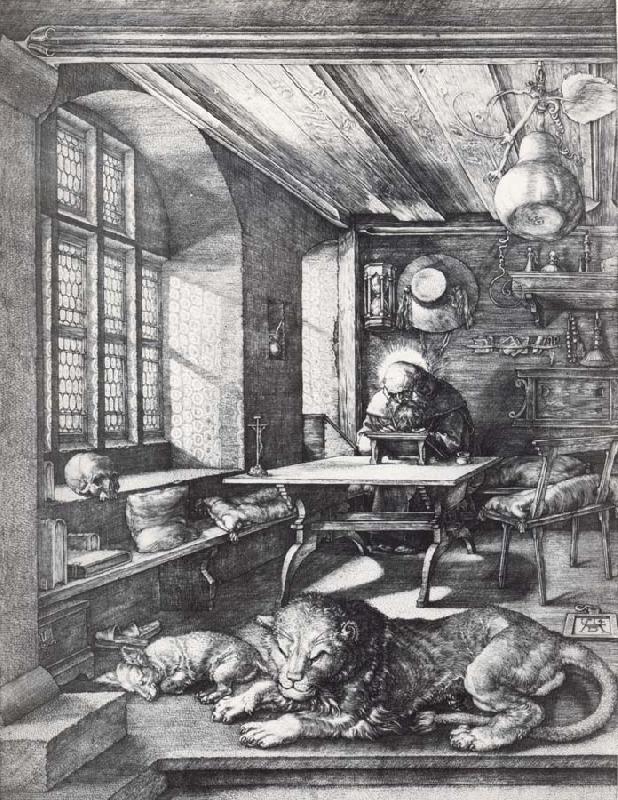
He begins by discussing two Albrecht Dürer engravings from 1514: St. Jerome in his Study and Melancholia. The former, Josipovici writes, depicts the saint as calm, at ease, "bathed in warm sunshine", "at one with himself and with his God as he works". The latter engraving is, by contrast, full of chaos, furious energy, depicting "art in competition with God", Melancolia as "a terrestrial craftsman cut off from all tradition and therefore incapable of productive work". She is inactive "because all work has grown meaningless to her": "St. Jerome shows us what has got lost; Melancolia I what we are left with.” In the following century, this new situation, combined with new possibilities presented by the printing press, is seen as the occasion for comedy for Rabelais and Cerventes. Both writers, in acknowledging the absurdity of writing in isolation for an unknown audience—where in the past storytellers told their tales directly to an audience—undercut the authority of their own narratives, reminding the reader how things really are—remember, after all, this is just a story. Don Quixote
To be blunt, I don't think enough attention has been paid to what Josipovici says about the disenchantment of the world; it is, as Max Cairnduff writes, “absolutely critical to everything that follows”. Reviewers have missed the centrality of this, while also missing the related observation by Josipovici that this disenchantment is generally assumed to be "a Good Thing", "since it led us from an era of superstition to our modern era of common sense and scientific understanding". Which is to say that for Josipovici, as Stephen Mitchelmore emphasizes, it is "not necessarily A Good Thing". This is no small point, yet it is treated as if it were. It is in fact the main point. But how are we to approach this question, from where we sit? It is, admittedly, not easy. I submit that most readers are unlikely to be receptive to this message, and understandably so, since the very structure of our lives seems to argue against it. It is, however, a message I think we need to hear. I'm not going to spend a lot of time on the problem of authority (this is covered to my satisfaction by both Cairnduff and Mitchelmore in the posts I've linked above). I'm instead going to complicate the matter of the disenchantment of the world, but in a way that I hope will help to clarify some of what is at stake.
In The Book of God (1988), his marvelous study of The Bible, Josipovici wrote the following:
But what if we try to look at this period from the standpoint of ordinary people? What if we think of the disenchantment of the world as a very real thing, with events affecting real people, and not simply as an increasing sense "people" had that things were changing? Because the period we're talking about just happens to correspond exactly with the long transition from feudalism to capitalism. It is the period of Karl Polanyi’s “Great Transformation”. The late feudal period was, again from the perspective of ordinary people, marked by elites banding together, by the bourgeoisie and aristocracy putting aside their longstanding differences to defeat the various diverse anti-feudal movements that had characterized the preceding few centuries, which had taken the form of peasant revolts, popular heresy and millenarian movements, not to mention everyday forms of passive resistance, and so on. So, rather than the traditional conception of a smooth or inevitable "transition" from feudalism to capitalism, it is, I think, more accurate to view capitalism as the counter-revolution (just as the United States Constitution is an outgrowth of a counter-revolution, undermining the more popular democratic tendencies of the American Revolution itself). In this light, common people were caught in between the replacement of one form of traditional authority, which they actively (as well as passively) resisted for centuries, and the newer authority imposed by the emergent capitalist social relations and mode of production, which they also actively resisted.
In this context, then, what is the disenchantment of the world? I see it as two related things, always keeping in mind these shifting modes of authority faced by ordinary people. First is the loss of the commons, and all that entails, including access to means of subsistence, control over reproduction, and community life, including festivals, holidays, gossip, mutual care, and resistance. Second, following from the first and no less important, is the disciplining of labor, which provided the backdrop for the philosophical/scientific attack on the body, as in Descartes, and theories of the state, as in Hobbes, which form twin, if occasionally opposed, pillars of our modern scientific and intellectual heritage. Related to both of these is the privatization of religion, or what could be called the "Christianization of the masses"; we know about the inwardness of mainline Protestantism itself (again, Josipovici dwells on this important point in his discussion of Kierkegaard, a writer he also discusses at length in On Trust), but the Catholic confession dates from this period as well—private religious practice being imposed, just as the more communal religious practices are actively being driven out. The Protestant Reformation was in many respects a massive land grab, another significant moment in the general enclosure of the commons. And this is the period of the witch-hunts, which, far from being the irrational attacks from the undifferentiated, ignorant mob of our popular imagination, were instead more or less systematic secular campaigns against common practices and beliefs, primarily those practices and beliefs of women in the areas of reproduction; a campaign, not incidentally, fully supported by some of the biggest names in our scientific legacy.
As Silvia Federici puts it, in her indispensable book, Caliban and the Witch (note: in the next few paragraphs, all quotes are from Federici, unless otherwise specified, but I am informed here by Marx, Polanyi, Peter Linebaugh and Marcus Rediker, Maria Mies, Fernand Braudel, and Giovanni Arrighi, among others):
But we were talking about artists. Despite what some proponents of political art would have us believe, it is not the artist's job to report on political events. Nevertheless, their work is instructive. Dürer’s The Fall of Man (1510), which depicts Adam and Eve being ejected from Eden, can be read as "[evoking] the expulsion of the peasants from their common lands". His Monument to the Vanquished Peasants (1526), following the Peasant War of 1525, could "suggest that the peasants were betrayed or that they themselves should be treated as traitors" and "has been interpreted either as a satire of the rebel peasants or as homage to their moral strength". Dürer was a follower of Luther, and his work is said to have "helped to disseminate the teachings of the Reformation". Luther himself condemned the peasant rebellions; Dürer perhaps agreed, but as an artist saw what he saw, and was able to convey some measure of ambivalence. His version of The Four Horsemen of the Apocalypse was but one example of what was at the time a common artistic theme, which with its Biblical imagery reflected the horrible, very real suffering experienced by very real, ordinary people, who, in a situation of enforced scarcity, were constrained from maintaining their own subsistence in the traditional manner. The first half of the 16th century resulted in "the absolute impoverishment of the European working class, a phenomenon so widespread and general that, by 1550 and long after, workers in Europe were referred to as simply 'the poor'." Meat disappeared from workers’ diets—"a historic setback . . . compared to the abundance of meat that had typified the late Middle Ages." Here is Federici expanding on this point, bringing Rabelais back into our story:
Few people know this history; fewer still look at it from the standpoint of the ordinary people affected by its forward march, though some are sensitive to the difficult problems that history has wrought. We are most of us ordinary people ourselves, who identify all too completely with the winners. So it's probably the case that most anyone reading the book likely does see the disenchantment of the world as a good thing, if they think of it at all. Josipovici quotes the following from a footnote in T.J. Clark's Farewell to an Idea: Episodes from a History of Modernism:
Instead, responses have most often focused on the final two chapters of the book, in which Josipovici turns his attention back to the question raised by the title. What, indeed, ever happened to modernism? Unfortunately, these chapters, while enjoyable reads (large stretches of them are just as fascinating as the rest of the book), are not nearly as successful as the book up to that point, or indeed the rest of his criticism outside of this book. In part this is simply because he mentions several big English literary authors by name (McEwan, Amis, Barnes, etc) without making it clear why they in particular are found wanting. In this way, I think, it has been easy for admirers of those writers to read these passage as attacks. Which is exactly what happened, especially with the very first reactions. For myself, this was the first time in all of his work that I felt he wasn't speaking to me. These two chapters are written, fairly explicitly, to an English audience, with references to "these shores" and the English literary world in particular. At one point, while extolling the virtues of Clark's book, he notes that Clark, by "Writing about episodes in a history",
Related to this is a curious feature common to many of the reviews I've seen, positive and negative. These readers have noticed that Josipovici favors certain writers over others. They've even noticed to some extent what seems to differentiate those writers. Yet, having read the book, they can still do little more than wonder "why can't you like both" kinds of writers? As if two distinct species of writer were being posited. Some have expressed this point with considerable irritation, annoyed that they are being told what to like. They are being told no such thing. It is apparently easy to miss that Josipovici admits that he has enjoyed many of the novels by the authors in question. But he also says that, when he first read such writers, he wondered why they didn't touch him the way other writers did. They were enjoyable, diverting narratives, but he never felt compelled to return to them. It could be said that this disparity has animated his critical career. Anyway, it is not being suggested that readers cannot like whatever they want, just as it is not being asserted that Martin Amis and Ian McEwan are terrible writers. What is, however, being suggested is, first, what characterizes the condition of being modern, and, second, what an appropriate response to that condition might be. In this context, I wonder if it could be argued that Philip Roth is responding appropriately as an American writing after the Second World War. And if not, it seems to me that his response would still need to be situated in that American context (I happen to think this is a potentially fruitful line of inquiry, considering the American tradition of so-called post-modernism, but then I am an American). Of course, as Josipovici readily admits later in the book, these kinds of assessments are necessarily affected by our own personal situation (it is in this context that he admits that the Marxist perspective on Modernism perhaps has a point).
One of the factors leading to the writing of this book was Josipovici's dismay at the adulation showered on Irène Némirovsky's posthumous novel, Suite Française. Written in 1942, and set in the war, the novel would have been old-fashioned at the time, and in its mode is little more than "run-of-the-mill middlebrow narrative", yet was treated as a modern classic when discovered and finally published in 2004. So, in Chapter 14 ("It Took Talent to Lead Art Astray"), Josipovici discusses Némirovsky's novel, comparing it to a novel of similar vintage, also about the war, by Claude Simon. Némirovsky, he says, "is simply unaware of the inappropriateness of what she is doing, and one has to say that by her writing she makes 'a written renunciation to all claim to be an author'." In this case, it is useful to see the excerpts from the two novels, to see what Josipovici is claiming about the approaches taken by the two writers, to see what he means by an "appropriate" response. But, again, his problem is less with Némirovsky, who could only do what she felt was right, but in the out-sized praise her work received:
Towards the end of the book, Josipovici writes that "There cannot, then, be a definitive 'story' of Modernism. We cannot step outside it, much as we would like to, and pronounce with authority on it. We can only try to persuade people to see it from our point of view." His book is just such an attempt at persuasion, though he has been accused of elitism, of smugness (!!), of nostalgia, of snobbery. Rather, I think, he is peculiarly positioned to be able to perceive things many of us cannot, in part because of the details of his biography. In the final paragraph of the book, he allows that his particular affinities "may be largely because of who and what I am". He closes the book like this:
Related posts:
"Smoothness of Surface"
"A world about to be lost"
"The very notion of wholeness"
Notes on "The Bible Open and Closed"
"Modernism against Modernity"
Notes in advance of reading What Ever Happened to Modernism?
Follow-up to this post
Review of In a Hotel Garden
Review in The Quarterly Conversation of Goldberg: Variations (and follow-up)
Review of Everything Passes
I think the book is just as necessary as Josipovici’s earlier books On Trust, The Book of God, and the collection The Singer on the Shore. In the course of this essay, there are two aspects of the book I would like to devote special attention to. First is the central role played by "the disenchantment of the world". Second is what I think is a perhaps understandable, though real, miscalculation in the last few chapters of the book, chapters which have been given an overwhelming amount of attention by most reviewers, attention which has not served the book well, though, as noted above, it has perhaps attracted new readers (good and bad). Effectively, reviewers have all too often ignored or misunderstood the former, while taking undue offense at the latter.
The bulk of the book is devoted to an exploration of what modernism, for Josipovici, is. His definition, of course, is not the only definition of modernism available to us, which is but one reason for the confusion surrounding the book (for some salient remarks on this point, in this case with respect to James Joyce, see Stephen Mitchelmore's most recent post). For Josipovici it has to do with art's awareness of and response to the condition of being modern, which in part means that the world has become "disenchanted", among other things throwing sensitive artists into a crisis of authority. Allow me to quote from Mark Thwaite's concise description of the problem:
In a world that moved from being viewed by the vast majority through a sacramental lens, to one where earthly powers had ever more secular explanations, the problem of authority became a problem for art and artists. Why and in what way did the artist have authority to speak? And how could that question inform the art that the artist produced, so that their work did not exhibit the bad faith of pretending that question away. [...] Do artists seek to re-enchant the world (and who/what gives them authority to do so) or to respond to its disenchantment?How, under such circumstances, can the artist create? For whom does he or she create? Here, then, is Josipovici:
Here the desire, even the need, to create comes to be seen not as a gift but as a curse. For while the desire to create seems to be the most natural thing in the world, something we are all born with, what is it in a world without sure relation to either tradition or authority but a meaningless self-indulgence? When the social trappings of art fall away, when patronage disappears and the artist is forced to compete in the market-place for the sale of his goods, can there be any justification for art other than the desire for money and fame? […] in today's world there is no place for natural, spontaneous creation; everything we do seems false, laboured, second-hand; it feels like padding, pretence, a lie perpetrated by those who like to think of themselves as artists, in collusion with a market which knows that enough people need to feel they are in touch with some higher truth to make the art business profitable.The book opens with a series of quotations from four writers faced with this dilemma, selected by Josipovici from among many possible options to "stand for a century of pain, anxiety and despair", to "stand for what has been called the Crisis of Modernism": Mallarmé ("...each day discouragement overwhelms me..."; "...I am disgusted with my self; ... and cry when I feel myself to be empty and cannot put pen to the implacably white paper"), Hugo von Hofmannsthal ("I have quite lost the faculty to think or speak on any subject in a coherent fashion"; "...the language in which it might perhaps have been given to me not only to write, but also to think, is [...] a language of which I do not know even one word, [...] in which I may once, in my grave, have to account for myself before an unknown judge."), Kafka ("I can't write. I haven't written a single line that I can accept. . ."), and Beckett ("I speak of an art. . .weary of puny exploits, weary of pretending to be able, of being able, of doing a little better the same old thing, of going a little further along a dreary road." "The expression that there is nothing to express, nothing with which to express, nothing from which to express, no power to express, no desire to express, together with the obligation to express.") These quotations all come from the years 1850 to 1950, which is to say the years that are commonly seen as the Modernist period. Josipovici is aware that this makes it all too easy to reinforce the conception of Modernism as a style or period, or both, either way "as something safely behind us", rather than, as he argues, "a coming into awareness by art of its precarious status and responsibilities, and therefore as something that will, from now on, always be with us". This "precariousness" is seen as a condition of being modern; Modernism becomes, then, "a response by artists to the 'disenchantment of the world'". Josipovici then spends several chapters exploring this disenchantment, using the work of several artists and writers as illustrations of the problem and of the array of artistic responses to the problem.
He begins by discussing two Albrecht Dürer engravings from 1514: St. Jerome in his Study and Melancholia. The former, Josipovici writes, depicts the saint as calm, at ease, "bathed in warm sunshine", "at one with himself and with his God as he works". The latter engraving is, by contrast, full of chaos, furious energy, depicting "art in competition with God", Melancolia as "a terrestrial craftsman cut off from all tradition and therefore incapable of productive work". She is inactive "because all work has grown meaningless to her": "St. Jerome shows us what has got lost; Melancolia I what we are left with.” In the following century, this new situation, combined with new possibilities presented by the printing press, is seen as the occasion for comedy for Rabelais and Cerventes. Both writers, in acknowledging the absurdity of writing in isolation for an unknown audience—where in the past storytellers told their tales directly to an audience—undercut the authority of their own narratives, reminding the reader how things really are—remember, after all, this is just a story. Don Quixote

dramatises the way we as readers collude in this game because we want, for the duration of our reading, to be part of a realised world, a world full of meaning and adventure, an enchanted world. It is no coincidence that the novel emerges at the very moment the world is growing disenchanted.Somewhat later we have another important example in Laurence Sterne’s Tristram Shandy (not discussed in the book, though Josipovici has written about it elsewhere), in which the narrator hilariously never quite gets around to getting moving on telling the story of his life. Several key pages are spent on the poetry of Wordsworth (many reviews have indeed taken note of the unique presence of this poet in a book on Modernism) and the philosophical works of Kierkegaard, in particular in connection with problems of authority, anxiety, and inward-looking religious practice.
To be blunt, I don't think enough attention has been paid to what Josipovici says about the disenchantment of the world; it is, as Max Cairnduff writes, “absolutely critical to everything that follows”. Reviewers have missed the centrality of this, while also missing the related observation by Josipovici that this disenchantment is generally assumed to be "a Good Thing", "since it led us from an era of superstition to our modern era of common sense and scientific understanding". Which is to say that for Josipovici, as Stephen Mitchelmore emphasizes, it is "not necessarily A Good Thing". This is no small point, yet it is treated as if it were. It is in fact the main point. But how are we to approach this question, from where we sit? It is, admittedly, not easy. I submit that most readers are unlikely to be receptive to this message, and understandably so, since the very structure of our lives seems to argue against it. It is, however, a message I think we need to hear. I'm not going to spend a lot of time on the problem of authority (this is covered to my satisfaction by both Cairnduff and Mitchelmore in the posts I've linked above). I'm instead going to complicate the matter of the disenchantment of the world, but in a way that I hope will help to clarify some of what is at stake.
In The Book of God (1988), his marvelous study of The Bible, Josipovici wrote the following:
. . . once Luther stood up and asserted the need to speak the truth as he saw it and not pay lip-service to tradition, things could never be quite the same again. We tend to see Luther's break with the medieval church, like Spinoza's with Jewish tradition, as the triumph of light and integrity over the forces of obscurantism and hypocrisy; but this is to see it from their own point of view. It is important, however, to grasp what gets lost as well as what is won in such revolutions. . .Our point of view, or what feminists call standpoint, can be an obstacle; further, we can learn a lot by considering matters from alternative standpoints, especially those that are underrepresented in official histories. We view these events, respectively, from Luther’s and Spinoza’s perspectives—we see them as signposts, if you will, on the way to our current secular world, a world, in its modernity anyway, that most of us see as desirable and inevitable, if perhaps besieged. We identify with the smug self-congratulation of the Age of Reason and the Enlightenment—the very labels tell us how to think about them!—and all too rarely do we consider what was lost, or if we do, we are rarely likely to consider that what was lost is worth worrying about or mourning. Josipovici, along with other critics and writers, has looked past this point of view, to consider the perspectives of artists. And indeed artists can and do offer us glimpses into changes that took place, worlds that were lost. But they do it from their own standpoint, which is a standpoint often at some remove from the events. For when we look at this period from the standpoint of artists, we are necessarily also looking at it also (but not completely) from the standpoint of the elite, or an elite, for in this period artists were either themselves elites, or at least patronized by elites, whether aristocratic, clerical, or bourgeois. So when we think of the declining of traditional authority, we are thinking of not only the Catholic Church, but also the feudal lords. In their place, eventually, are the various Protestant churches, and the bourgeoisie. This was a long process, covering almost the entire period under discussion, in one way or another.
But what if we try to look at this period from the standpoint of ordinary people? What if we think of the disenchantment of the world as a very real thing, with events affecting real people, and not simply as an increasing sense "people" had that things were changing? Because the period we're talking about just happens to correspond exactly with the long transition from feudalism to capitalism. It is the period of Karl Polanyi’s “Great Transformation”. The late feudal period was, again from the perspective of ordinary people, marked by elites banding together, by the bourgeoisie and aristocracy putting aside their longstanding differences to defeat the various diverse anti-feudal movements that had characterized the preceding few centuries, which had taken the form of peasant revolts, popular heresy and millenarian movements, not to mention everyday forms of passive resistance, and so on. So, rather than the traditional conception of a smooth or inevitable "transition" from feudalism to capitalism, it is, I think, more accurate to view capitalism as the counter-revolution (just as the United States Constitution is an outgrowth of a counter-revolution, undermining the more popular democratic tendencies of the American Revolution itself). In this light, common people were caught in between the replacement of one form of traditional authority, which they actively (as well as passively) resisted for centuries, and the newer authority imposed by the emergent capitalist social relations and mode of production, which they also actively resisted.
In this context, then, what is the disenchantment of the world? I see it as two related things, always keeping in mind these shifting modes of authority faced by ordinary people. First is the loss of the commons, and all that entails, including access to means of subsistence, control over reproduction, and community life, including festivals, holidays, gossip, mutual care, and resistance. Second, following from the first and no less important, is the disciplining of labor, which provided the backdrop for the philosophical/scientific attack on the body, as in Descartes, and theories of the state, as in Hobbes, which form twin, if occasionally opposed, pillars of our modern scientific and intellectual heritage. Related to both of these is the privatization of religion, or what could be called the "Christianization of the masses"; we know about the inwardness of mainline Protestantism itself (again, Josipovici dwells on this important point in his discussion of Kierkegaard, a writer he also discusses at length in On Trust), but the Catholic confession dates from this period as well—private religious practice being imposed, just as the more communal religious practices are actively being driven out. The Protestant Reformation was in many respects a massive land grab, another significant moment in the general enclosure of the commons. And this is the period of the witch-hunts, which, far from being the irrational attacks from the undifferentiated, ignorant mob of our popular imagination, were instead more or less systematic secular campaigns against common practices and beliefs, primarily those practices and beliefs of women in the areas of reproduction; a campaign, not incidentally, fully supported by some of the biggest names in our scientific legacy.
As Silvia Federici puts it, in her indispensable book, Caliban and the Witch (note: in the next few paragraphs, all quotes are from Federici, unless otherwise specified, but I am informed here by Marx, Polanyi, Peter Linebaugh and Marcus Rediker, Maria Mies, Fernand Braudel, and Giovanni Arrighi, among others):
What died was the concept of the body as a receptacle of magical powers that had prevailed in the medieval world. In reality, it was destroyed. For in the background of the new philosophy we find a vast initiative by the state, whereby what the philosophers classified as "irrational" was branded as crime.[...] "Knowledge" can only become "power" if it can enforce its prescriptions. This means that the mechanical body, the body-machine, could not have become a model of social behavior without the destruction by the state of a vast range of pre-capitalist beliefs, practices, and social subjects whose existence contradicted the regularization of corporeal behavior promised by Mechanical Philosophy. [...] This is how we must read the attack against witchcraft and against that magical view of the world which, despite the efforts of the Church, had continued to prevail on a popular level through the Middle Ages. [...] Eradicating these practices was a necessary condition for the capitalist rationalization of work, since magic appeared as an illicit form of power and an instrument to obtain what one wanted without work, that is, a refusal of work in action.[...] Magic, moreover, rested upon a qualitative conception of space and time that precluded a regularization of the labor process. [...] From [the ruling class's] viewpoint it hardly mattered whether the powers that people claimed to have, or aspired to have, were real or not, for the very existence of magical beliefs was a source of social insubordination. [Note: the above has been collapsed into one paragraph, with elisions bracketed off, in order to save space; emphasis is in the original]This is the disenchantment of the world, and it is, in my opinion, undeniably a tragedy, a regrettable loss, one very much worth mourning. This is not at all popular view in the mainstream, but neither is it popular among leftists or Marxists, who seem just as wedded to the telos of progress as any liberal or capitalist, and who are generally more than happy to consign to the dustbin of history the "rural idiocies" of those ignorant masses dispossessed in this period of "so-called primitive accumulation". Indeed, one of the better reviews of What Ever Happened to Modernism? was by Tim Black at Spiked. Black’s review is from a largely Marxist perspective, and though he calls the book "important" (and actually offers an interesting defense of realism), he also calls it "irritating" and "reactionary". For another recent example of this general attitude, in his book First As Tragedy, Then As Farce, Slavoj Žižek wrote "if there is one good thing about capitalism, it is that, precisely, mother earth now no longer exists" and "we should remain resolutely modern and reject the all too glib generalization whereby critique of capitalism morphs into the critique of 'instrumental reason' or 'modern technological civilization'. " No one who seriously considers the history of capitalism from the perspective of not only what actually happened to those people who were expropriated in the past, but also what is happening to those who are being expropriated today, still, in the same ways, but in different places, can so easily dismiss such "morphed" critiques.
But we were talking about artists. Despite what some proponents of political art would have us believe, it is not the artist's job to report on political events. Nevertheless, their work is instructive. Dürer’s The Fall of Man (1510), which depicts Adam and Eve being ejected from Eden, can be read as "[evoking] the expulsion of the peasants from their common lands". His Monument to the Vanquished Peasants (1526), following the Peasant War of 1525, could "suggest that the peasants were betrayed or that they themselves should be treated as traitors" and "has been interpreted either as a satire of the rebel peasants or as homage to their moral strength". Dürer was a follower of Luther, and his work is said to have "helped to disseminate the teachings of the Reformation". Luther himself condemned the peasant rebellions; Dürer perhaps agreed, but as an artist saw what he saw, and was able to convey some measure of ambivalence. His version of The Four Horsemen of the Apocalypse was but one example of what was at the time a common artistic theme, which with its Biblical imagery reflected the horrible, very real suffering experienced by very real, ordinary people, who, in a situation of enforced scarcity, were constrained from maintaining their own subsistence in the traditional manner. The first half of the 16th century resulted in "the absolute impoverishment of the European working class, a phenomenon so widespread and general that, by 1550 and long after, workers in Europe were referred to as simply 'the poor'." Meat disappeared from workers’ diets—"a historic setback . . . compared to the abundance of meat that had typified the late Middle Ages." Here is Federici expanding on this point, bringing Rabelais back into our story:
Not only did meat disappear, but food shortages became common, aggravated in times of harvest failure, when the scanty grain reserves sent the price of grain sky-high, condemning city dwellers to starvation. This is what occurred in the famine years of the 1540s and 1550s, and again in the decades of the 1580s and 1590s, which were some of the worst in the history of the European proletariat, coinciding with widespread unrest and a record number of witch-trials. But malnutrition was rampant also in normal times, so that food acquired a high symbolic value as a marker of rank. The desire for it among the poor reached epic proportions, inspiring dreams of Pantagruelian orgies, like those described by Rabelais in his Gargantua and Pantagruel (1552), and causing nightmarish obsessions, such as the conviction (spread among north-eastern Italian farmers) that witches roamed the countryside at night to feed upon the cattle.Allow me to leave here my detour into this working class history. I'd planned on delving more into the responses of artists to this situation, with a special emphasis on Shakespeare (including a digression into Josipovici's use of the work of the medieval historian Peter Brown in his elucidation of Richard II in On Trust; for this, let me instead refer the reader to my piece, "A world about to be lost"), but I believe I've said enough. My point, I think, is sufficiently made.
Few people know this history; fewer still look at it from the standpoint of the ordinary people affected by its forward march, though some are sensitive to the difficult problems that history has wrought. We are most of us ordinary people ourselves, who identify all too completely with the winners. So it's probably the case that most anyone reading the book likely does see the disenchantment of the world as a good thing, if they think of it at all. Josipovici quotes the following from a footnote in T.J. Clark's Farewell to an Idea: Episodes from a History of Modernism:
I realize that I shall be taken here and elsewhere to be idealizing pre-modern society, and inventing a previous watertight world of myth and ritual, agreed-on hierarchies, implicit understandings, embodied places, and so on. There is no easy way out of this dilemma. Of course pre-Modern societies (and certainly the ones existing in Europe immediately before the spread of mercantile capitalism and the seventeenth-century crisis) were conflicted and ideologically incomplete. I am on the side of historians who have fought against the picture of a pre-modern Europe characterised by absolute cultural uniformity, immovable religious consensus, the unthinkability of alternative views of the world, etc. Nonetheless, if we do not make a distinction between societies built, however inefficiently, upon instanced and incorporated belief, with distinctions and places said to be inherited from time immemorial, and societies driven by a new kind of economic imperative, in which place and belief are subject to constant revision by the very forces that give society form, then I reckon we forfeit the chance of thinking critically about the past two hundred years. To call such comparative thinking 'nostalgia' (or in the present techno-ecstatic conjuncture, 'Luddism') is just the latest form of philistinism about history in general.As such, the book is fighting an uphill battle, and not just against philistinism. To the extent that reviewers have addressed the matter at all, nostalgia is indeed usually the charge (regardless of explicit attempts to anticipate and forestall such a charge).
Instead, responses have most often focused on the final two chapters of the book, in which Josipovici turns his attention back to the question raised by the title. What, indeed, ever happened to modernism? Unfortunately, these chapters, while enjoyable reads (large stretches of them are just as fascinating as the rest of the book), are not nearly as successful as the book up to that point, or indeed the rest of his criticism outside of this book. In part this is simply because he mentions several big English literary authors by name (McEwan, Amis, Barnes, etc) without making it clear why they in particular are found wanting. In this way, I think, it has been easy for admirers of those writers to read these passage as attacks. Which is exactly what happened, especially with the very first reactions. For myself, this was the first time in all of his work that I felt he wasn't speaking to me. These two chapters are written, fairly explicitly, to an English audience, with references to "these shores" and the English literary world in particular. At one point, while extolling the virtues of Clark's book, he notes that Clark, by "Writing about episodes in a history",
is free to explore a whole web of stories rather than trace any linear sequence, and thus restore a sense of history being made—by artists, by events—rather than simply lived out, that the blind alleys down which artists have gone at certain periods of their lives are as important as their achieved successes, and that different responses are called for in pre-First World War France, in post-Revolutionary Russia and in America after the Second World War.I like this a lot, and I especially like the bit about blind alleys (I'm always thinking artists' minor or lesser works are too easily dismissed in this culture because we are impatient to move on to the next book or album or mp3 file). But I'm thrown, just a little, but the clause about the need for different responses. Not because it strikes me as wrong (it does not), but because in the previous chapter, one of the examples he uses of a writer who we read "to pass the time, to reassure ourselves that the world has meaning, and then . . . leave . . . and move on to the next book", is the American Philip Roth. He subsequently spends more time (though still not much) on Roth than he does on any other contemporary writer, because Roth has a reputation for being playful and "experimental", and Josipovici senses that his readers will have mistaken his book as an extended argument for experimental art—"Is that not what Modernism is about?" No, it is not: "If that is your reaction you have not really been taking in what I have been saying." It's clear enough to me, a longtime reader, that Josipovici has not equated Modernism with experimental art, but it's not difficult to imagine it not being clear to readers unfamiliar with his argument from his other work, given the general sense of Modernism as indeed being about experiment and innovation (on the other hand, does anyone really think of Kafka as an experimental writer?). Frankly, his remarks about the big shot contemporary writers are not terribly persuasive (even though I agree with most of them).
Related to this is a curious feature common to many of the reviews I've seen, positive and negative. These readers have noticed that Josipovici favors certain writers over others. They've even noticed to some extent what seems to differentiate those writers. Yet, having read the book, they can still do little more than wonder "why can't you like both" kinds of writers? As if two distinct species of writer were being posited. Some have expressed this point with considerable irritation, annoyed that they are being told what to like. They are being told no such thing. It is apparently easy to miss that Josipovici admits that he has enjoyed many of the novels by the authors in question. But he also says that, when he first read such writers, he wondered why they didn't touch him the way other writers did. They were enjoyable, diverting narratives, but he never felt compelled to return to them. It could be said that this disparity has animated his critical career. Anyway, it is not being suggested that readers cannot like whatever they want, just as it is not being asserted that Martin Amis and Ian McEwan are terrible writers. What is, however, being suggested is, first, what characterizes the condition of being modern, and, second, what an appropriate response to that condition might be. In this context, I wonder if it could be argued that Philip Roth is responding appropriately as an American writing after the Second World War. And if not, it seems to me that his response would still need to be situated in that American context (I happen to think this is a potentially fruitful line of inquiry, considering the American tradition of so-called post-modernism, but then I am an American). Of course, as Josipovici readily admits later in the book, these kinds of assessments are necessarily affected by our own personal situation (it is in this context that he admits that the Marxist perspective on Modernism perhaps has a point).
One of the factors leading to the writing of this book was Josipovici's dismay at the adulation showered on Irène Némirovsky's posthumous novel, Suite Française. Written in 1942, and set in the war, the novel would have been old-fashioned at the time, and in its mode is little more than "run-of-the-mill middlebrow narrative", yet was treated as a modern classic when discovered and finally published in 2004. So, in Chapter 14 ("It Took Talent to Lead Art Astray"), Josipovici discusses Némirovsky's novel, comparing it to a novel of similar vintage, also about the war, by Claude Simon. Némirovsky, he says, "is simply unaware of the inappropriateness of what she is doing, and one has to say that by her writing she makes 'a written renunciation to all claim to be an author'." In this case, it is useful to see the excerpts from the two novels, to see what Josipovici is claiming about the approaches taken by the two writers, to see what he means by an "appropriate" response. But, again, his problem is less with Némirovsky, who could only do what she felt was right, but in the out-sized praise her work received:
[T]he question is not why she should have written as she did, but what has happened to our culture that serious and intelligent and well-read reviewers, not to speak of prize-winnings novelists and distinguished biographers, many of whom have studied the poems of Eliot or the novels of Virginia Woolf at university, should so betray their calling as to go into ecstasies over books like Némirovsky's while, in their lifetimes and now after their deaths, ignoring the work of novelists like Claude Simon, Georges Perec, Thomas Bernhard and Gert Hofmann.This, then, is a fuller expression of the question asked by the title. But in the very next paragraph he admits that "To answer this would require a sociologist, perhaps, and another book." He is not really in a position to answer the question. It could be said that the book itself intends to raise the question rather than to answer it. Well, one can almost hear it being said (indeed, Weinberger says it with much annoyance), if he's not going to answer the question, what is the point? The point, I think, is that some questions need to be sensitively and intelligently posed before they can be answered. That is, since the disenchantment of the world is a general cultural problem, the question raised by the title cannot be answered via literary criticism alone, or through art history.
Towards the end of the book, Josipovici writes that "There cannot, then, be a definitive 'story' of Modernism. We cannot step outside it, much as we would like to, and pronounce with authority on it. We can only try to persuade people to see it from our point of view." His book is just such an attempt at persuasion, though he has been accused of elitism, of smugness (!!), of nostalgia, of snobbery. Rather, I think, he is peculiarly positioned to be able to perceive things many of us cannot, in part because of the details of his biography. In the final paragraph of the book, he allows that his particular affinities "may be largely because of who and what I am". He closes the book like this:
The late R.B. Kitaj compared Cézanne's rootedness in his native Provence to what he called the 'diasporist' ... imagination of the uprooted Picasso, and he suggested that at some deep level Modernism and the diasporist imagination go together. This may be true if we have a flexible enough notion of disapora to accept that an apparently rooted Frenchman like Bonnard or Englishwoman like Virginia Woolf could also have created a 'diasporic' art—and then one would want to look at Bonnard's relocation to the South of France in the latter part of his life as a kind of exile in which he went with his problematic wife, and at Virginia Woolf's sense of herself as a woman excluded from a male-dominated society. To that extent the Marxist critique of Modernism I mentioned at the start may have a point: Modernism may not be a consequence of the crisis of the bourgeoisie but it may be the product of a general European rootlessness in the wake of the French and Industrial revolutions. All will then depend on whether we see such rootlessness as pathological or as giving those who are imbued with it a certain vantage point, allowing them to see things which might otherwise have remained hidden. In other words, are we to see our own history, that which makes us what we are, as something which blinkers us or which sharpens our vision. This is, in itself, of course, a very Modernist question.For all that Josipovici is advancing a particular perspective, he leaves it up to us to see for ourselves. Can it not be said that each of us is potentially our own diaspora? We have been fragmented, dispersed, alienated. We constitute a working class massive, but identify all too much with the very power that destroyed the history described above and seems unable to avoid destroying everything it touches, on the way alienating us from not only our own labor, but our very existences, though some of us, not only artists, are afforded glimpses of other possibilities and are receptive to art that suggests such possibilities, and otherwise questions and breathes. This is why all of this matters, and why Modernism continues to speak to us, through the din of received histories and imperial narratives, fictional or otherwise, and why we need critics like Gabriel Josipovici.
Related posts:
"Smoothness of Surface"
"A world about to be lost"
"The very notion of wholeness"
Notes on "The Bible Open and Closed"
"Modernism against Modernity"
Notes in advance of reading What Ever Happened to Modernism?
Follow-up to this post
Review of In a Hotel Garden
Review in The Quarterly Conversation of Goldberg: Variations (and follow-up)
Review of Everything Passes
Friday, June 10, 2011
Translation revisited
Last week, our friend BDR, in linking to Stephen Mitchelmore's recent meditation on Peter Handke's fiction, reported an opinion of a professor acquaintance who told him "if you can't read Handke in German don't bother since Handke's main interest is the language." With all due respect, I call bullshit on this. I cannot read Handke, or anyone else, in the German, but I would be much the poorer for not having read the English translations of Slow Homecoming, Across, or Repetition, to name only three from the 1980s. They are remarkable works in their own right. I'd go further and say that few works written originally in English from that same decade compare favorably with them. So to say I shouldn't have bothered? Nonsense.
On a related note, back in March, translator Daniel Hahn had a post at Words Without Borders in which he took issue with how translations are reviewed. He rants thus (emphasis his):
I began reading Hahn's post expecting it to contain utterly banal points with which I would trivially agree. After all, it is all too believable that reviewers both tend to ignore the work of translators and have little understanding of what it is the translator does. But Hahn takes it further, appearing to claim that the translator is entirely responsible for "the rhythm, the texture, the beauty of the prose, the warmth and wit of the voice". In fact, the translator is responsible for conveying as best as possible the original author's rhythm, texture, beauty, warmth, and wit. The translator makes the best possible decisions within constraints presented by the original work.
Along with those Manheim-translated works mentioned above, I've also read Handke books rendered into English by other translators, such as Scott Abbott and Michael Roloff, and have never gotten the impression I was reading a stylistically different writer. I have just begun reading Charlotte Mandell's translation, from the French, of Mathias Énard's recent novel, Zone. The last novel I read was, coincidentally, Mandell's translation of Jonathan Littell's remarkable novel, The Kindly Ones. Oddly, they have very little in common at the level of the sentence! And neither of them bear any obvious resemblance whatsoever to Mandell's translations of Maurice Blanchot, which themselves are instead stylistically similar to other Blanchot translations, for example, those by Ann Smock or Lydia Davis (meanwhile, Davis' own fiction is nothing like her translations of Blanchot). This point aside, which I am sure I have belabored, Hahn here, in so easily separating plotting and characterization from the language used, demonstrates as little appreciation of fiction as the standard mainstream reviewer.
Daniel Green, highlighting Hahn's post, agrees with him too readily, though he makes this excellent point, which is the point I'd originally thought Hahn was going to make, as I began reading him: "Too many reviewers make too many facile judgments of translations in which the translation itself drops out. . ." Unfortunately, Dan uses this as an opportunity to once again all but throw his hands up when it comes to translations. He writes:
There once was a time when a literate person knew and could read multiple languages as a matter of course. There are no doubt countless reasons why this is no longer the case, at least in the Anglo-American world. And, of course, literacy itself is more widespread. Anyway, regardless of the reasons, many of us rely entirely on translations if we are to read anything originally written in a language other than our own. There is undeniably a distance between the original work and its possibly multiple translations. Some of us, myself included, have looked on this situation with anxiety. How do I know which translation to choose? What am I missing? How will I ever know or understand the work in question? As such, we owe good translators a great debt of gratitude, and we should always remember what it is that they do for literature. And certainly praising any quality of the prose without mentioning its status as translation is opening a reviewer up to easy and deserved criticism. But the history of literature is rife with misreadings and poor interpretations and context-free assessments, not to mention misleading translations; indeed, the history of literature arguably is these misreadings. We do the best we can with what we have. That so many of us require translations in order to read most of the great works of world literature is no reason not to read them, nor is it a reason to refuse to critically engage with such works at whatever level we see fit.
As readers, we can never "know fully" any work, translated or not. We are always at some remove from the work. Treating art as a set of objects to be assessed and judged is finally little different than treating it as a set of commodities to be bought and sold.
On a related note, back in March, translator Daniel Hahn had a post at Words Without Borders in which he took issue with how translations are reviewed. He rants thus (emphasis his):
what makes me crazy is when the reviewer praises something that I did and gives the impression that I’m not there. By all means compliment the author on the tightness of the plotting, on the deftness of the characterization, and ignore me—they’re supported by my work, of course, but marginally. But a reviewer who thinks he can praise the rhythm, the texture, the beauty of the prose, the warmth and wit of the voice, without acknowledging who’s responsible—as though those things in an author’s original simply reappear automatically after the mechanics of translation have been applied to a text—that’s a reviewer who simply has no understanding of what translation is. There’s a reason the copyright in my translations belongs to me and not the original author. The plot and the ideas and the themes aren’t mine, but the words are, all of them, and the way they all fit together, too. And if that’s what you’re reviewing, I want credit. (Or, for that matter, criticism.)This strikes me as, frankly, wrong. All three of those Handke titles I mentioned above were translated into English by Ralph Manheim. Another of my Handke favorites is the memoir about his mother, A Sorrow Beyond Dreams, which was also translated by Manheim. Perhaps it's simply Manheim I like! I think not.
I began reading Hahn's post expecting it to contain utterly banal points with which I would trivially agree. After all, it is all too believable that reviewers both tend to ignore the work of translators and have little understanding of what it is the translator does. But Hahn takes it further, appearing to claim that the translator is entirely responsible for "the rhythm, the texture, the beauty of the prose, the warmth and wit of the voice". In fact, the translator is responsible for conveying as best as possible the original author's rhythm, texture, beauty, warmth, and wit. The translator makes the best possible decisions within constraints presented by the original work.
Along with those Manheim-translated works mentioned above, I've also read Handke books rendered into English by other translators, such as Scott Abbott and Michael Roloff, and have never gotten the impression I was reading a stylistically different writer. I have just begun reading Charlotte Mandell's translation, from the French, of Mathias Énard's recent novel, Zone. The last novel I read was, coincidentally, Mandell's translation of Jonathan Littell's remarkable novel, The Kindly Ones. Oddly, they have very little in common at the level of the sentence! And neither of them bear any obvious resemblance whatsoever to Mandell's translations of Maurice Blanchot, which themselves are instead stylistically similar to other Blanchot translations, for example, those by Ann Smock or Lydia Davis (meanwhile, Davis' own fiction is nothing like her translations of Blanchot). This point aside, which I am sure I have belabored, Hahn here, in so easily separating plotting and characterization from the language used, demonstrates as little appreciation of fiction as the standard mainstream reviewer.
Daniel Green, highlighting Hahn's post, agrees with him too readily, though he makes this excellent point, which is the point I'd originally thought Hahn was going to make, as I began reading him: "Too many reviewers make too many facile judgments of translations in which the translation itself drops out. . ." Unfortunately, Dan uses this as an opportunity to once again all but throw his hands up when it comes to translations. He writes:
This is the tragedy of translation: Many of us will read some great books only in their translated versions, and thus we won't finally really know fully what makes them great. It's also possible we might read some rather mediocre books that have actually been made better by their translations. Given the cachet translated fiction seems to have acquired among some readers (its very lack of widespread availability, its lack of attention from the major newspaper book reviews perhaps allowing the devotee of translated fiction to feel one of the enlightened few), I think it likely some translated books of this latter kind are getting more attention than they deserve--under the prevailing circumstances, any new translated work deserves notice. Making authors and their work available through translation is an entirely worthy service, but understanding their limits are also important. We shouldn't make claims about the underlying work--on which the translation is a variation and therefore a new work--we can't possibly validate without in fact reading it.There are some good points mixed with the bad here. I think he's right that there is some excessive valorizing of translated works for their own sake, and it's of course trivially true that translations have their limitations, and that we should be cognizant of them. However, where Daniel Hahn wants to isolate plot and structure from the "rhythm, texture, beauty, warmth, and wit" of the language, Daniel Green insists, as he often does, that because we necessarily read some great books in translation, "we won't finally really know fully what makes them great" because of that distance. The problem with this is that it assumes that "knowing fully" what makes great books great is the ultimate object of reading.
There once was a time when a literate person knew and could read multiple languages as a matter of course. There are no doubt countless reasons why this is no longer the case, at least in the Anglo-American world. And, of course, literacy itself is more widespread. Anyway, regardless of the reasons, many of us rely entirely on translations if we are to read anything originally written in a language other than our own. There is undeniably a distance between the original work and its possibly multiple translations. Some of us, myself included, have looked on this situation with anxiety. How do I know which translation to choose? What am I missing? How will I ever know or understand the work in question? As such, we owe good translators a great debt of gratitude, and we should always remember what it is that they do for literature. And certainly praising any quality of the prose without mentioning its status as translation is opening a reviewer up to easy and deserved criticism. But the history of literature is rife with misreadings and poor interpretations and context-free assessments, not to mention misleading translations; indeed, the history of literature arguably is these misreadings. We do the best we can with what we have. That so many of us require translations in order to read most of the great works of world literature is no reason not to read them, nor is it a reason to refuse to critically engage with such works at whatever level we see fit.
As readers, we can never "know fully" any work, translated or not. We are always at some remove from the work. Treating art as a set of objects to be assessed and judged is finally little different than treating it as a set of commodities to be bought and sold.
Wednesday, May 25, 2011
"The wish was father to the thought"
At the very end of The Tyranny of Science, a book collecting a series of four lectures Paul Feyerabend gave at Berkeley in the early 1990s, this question is asked of Feyerabend:
But back to the question and response. I was amused that, after four days of Feyerabend's lectures, the person asking is able to innocently use the word "evolved", implying a telos of progress at odds with his thesis, or that the "rise of rationalism" is necessarily a good thing. When I first read the question, I admit that I read it as wondering how the "evolved" Greeks did not consider women as people, like men. I quickly read past the "considered as such, as women", which evidently has more to do with their biological function, as women, as those who give birth, etc. My misreading made me laugh (and actually provided the kernel leading to me writing this post), but the implied telos of progress remains and serves as a useful point of departure.
Interestingly, Feyerabend hints that the notion that women are merely "breeding ovens" is, relatively speaking, for Aeschylus, a new one. He notes that, for the more ancient Furies, the mother is a "blood relative", or in our scientific language, a genetic contributor. He notes that Apollo's idea overturns this. What he doesn't say is why that might be. He observes that the idea that women are merely "breeding ovens" is not implausible given the knowledge available to people at the time, but he doesn't say anything about why such a new idea would be appealing. I would like to suggest that the Oresteia is in a sense a dramatization of the domestication of the female, a manifestation of the hiding, the covering up, of the older matriarchal order. By the end, the Furies have been tamed; they have become "the Kindly Ones". (It is, by the way, entirely coincidental that I completed Jonathan Littell's astonishing novel by that name just prior to reading The Tyranny of Science.)
I've made the argument (or, well, assertion) multiple times already that the histories of philosophy and science would look a lot different if the experience of women were considered worthy of attention, or if those disciplines had been practiced by women, rather than by men off doing Important Work. I originally said this based on some reading, but really on little more than a hunch. Lately, however, I have been reading works that have both reinforced this conviction and deepened my understanding and appreciation of the problem. One of these was a book I read last year by the late Marxist historian George Thomson with the very dry academic title, Studies in Ancient Greek Society: The Prehistoric Aegean. To quote from the back cover, Thomson "traces the economic and social development of Greece in the Bronze Age and deals with the evolution of epic poetry" including "detailed discussions of such topics as matriarchy and land tenure." It's a boring, somewhat convoluted story as to how I ended up reading this fairly obscure book, but I'm glad I did: it's a fucking monster, deeply learned, incredibly erudite, often over my head, at times unexpectedly very funny (his occasional rants about bourgeois historians are frankly awesome), and fascinating as hell.
With respect to the topic at hand, one of the interesting things Thomson does is trace the roots of the Greek myths, including, among other things, how they were cobbled together over centuries from disparate stories about various local gods. Another is trace the attitudes the Greeks had towards others and towards their own past. For this, he surveys a variety of reports, from Herodotus, Eusebius, Strabo, Aristotle, Thucydides, with references to confirmations from Plato and Aristophanes: "The Greeks were well acquainted with the realities of primitive society":
In relation to what you said the first day, talking about the Furies, namely that the mother was seen as just a breeding oven, I would like to understand the reasons why in such an evolved society as it was in ancient Greece, women were not considered as such, as women.Here is Feyerabend's reply:
In the play itself this idea is introduced by Apollo, who represents a new kind of religion. For the Furies the mother is not just a breeding oven, it is a blood relative. So there are two parties and the question is how the new party arose. I do not know that. Athena's solution is that both parties have made contributions to the history of the city and should be remembered by it. Was it implausible to make the assumption that women are a breeding oven? Not on the basis of what was known at the time. Women gave birth. They bore the child for nine months. They became pregnant as a result of intercourse. This was known and that is not being denied. What is being denied is, to use modern terms, is that women make a genetic contribution. That is a very subtle matter which at that time could only be dealt with by ideology.This response is both interesting and unsatisfactory, in the way that the book as a whole is both interesting and unsatisfactory. The book is unsatisfactory, for me, because, as Feyerabend himself anticipates more than once in these lectures, I would have preferred a more "systematic" account of the "rise of rationalism" and his argument that (quoting the back cover) "some very basic assumptions about science are simply false and that substantial parts of scientific ideology were created on the basis of superficial generalizations that led to absurd misconceptions about the nature of human life". He explains why he does not offer such a systematic argument (e.g., systematization is part of the problem; fair enough), yet I desire one nonetheless. I'll have to look elsewhere (any recommendations?). The book is interesting, in part, because Feyerabend tells stories, including the stories contained in some of the Greek tragedies, to illustrate some of the problems with the stories told by the early philosophers. He is also at pains to remind us of the context of the tragedies, as well as of such artifacts as Plato's dialogues, how what we read is necessarily only an aspect of how they would have been experienced in their own time. All this is very well and good. However, he is often unclear about the significance of some of what he relates, or perhaps he assigns a different significance than they seem to reveal to me.
But back to the question and response. I was amused that, after four days of Feyerabend's lectures, the person asking is able to innocently use the word "evolved", implying a telos of progress at odds with his thesis, or that the "rise of rationalism" is necessarily a good thing. When I first read the question, I admit that I read it as wondering how the "evolved" Greeks did not consider women as people, like men. I quickly read past the "considered as such, as women", which evidently has more to do with their biological function, as women, as those who give birth, etc. My misreading made me laugh (and actually provided the kernel leading to me writing this post), but the implied telos of progress remains and serves as a useful point of departure.
Interestingly, Feyerabend hints that the notion that women are merely "breeding ovens" is, relatively speaking, for Aeschylus, a new one. He notes that, for the more ancient Furies, the mother is a "blood relative", or in our scientific language, a genetic contributor. He notes that Apollo's idea overturns this. What he doesn't say is why that might be. He observes that the idea that women are merely "breeding ovens" is not implausible given the knowledge available to people at the time, but he doesn't say anything about why such a new idea would be appealing. I would like to suggest that the Oresteia is in a sense a dramatization of the domestication of the female, a manifestation of the hiding, the covering up, of the older matriarchal order. By the end, the Furies have been tamed; they have become "the Kindly Ones". (It is, by the way, entirely coincidental that I completed Jonathan Littell's astonishing novel by that name just prior to reading The Tyranny of Science.)
I've made the argument (or, well, assertion) multiple times already that the histories of philosophy and science would look a lot different if the experience of women were considered worthy of attention, or if those disciplines had been practiced by women, rather than by men off doing Important Work. I originally said this based on some reading, but really on little more than a hunch. Lately, however, I have been reading works that have both reinforced this conviction and deepened my understanding and appreciation of the problem. One of these was a book I read last year by the late Marxist historian George Thomson with the very dry academic title, Studies in Ancient Greek Society: The Prehistoric Aegean. To quote from the back cover, Thomson "traces the economic and social development of Greece in the Bronze Age and deals with the evolution of epic poetry" including "detailed discussions of such topics as matriarchy and land tenure." It's a boring, somewhat convoluted story as to how I ended up reading this fairly obscure book, but I'm glad I did: it's a fucking monster, deeply learned, incredibly erudite, often over my head, at times unexpectedly very funny (his occasional rants about bourgeois historians are frankly awesome), and fascinating as hell.
With respect to the topic at hand, one of the interesting things Thomson does is trace the roots of the Greek myths, including, among other things, how they were cobbled together over centuries from disparate stories about various local gods. Another is trace the attitudes the Greeks had towards others and towards their own past. For this, he surveys a variety of reports, from Herodotus, Eusebius, Strabo, Aristotle, Thucydides, with references to confirmations from Plato and Aristophanes: "The Greeks were well acquainted with the realities of primitive society":
Surrounded as they were by more backward peoples at various stages of savagery or barbarism and by the advanced but archaic empires of the Near East, the civilised Greeks did not fail to observe that the status of women in these surrounding countries was very different from what it was in their own.Without going into great detail (or excerpting several whole pages), the upshot is that these peoples employed a wide range of matriarchal characteristics, from different rules for descent and matrimony to different configurations of property and labor to more egalitarian sexual roles. Thomson says, "There is no reason to discredit this tradition. Athenians would not have fabricated a story which represented their ancestors as savages" and quotes Thucydides thus: "The Greeks lived once as the barbarians live now." But, he writes, already reaction had set in:
The materialist view of social evolution was irreconcilable with the doctrine, fostered by the growth of slavery, that Greek and barbarian were different by nature. If such things as primitive communism, group-marriage, and matriarchy were admitted into the beginnings of Greek civilisation, what would become of the dogma, on which the ruling class leant more and more heavily as the city-state declined, that its economic basis in private property, slave labour, and the subjection of women rested on natural justice? If the writings of the later materialists, Demokritos and Epicurus, had not perished, we might well have possessed a more penetrating analysis of early Greek society than Aristotle's. But they perished partly for that reason. Plato wanted the works of Demokritos to be burnt, and his wish has been fulfilled.In case my point in discussing these two books together is unclear, I'll finish up by simply observing that it has always been in the interests of ruling classes to naturalize their power and the social and property relations informing that power. Likewise, it has always therefore been necessary to avoid or obscure any history—specifically, the central role of women—that reminds us how things otherwise have been and still could be.
No serious student can read Aristotle's Politics without admiration for the author's erudition and insight. If that book had perished, the world would be the poorer. But this must not prevent us from recognising its limitations. He knew that the Greeks had once lived in tribes, and he must have been familiar with the tradition that they had once been without slaves. He was presumably aware of the part assigned to Kekrops in the history of matrimony, and in any case he had before him the example of contemporary Sparta, where the rule of monogamy was so little binding that half a dozen brothers might share a wife between them and adultery was not punishable or even discreditable. Yet, accepting the city-state as the only possible formation for civilised life, he constructs a theory in which the original nucleus of society is identified as the married couple dominated by the male and supported by slave labour. The principle laid down by Thucydides was precluded from the start.
Where Aristotle failed, we cannot expect much of Herodotus. During all his travels the truth stated so lucidly by Thucydides never dawned on him. All he has to say of the Egyptian matriarchate is that 'sons were not obliged to support their parents, but daughters were'—alluding to the rule of inheritance; and the remark occurs in a passage where he is more concerned to divert his readers than to interpret the facts. Hence it is not surprising that he introduced his account of the Lycian matriarchate with the observation that 'it is unparalleled among the peoples of mankind'. The wish was father to the thought. The significance of this misstatement is that it represents what [...] the Greeks of his day were predisposed to believe.
Monday, May 02, 2011
Righteous
Our eternal war with Eurasia needs no justification, yet has always been justified.
Update - 9pm: I learned about the death of Osama bin Laden during last night's long baseball game between the Philadelphia Phillies and the New York Mets, first via Phillies blog threads I participate in, then from the ESPN broadcast team. Soon, chants of "U-S-A, U-S-A" could be heard circling the stadium, no doubt to the bemusement of the players on the field. Much was made of the notoriously difficult Philadelphia fans' ability to "get this one right". As if they would be anything other than virulently patriotic. The threads alternated between patriotic, celebratory guff and half-hearted talk about the game at hand, which for once, it was said, was meaningless in the face of Important Good News. A few voices here and there expressed some ambivalence, but for the most part, patriotism brought everyone together, rallying everyone around Obama. Post-game wraps dealt with the game in a perfunctory manner: the Phillies lost, but it's ok, it was a Good Day. I was annoyed (I wanted to talk about the game!), and I felt, renewed, my isolation from the political culture at large. Why do I still allow myself to be surprised that there is still so much distance? The persistence, ten years after the fact, in most Americans' abject ignorance of any sort of coherent explanations for why things happen is, somehow, still, dismaying for me.
"To the extent that people are euphoric over Bin Laden's death, this is a measure of the permanence of his achievement." So says Richard Estes, at American Leftist, in his excellent post on the subject: "[T]here is a perverse, unacknowledged alliance between al-Qaeda, neoliberals and neoconsevatives, as all three groups are in agreement about the urgency associated with the need to marginalize and impoverish workers even if it is in the service of strikingly different visions of the future." He also includes some updates, with useful links on the failure of the option Bin Laden represented, its irrelevance to the changes shaping the Middle East now.
Update - 9pm: I learned about the death of Osama bin Laden during last night's long baseball game between the Philadelphia Phillies and the New York Mets, first via Phillies blog threads I participate in, then from the ESPN broadcast team. Soon, chants of "U-S-A, U-S-A" could be heard circling the stadium, no doubt to the bemusement of the players on the field. Much was made of the notoriously difficult Philadelphia fans' ability to "get this one right". As if they would be anything other than virulently patriotic. The threads alternated between patriotic, celebratory guff and half-hearted talk about the game at hand, which for once, it was said, was meaningless in the face of Important Good News. A few voices here and there expressed some ambivalence, but for the most part, patriotism brought everyone together, rallying everyone around Obama. Post-game wraps dealt with the game in a perfunctory manner: the Phillies lost, but it's ok, it was a Good Day. I was annoyed (I wanted to talk about the game!), and I felt, renewed, my isolation from the political culture at large. Why do I still allow myself to be surprised that there is still so much distance? The persistence, ten years after the fact, in most Americans' abject ignorance of any sort of coherent explanations for why things happen is, somehow, still, dismaying for me.
"To the extent that people are euphoric over Bin Laden's death, this is a measure of the permanence of his achievement." So says Richard Estes, at American Leftist, in his excellent post on the subject: "[T]here is a perverse, unacknowledged alliance between al-Qaeda, neoliberals and neoconsevatives, as all three groups are in agreement about the urgency associated with the need to marginalize and impoverish workers even if it is in the service of strikingly different visions of the future." He also includes some updates, with useful links on the failure of the option Bin Laden represented, its irrelevance to the changes shaping the Middle East now.
Tuesday, March 22, 2011
Again
And so we are bombing Libya. Again we are put in the position—or we put ourselves in the position—of having to "have an opinion" on some indefensible action the United States takes overseas (but, oh, yes, I forgot: this time it's a UN-sanctioned affair; Madeline Albright: "If possible we will act in the world multilaterally, but if necessary, we will act unilaterally."). Again we are asked to accept the notion of "humanitarian intervention". Again we are told that, in fact, such "intervention" can only be carried out via a bombing campaign. We are blandly assured that everything is above board. You know, just like the last time, and the time before that. Besides, they say, we were invited; how could we refuse? Indeed how?
We are admonished that it is important to listen to the claims or desires of actual Libyans. No doubt this is true, to the extent that we can know what those are. Nevertheless, it remains up to us to recognize and remember the character of our own putative leaders. We know damn well that they are neither trustworthy nor reliable, though too many of us still seem to need to believe otherwise. As ever, history is collapsed into a moment, context is obliterated, and we are presented with an urgent fait accompli.
Bombs kill people, and are meant to, and they destroy cultures and property. All are necessary, from the perspective of empire. We must not continue to forget this whenever another disaster flits across our television or computer screens. No post-World War II American military action has been either morally defensible or justifiable (and don't pretend that World War II was as simple as all that). No such action is possible, given the current configurations of capital and power. A knee-jerk anti-war response is the only acceptable answer.
We are admonished that it is important to listen to the claims or desires of actual Libyans. No doubt this is true, to the extent that we can know what those are. Nevertheless, it remains up to us to recognize and remember the character of our own putative leaders. We know damn well that they are neither trustworthy nor reliable, though too many of us still seem to need to believe otherwise. As ever, history is collapsed into a moment, context is obliterated, and we are presented with an urgent fait accompli.
Bombs kill people, and are meant to, and they destroy cultures and property. All are necessary, from the perspective of empire. We must not continue to forget this whenever another disaster flits across our television or computer screens. No post-World War II American military action has been either morally defensible or justifiable (and don't pretend that World War II was as simple as all that). No such action is possible, given the current configurations of capital and power. A knee-jerk anti-war response is the only acceptable answer.
Thursday, March 17, 2011
When one thinks of death
"There is nothing to praise, nothing to damn, nothing to accuse, but much that is absurd, indeed it is all absurd, when one thinks of death."
These words come from Thomas Bernhard's "Speech on the Occasion of the Awarding of the Austrian State Prize", which appears in full in the recently published My Prizes: An Accounting. Bernhard readers will have already been familiar with the phrase, or at least the second half of it, in some form. It is, after all, the kind of thing he would say, and often did. In his "Speech at the Awarding of the Georg Büchner Prize", for another example, he begins
"What we are speaking of here is unfathomable, we are not properly alive, our existence and suppositions are all hypocritical, we are cut down in our aspirations at the final, fatal conclusion of our lethal misunderstanding with nature, into which science has led us and abandoned us..."
And, for just one of many possible fictional examples, this blog's name, of course, is taken from a passage in The Loser, in which the narrator speaks of "the existence machine", into which we are thrown, without being asked; life is ongoing when we arrive, life chews us up, life continues when we are gone. We have no say in the matter. That is to say, all is absurd, when one thinks of death.
Some readers fixate on Bernhard's litanies of hate and despair, a vein through which one could look on the remarks quoted above and see a morbid, depressing writer. But it misses the fact that Bernhard is very funny. And, in fact, if we re-consider those remarks, they are kind of ridiculous. In the context of the book My Prizes, we get the impression he tossed the lines off in a hurry, as though they were meaningless to him, as he claimed the prizes themselves to be (except for the money, which he was more than happy to take). Words that we formerly encountered, most likely, in the context of a review or a profile of Bernhard, playing the role of characterization (like, dude, he's so hardcore, he scolded silly people about death at a frivolous award ceremony, that kind of color), become something more like a darkly comic practical joke. (Notice, too, how the word death is italicized in the first quote above. One can almost hear the hilarious contempt with which he no doubt spoke the word.) They serve the purpose of gratuitously puncturing the events at which they were delivered. So we must be wary of taking the remarks too seriously as a philosophy. Except insofar as it is absurd that humans toil and sweat and struggle and then just fucking die.
But this post wasn't supposed to be about Thomas Bernhard. Then what?
The fact is, I've been thinking about death. Not constantly; I'm not at all death-obsessed. But I've been thinking about our alienation from it. Mine anyway. An old friend of mine was in town recently. His mother died a year ago, so inevitably we spent some time talking about her and about how the last year had been for him. He'd also had a close friend die about a year previously, so he'd been confronted with death in a new way for him. He felt now that he no longer feared it. Whereas I've never had someone close to me die, other than grandparents, whose deaths made me sad in the abstract but which I was able to keep my distance from, because, I've always rationalized, they were old and had lived long, full lives. Of course, this is a blessing; I've been very fortunate. (It is also, to some extent, a function of privilege.) But I've thought a lot about how I'm not prepared for death, how I was sheltered from experiencing others' sadness and grief. Death is an intellectual thing, for me, distant. It happens to other people, in other places. To expand this "my" back out to a shared "our", it seems to me, though others have not been nearly so fortunate as me in their personal lives, that our culture operates in great denial of death. This is not an original idea, but it strikes me as important.
We've lately been attending a local Quaker Meeting with some regularity, and this past Sunday, some were moved to speak about the earthquake and tsunami in Japan. Death in this larger sense, then, was on everyone's mind. Unspoken, but on my mind at least, was the unfolding nuclear disaster. The terrible irony of this happening in Japan of all places. I thought about the different kinds of damages inflicted on impoverished countries, such as Haiti, versus the wealthier, more infrastructurally sound Japan, and about the reasons for those differences. Yet it is Japan that has nuclear reactors. Just now, writing this, this phrase from Bernhard, quoted above, appears more serious now, looms ominously: "our lethal misunderstanding with nature, into which science has led us and abandoned us". Science, our faith. Capitalism, our religion. Civilization, endgame.
The first time I read Blanchot I didn't understand. The second and third times, too, of course, but the first was a different sort of not understanding, I think, than the others, or than continues to attend my reading of him. In this case, it was the fiction Death Sentence. There was something about that work that I could not quite get. Perhaps relate to is a better way to put it—I couldn't relate to it—though I'm usually allergic to that kind of formulation. But it was the way death hovered over the text. I couldn't relate to it as an immediate concern. As a concern. It was a new kind of not understanding for me. It somehow made it difficult for me to pin the work down (as though the work needed to be pinned down; I oppose reduction, yet I reduce). Or was one of the difficulties.
I am not making sense. Let me try something else. In the past I have written about a) the decline of a shared symbolic language and b) the kind of writing I have associated with contemporary Anglo-American writing, writing, fictional or not, that I have called utilitarian (also), which others might call journalism. In this kind of writing, much concerned with the facts, and with argument, death is a fact. It happens, we know it happens, we're not fooled (we're nobody's fools). But somehow it's not a part of life. It is controlled. It is offstage. (Or perhaps it is gruesomely violent, clinically so, but distanced, reported, fact-like, uninvolved.) Anyway, I've written of this kind of writing in part to highlight that it has been my own default setting, at least in the sense of my expectations as a reader, expectations which have made reading certain European writers difficult, slippery. I've many times mentioned Blanchot, of course, and I've talked about Barthes and jouissance and so on. What I've left unmentioned so far has been the way that death seems to figure in the work of so many of these writers. I often can't get a handle on it; it helps keep the work at a distance.
I think that I've had trouble with such writing, in part because I have not shared in the literary or cultural concerns shaping the writing. I have no neat and tidy explanation for how and why I've been alternating talking about literature and life in this manner, except to suggest that one shouldn't be necessary. Except also to wonder whether to no longer be able to share in a common language is to be somewhat less than fully alive. We appeal to literature for many reasons, though in our culture we'd more often rather be entertained. We do not learn to understand death as a part of life, even if we "know" it to be the end of life. We deny it. Our scientific enterprise, medical science in particular, seems to be, to a large extent, a mass delusion in denial of death, a shared delusion that it can be resisted, that it ought to be. We are not supposed to die in our own homes anymore. Just as we are not supposed to be born at home either. The whole process must be contained.
I arbitrarily took Illness as Metaphor off the shelf yesterday and read it. In it, Susan Sontag writes, on cue: "For those who live neither with religious consolation about death nor with a sense of death (or of anything else) as natural, death is the obscene mystery, the ultimate affront, the thing that cannot be controlled. It can only be denied." And later: "part of the denial of death in this culture is a vast expansion of the category of illness as such". So that disease can be explained, and death controlled.
But here's the thing. I have gravitated towards the writings of the French and German writers, who make the English and American writers seem so shallow. On the one hand, I am unable to access the language of death, for reasons suggested above. I resist the tendency of my own culture to separate death from life, to attempt to solve the problem. The United States and to a somewhat lesser extent England are merely the apotheosis of this general Western tendency (that is, I am far from excluding Europe from this, even as I oppose the continental writers to the Anglo-American). Those writers I refer to respond in part to this with some dismay; this is one of the problems of modernism. On the other hand, such writers do seem death-soaked. I am referring mainly to that set of writers that David Auerbach of Waggish recently, in his review of Lars Iyers' novel version of Spurious, called "deeply serious", "Creators who are searching, reaching, profound, bombastic". He goes on to quote a passage from Blanchot's essay "Literature and the Right to Death", which he says "could read as either pompous nonsense or the deepest truth, depending on the day." And, indeed, depending on the day, or week, or my level of sleeplessness, or whatever, I can read that passage and either glean something, or the beginning of something, deeply meaningful, or not understand it in the least. At times I have found it wearying having to work so hard against my not eradicated journalistic expectations. Bernhard is a tonic, of course, and perhaps a lesson, a reminder, that the others are not so po-faced as they may at times seem in translation, or at least on the surface. As, indeed, is Spurious itself (it is very funny). But even so, it is there.
And, as Auerbach notes in his review, they are unrelentingly male. This is not an unimportant point, and it brings me, finally, after much dithering, to my own point, or at least the point with which I will conclude these ramblings. I've suggested in the past that the history of philosophy would look a lot different if it hadn't been written almost exclusively by men, about men, for men, away from the concerns of women and children, away from the province of reproduction. I've similarly suggested that science would have come around to certain discoveries about childhood development if scientists had bothered to pay the least attention to children, and to the women who raised them. If such men hadn't been off doing Important Work, while life itself went on around and without them. In both cases we likely could have been spared a lot of nonsense about human nature (and perhaps, instead, have inherited other nonsense, but a healthier, more life-focused nonsense, I assert). But my point is that, though I gravitate towards those writers responding to the modern condition, now stretching back several hundred years (both the condition and the response to it), I resist the strong tendency in this tradition to see life itself as the misery. I wish rather, writing as the father of a beautiful little girl, to celebrate life. It is, at times, easy to do that. All I have to do is be in her company for a few minutes, and life is great. Life is great. But it doesn't take long, when away from her, when commuting, when reading about the problems of the world, to despair about the future world that awaits her. And I thus write with sadness and anger as I consider, as I often must, the death cult that is capitalism, its continued encroachment on and destruction of the natural world, and the immanent disaster "into which science has led us and abandoned us".
These words come from Thomas Bernhard's "Speech on the Occasion of the Awarding of the Austrian State Prize", which appears in full in the recently published My Prizes: An Accounting. Bernhard readers will have already been familiar with the phrase, or at least the second half of it, in some form. It is, after all, the kind of thing he would say, and often did. In his "Speech at the Awarding of the Georg Büchner Prize", for another example, he begins
"What we are speaking of here is unfathomable, we are not properly alive, our existence and suppositions are all hypocritical, we are cut down in our aspirations at the final, fatal conclusion of our lethal misunderstanding with nature, into which science has led us and abandoned us..."
And, for just one of many possible fictional examples, this blog's name, of course, is taken from a passage in The Loser, in which the narrator speaks of "the existence machine", into which we are thrown, without being asked; life is ongoing when we arrive, life chews us up, life continues when we are gone. We have no say in the matter. That is to say, all is absurd, when one thinks of death.
Some readers fixate on Bernhard's litanies of hate and despair, a vein through which one could look on the remarks quoted above and see a morbid, depressing writer. But it misses the fact that Bernhard is very funny. And, in fact, if we re-consider those remarks, they are kind of ridiculous. In the context of the book My Prizes, we get the impression he tossed the lines off in a hurry, as though they were meaningless to him, as he claimed the prizes themselves to be (except for the money, which he was more than happy to take). Words that we formerly encountered, most likely, in the context of a review or a profile of Bernhard, playing the role of characterization (like, dude, he's so hardcore, he scolded silly people about death at a frivolous award ceremony, that kind of color), become something more like a darkly comic practical joke. (Notice, too, how the word death is italicized in the first quote above. One can almost hear the hilarious contempt with which he no doubt spoke the word.) They serve the purpose of gratuitously puncturing the events at which they were delivered. So we must be wary of taking the remarks too seriously as a philosophy. Except insofar as it is absurd that humans toil and sweat and struggle and then just fucking die.
But this post wasn't supposed to be about Thomas Bernhard. Then what?
The fact is, I've been thinking about death. Not constantly; I'm not at all death-obsessed. But I've been thinking about our alienation from it. Mine anyway. An old friend of mine was in town recently. His mother died a year ago, so inevitably we spent some time talking about her and about how the last year had been for him. He'd also had a close friend die about a year previously, so he'd been confronted with death in a new way for him. He felt now that he no longer feared it. Whereas I've never had someone close to me die, other than grandparents, whose deaths made me sad in the abstract but which I was able to keep my distance from, because, I've always rationalized, they were old and had lived long, full lives. Of course, this is a blessing; I've been very fortunate. (It is also, to some extent, a function of privilege.) But I've thought a lot about how I'm not prepared for death, how I was sheltered from experiencing others' sadness and grief. Death is an intellectual thing, for me, distant. It happens to other people, in other places. To expand this "my" back out to a shared "our", it seems to me, though others have not been nearly so fortunate as me in their personal lives, that our culture operates in great denial of death. This is not an original idea, but it strikes me as important.
We've lately been attending a local Quaker Meeting with some regularity, and this past Sunday, some were moved to speak about the earthquake and tsunami in Japan. Death in this larger sense, then, was on everyone's mind. Unspoken, but on my mind at least, was the unfolding nuclear disaster. The terrible irony of this happening in Japan of all places. I thought about the different kinds of damages inflicted on impoverished countries, such as Haiti, versus the wealthier, more infrastructurally sound Japan, and about the reasons for those differences. Yet it is Japan that has nuclear reactors. Just now, writing this, this phrase from Bernhard, quoted above, appears more serious now, looms ominously: "our lethal misunderstanding with nature, into which science has led us and abandoned us". Science, our faith. Capitalism, our religion. Civilization, endgame.
The first time I read Blanchot I didn't understand. The second and third times, too, of course, but the first was a different sort of not understanding, I think, than the others, or than continues to attend my reading of him. In this case, it was the fiction Death Sentence. There was something about that work that I could not quite get. Perhaps relate to is a better way to put it—I couldn't relate to it—though I'm usually allergic to that kind of formulation. But it was the way death hovered over the text. I couldn't relate to it as an immediate concern. As a concern. It was a new kind of not understanding for me. It somehow made it difficult for me to pin the work down (as though the work needed to be pinned down; I oppose reduction, yet I reduce). Or was one of the difficulties.
I am not making sense. Let me try something else. In the past I have written about a) the decline of a shared symbolic language and b) the kind of writing I have associated with contemporary Anglo-American writing, writing, fictional or not, that I have called utilitarian (also), which others might call journalism. In this kind of writing, much concerned with the facts, and with argument, death is a fact. It happens, we know it happens, we're not fooled (we're nobody's fools). But somehow it's not a part of life. It is controlled. It is offstage. (Or perhaps it is gruesomely violent, clinically so, but distanced, reported, fact-like, uninvolved.) Anyway, I've written of this kind of writing in part to highlight that it has been my own default setting, at least in the sense of my expectations as a reader, expectations which have made reading certain European writers difficult, slippery. I've many times mentioned Blanchot, of course, and I've talked about Barthes and jouissance and so on. What I've left unmentioned so far has been the way that death seems to figure in the work of so many of these writers. I often can't get a handle on it; it helps keep the work at a distance.
I think that I've had trouble with such writing, in part because I have not shared in the literary or cultural concerns shaping the writing. I have no neat and tidy explanation for how and why I've been alternating talking about literature and life in this manner, except to suggest that one shouldn't be necessary. Except also to wonder whether to no longer be able to share in a common language is to be somewhat less than fully alive. We appeal to literature for many reasons, though in our culture we'd more often rather be entertained. We do not learn to understand death as a part of life, even if we "know" it to be the end of life. We deny it. Our scientific enterprise, medical science in particular, seems to be, to a large extent, a mass delusion in denial of death, a shared delusion that it can be resisted, that it ought to be. We are not supposed to die in our own homes anymore. Just as we are not supposed to be born at home either. The whole process must be contained.
I arbitrarily took Illness as Metaphor off the shelf yesterday and read it. In it, Susan Sontag writes, on cue: "For those who live neither with religious consolation about death nor with a sense of death (or of anything else) as natural, death is the obscene mystery, the ultimate affront, the thing that cannot be controlled. It can only be denied." And later: "part of the denial of death in this culture is a vast expansion of the category of illness as such". So that disease can be explained, and death controlled.
But here's the thing. I have gravitated towards the writings of the French and German writers, who make the English and American writers seem so shallow. On the one hand, I am unable to access the language of death, for reasons suggested above. I resist the tendency of my own culture to separate death from life, to attempt to solve the problem. The United States and to a somewhat lesser extent England are merely the apotheosis of this general Western tendency (that is, I am far from excluding Europe from this, even as I oppose the continental writers to the Anglo-American). Those writers I refer to respond in part to this with some dismay; this is one of the problems of modernism. On the other hand, such writers do seem death-soaked. I am referring mainly to that set of writers that David Auerbach of Waggish recently, in his review of Lars Iyers' novel version of Spurious, called "deeply serious", "Creators who are searching, reaching, profound, bombastic". He goes on to quote a passage from Blanchot's essay "Literature and the Right to Death", which he says "could read as either pompous nonsense or the deepest truth, depending on the day." And, indeed, depending on the day, or week, or my level of sleeplessness, or whatever, I can read that passage and either glean something, or the beginning of something, deeply meaningful, or not understand it in the least. At times I have found it wearying having to work so hard against my not eradicated journalistic expectations. Bernhard is a tonic, of course, and perhaps a lesson, a reminder, that the others are not so po-faced as they may at times seem in translation, or at least on the surface. As, indeed, is Spurious itself (it is very funny). But even so, it is there.
And, as Auerbach notes in his review, they are unrelentingly male. This is not an unimportant point, and it brings me, finally, after much dithering, to my own point, or at least the point with which I will conclude these ramblings. I've suggested in the past that the history of philosophy would look a lot different if it hadn't been written almost exclusively by men, about men, for men, away from the concerns of women and children, away from the province of reproduction. I've similarly suggested that science would have come around to certain discoveries about childhood development if scientists had bothered to pay the least attention to children, and to the women who raised them. If such men hadn't been off doing Important Work, while life itself went on around and without them. In both cases we likely could have been spared a lot of nonsense about human nature (and perhaps, instead, have inherited other nonsense, but a healthier, more life-focused nonsense, I assert). But my point is that, though I gravitate towards those writers responding to the modern condition, now stretching back several hundred years (both the condition and the response to it), I resist the strong tendency in this tradition to see life itself as the misery. I wish rather, writing as the father of a beautiful little girl, to celebrate life. It is, at times, easy to do that. All I have to do is be in her company for a few minutes, and life is great. Life is great. But it doesn't take long, when away from her, when commuting, when reading about the problems of the world, to despair about the future world that awaits her. And I thus write with sadness and anger as I consider, as I often must, the death cult that is capitalism, its continued encroachment on and destruction of the natural world, and the immanent disaster "into which science has led us and abandoned us".
Saturday, March 05, 2011
"like any addict, it continues to do the same things, while expecting a different result"
Speaking of Stan Goff, today he posted this piece at Feral Scholar, by way of introducing us to this article by Sierra Bellows at the University of Virginia Magazine. Stan says:
Meanwhile, unbeknown to most Americans, there are still 75,000 troops in Iraq – where yet another rebellion threatens to break out; Commander-in-Chief Obama continues to oversee a lost and cruel war in Afghanistan; the CIA continues its covert drone war against rural Pakistan; and Federal Reserve Chair Ben Bernanke has successfully reflated a financial bubble, ensuring that the next crash – coming to a theater near you – is even more traumatic than the last. Then, we’ll see more Yorba Linda-like lunacies, because this is what middle-classes do when they are frightened.
I believe what the Irish bard said was, “the center cannot hold.”
The empire, in a word, has become unmanageable, but like any addict, it continues to do the same things, while expecting a different result. We 12-steppers call that “insanity.”
At last, I’ll get to my point, and link the article that this is leading into. Empires always become unmanageable, because they are inherently “addicted” to the exploitation of peripheries. As those peripheries are exhausted, the core must continually seek further and further afield to satisfy its habit. This core-periphery dynamic is, in fact, not only a feature of empire. Empire is one manifestation of the same process – an ecological one at bottom – that we call “civilization.” Because no core can continually feed on a periphery without materially exhausting it, no core can go on indefinitely. It will eventually overreach, and at that point, it loses the ability to manage its own system – a system that turns out at the end of the day to have created a fatal dependency on that periphery, even as it has pillaged it.
Noted: D.A. Clarke
From "Prostitution for everyone: Feminism, globalisation and the 'sex' industry", also collected in Not For Sale: Feminists Resisting Prostitution and Pornography (the always excellent Clarke, by the way, is co-blogger/moderator with Stan Goff at Feral Scholar; it was, by the way, Stan's very good book Sex & War that led me to the Not For Sale collection; many thanks to him, as always):
The way we use metaphors of pimping and whoring reveal a profound mistrust, a perception (valid, in my view) that the intrusion of 'market values' into community life or intimate life is not a healthy thing. Yet we persist simultaneously in the fantasy that the relationships of literal prostitution, the trade itself, the original from which our metaphorical distaste is drawn, are somehow harmless. The disconnect is remarkable; it is as if we could thoughtlessly describe something wicked or corrupt as 'as bad as racism', and in the next breath accept last week's lynching or cross-burning as a commonplace—or even a healthy expression of free speech and democracy. Despite our loose usage of 'metawhores' in common speech and thought, we do not often consider far deeper correspondences between prostitution and the daily life and culture which is (for most of us) largely defined and shaped by corporate capitalism.
[...]
In our 'marketised' society, we must expect these analogies with prostitution to abound, and to expand and multiply. Since the working definition of a prostitute is 'someone who will do anything for money', and a monetist society is one in which money is the only thing worth doing anything for, a gradual convergence is inevitable: the 'rational actor' of neoliberal economic theory would never refuse good money for the sake of a mere point of principle. Second only to outright slavery, prostitution has to be the ultimate expression of loyal adherence to 'market values'. What interests me is that the analogies, as in the Albert Gore example [in which, during the 2000 election campaign, Gore was attacked from the left as a 'corporate whore'] seem to arouse more outrage and distress than real prostitution itself.
Noted: Andrea Dworkin
From "Pornography, prostitution, and a beautiful and tragic recent history", collected in Not For Sale: Feminists Resisting Prostitution and Pornography (2005), an anthology of essays by various authors, edited by Rebecca Wisnant and Christine Stark:
One needs a political movement because something has to change and what has to change is not individual. It's not something an individual can change without holding hands with someone else and then another person after that. And in the collectivity of person-to-person, each person cannot do everything, but every person can do something. That is why one has a political movement: because a political movement makes it possible for people to do the thing they can do in a context that gives the doing meaning; because people then can give as much as they can give of what they know, of what they think; because people can give materially. No one has to—or can—do everything. It is appalling that in the United States people believe that an individual must do everything—that if one cannot do everything one need not do anything.
[...]
One of the worst parts of being an Amerikan is that if something does not happen fast, it does not happen at all; if one cannot make an issue, an atrocity, a tragedy palpable to people in five minutes, or in a sixty-second sound byte, one cannot communicate with other people. Amerikans don't have, or refuse to have, a sense of history, which is necessary in having a sense of endurance, duration—a sense of how hard it is to make change, how long it takes, how incredible it is that one moved forward an eighth of an inch, because then one gets the boot and one is kicked way back to the place where one started, but not quite, because one knows something that one did not know before. Political activism brings knowledge.
Monday, February 28, 2011
Scattered thoughts on children and learning; or: "children are born to philosophize"
Children and how they learn is a subject much on my mind of late. Play being of the utmost importance. (Piaget looms in the background, inevitably.)
We've received a book by Vivian Gussin Paley called A Child's Work: The Importance of Fantasy Play. I've only just begun it, but it's got me thinking. The ways in which children use fantasy in order to explore certain issues, in order to become who they are, reminds me of what Chris Knight and his colleagues have said and written about the human revolution. Very loosely, how in a sense the ability to make believe is what makes us human. Language being the ability to use symbols that are not in fact what they refer to. The ability to hold ideas in our minds, which are in a sense, fantasies.
It is in this context, among others, that I've often felt, though I remain an atheist, that the so-called rational drive to ridicule or eradicate religious belief is remarkably misguided.
Which reminds me of something Sarah Blaffer Hrdy wrote towards the end of her book Mothers and Others: The Evolutionary Origins of Mutual Understanding, about epigenetics, in which she wondered, speculated, at the possibility that those of our genes that have evolved enabling us to understand each other, and cooperate, both being necessary components of our becoming human, might at some point stop being "expressed", given the drastically changed and changing environment in which they have to operate on us, or to emerge. Which makes me double-back and think of our closed-off spaces, the unavailability of room for children to roam; and the current testing mania, teaching to the test, No Child Left Behind. How misguided, short-sighted, unsupportable it all is.
And the emphasis on play further reminds me of Gabriel Josipovici's work, and I think that literature is not a trivial matter, though we treat it like it is, though at the same time we nonetheless take it too seriously, too solemnly, when we take it at all, and that the best of it so often seems to embody a sense of play. The plays within plays of Shakespeare. The playfulness of Beckett and of Kafka (both all too often seen as dour). Kafka's work, and Borges', not unlike fables in their own way, in a sense, not unlike tales told by children, without the self-importance of literariness. . .
And just the other day, Skholiast noted the passing of two philosophers, J.T. Fraser and Matthew Lipman, only the former of which I'd ever heard, which means nothing. Both seem interesting, but Lipman is most pertinent here. "Frustrated by the apparent incapacity of college students to engage in critical thinking", he, among other things, wrote a series of novels aimed at pre-teens, intended, I gather, to explore philosophical topics. I love how Skholiast ends his post: "as a teacher of school-children I can confirm what probably ought to be obvious to anyone who thinks about it: children are born to philosophize, and what's more, ask far more ambitious questions than most grad students."
And I think, not for the first time, with some despair, that all of the elements are available, are accessible, for us to be better, but we seem bound and determined not to attend to what we know. We really don't know what we're doing, do we?
We've received a book by Vivian Gussin Paley called A Child's Work: The Importance of Fantasy Play. I've only just begun it, but it's got me thinking. The ways in which children use fantasy in order to explore certain issues, in order to become who they are, reminds me of what Chris Knight and his colleagues have said and written about the human revolution. Very loosely, how in a sense the ability to make believe is what makes us human. Language being the ability to use symbols that are not in fact what they refer to. The ability to hold ideas in our minds, which are in a sense, fantasies.
It is in this context, among others, that I've often felt, though I remain an atheist, that the so-called rational drive to ridicule or eradicate religious belief is remarkably misguided.
Which reminds me of something Sarah Blaffer Hrdy wrote towards the end of her book Mothers and Others: The Evolutionary Origins of Mutual Understanding, about epigenetics, in which she wondered, speculated, at the possibility that those of our genes that have evolved enabling us to understand each other, and cooperate, both being necessary components of our becoming human, might at some point stop being "expressed", given the drastically changed and changing environment in which they have to operate on us, or to emerge. Which makes me double-back and think of our closed-off spaces, the unavailability of room for children to roam; and the current testing mania, teaching to the test, No Child Left Behind. How misguided, short-sighted, unsupportable it all is.
And the emphasis on play further reminds me of Gabriel Josipovici's work, and I think that literature is not a trivial matter, though we treat it like it is, though at the same time we nonetheless take it too seriously, too solemnly, when we take it at all, and that the best of it so often seems to embody a sense of play. The plays within plays of Shakespeare. The playfulness of Beckett and of Kafka (both all too often seen as dour). Kafka's work, and Borges', not unlike fables in their own way, in a sense, not unlike tales told by children, without the self-importance of literariness. . .
And just the other day, Skholiast noted the passing of two philosophers, J.T. Fraser and Matthew Lipman, only the former of which I'd ever heard, which means nothing. Both seem interesting, but Lipman is most pertinent here. "Frustrated by the apparent incapacity of college students to engage in critical thinking", he, among other things, wrote a series of novels aimed at pre-teens, intended, I gather, to explore philosophical topics. I love how Skholiast ends his post: "as a teacher of school-children I can confirm what probably ought to be obvious to anyone who thinks about it: children are born to philosophize, and what's more, ask far more ambitious questions than most grad students."
And I think, not for the first time, with some despair, that all of the elements are available, are accessible, for us to be better, but we seem bound and determined not to attend to what we know. We really don't know what we're doing, do we?
Subscribe to:
Posts (Atom)